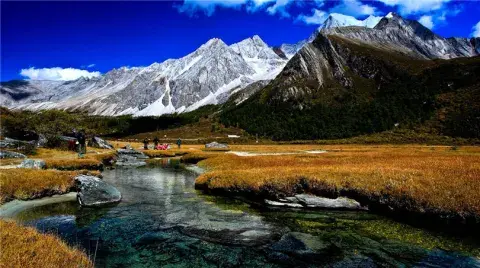
Daocheng is located in the south of Ganzi Tibetan Autonomous Prefecture, 800 kilometers from Chengdu. Daocheng and Yading Nature Reserve has an area of 56,000 hectares.
with beautiful glaciers, snow-capped mountains, forests and lakes, Daocheng displays a charming landscape. The glaciated rock knobs and fault basins are scattered in the highland, which witnesses the biggest glacial vestige in China. The Yading Natural Reserve ,with its 3 snow-scapped peaks towering proudly into the sky, is a famous Buddhist holy land, which is inspired by the local religion and exotic customs. almost isolated from the outside world, the quiet mountains and limpid rivers lie in Daocheng and make it known as an unearthly heaven of peace. far away from the hustle and bustle of the world, therefore it is called "the last Shangri-la", a peace of rare and pure land in the world.
Daocheng is know as Shangri-la
in 1928, Joseph Rock, an American missionary, reached Daocheng from Lijiang of Yunnan Province. He found this was a peaceful and beautiful land, which was far awar from the turmoil of the world. he published his photos taken here in the American magazine National Geographic, and aroused people's interest. The place he reached, he believed, was Zhongdian of Yunnan, but later, experts proved it was Daocheng of Sichuan Province.
in 1934, the American writer Hilton, based on Joseph Rock's experience and his imagination, wrote a novel entitled the Lost Horizon, in which a place as peaceful as a fairyland was vividly described. in the story,Conway and three other westerners were hijacked by a mysterious man. The plane crashed in a place named " Shangri-la", where the Tibetans and the Hans got along well, lived a long life, and different religions of Confucianism, Taoism, Buddhism, Christianity and Islam coexisted harmoniously. The book caused a great sensation in the west, for the people disliked war and longed for a happy life in Shangri-la. The name of the place contributed a new word to the English language, "Shangri-la" , a synonym for "the Garden of Eden" . later, it was adopted as a brand name for hotels and restaurants .