Giant Panda Breeding Center and Research Base

Chinese zoos are often equated to animal prisons by Western visitors. Fortunately Chengdu’s Giant Panda Breeding Center strays far from the norm. The research base is truly groundbreaking for country that pushes aside most environmental and ecological concerns due to its overpopulation...

Chinese zoos are often equated to animal prisons by Western visitors. Fortunately Chengdu’s Giant Panda Breeding Center strays far from the norm. The research base is truly groundbreaking for country that pushes aside most environmental and ecological concerns due to its overpopulation issues. The base has a research lab, museum, panda kindergarten, and adult panda grounds. In total the base has 45 pandas. The children stay in the panda kindergarten area until they are three years old. Then they can hold their own in the adult grounds.

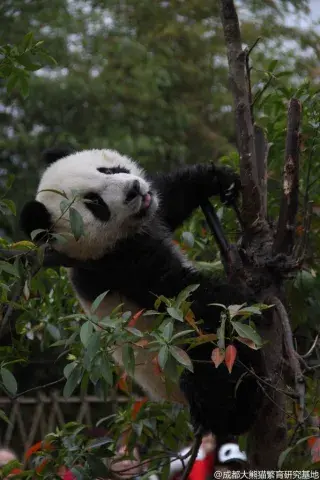
Baby Panda in the center in Chengdu


Right now there is only one baby panda under one year old. She is named Jing Jing in honor of the upcoming 2008 Olympics in Beijing. As of March 2006 she is six months old and already 24 kilograms. Watching her climb about her wooden jungle gym and her caretaker can make even the most dignified man crack a smile. This adorable creature is the closest thing this earth has to an ewok. For the absurd price of Y800 you can even take a picture with Jing Jing in your lap

Jing Jing at play with her caretaker (photo by Jamey Doole)

Arrive early to catch the pandas roll out of bed and begin their two hour breakfast. Pandas only absorb about 20% of the fibers they ingest, so they spend much of their waking hours chomping away on bamboo. In the wild, a panda’s diet is more than 95% bamboo. After waking up, taking a short stroll, and scratching their backs for a bit, it is time for breakfast. The staff generally leaves large piles of bamboo close to visitor paths, so entrants can be duly entertained. The panda nestles into a comfortable spot next to a large pile of bamboo and lays on his or her back. By the time they are finished, they will be covered in a pile of their own bamboo remains. Watching the pandas snack incessantly is somewhat mesmerizing.

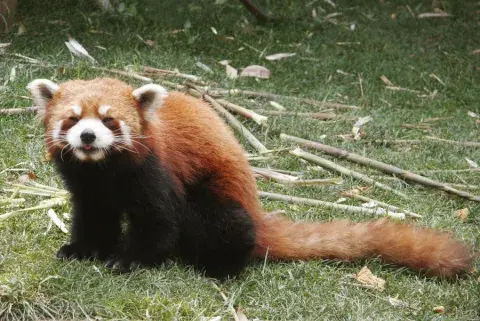
The base also has red pandas. However, one gets the feeling that red pandas are the giant panda’s red-headed step-sister. Visitors to this section are few and the price of a picture is only Y50. The red pandas may remind Westerners of raccoons or big cats. They do have beautiful fur and are quite elegant creatures.

Entrance to the base is Y30. A  small movie theater with a free 18 minute film about breeding pandas is worth seeing. The footage of mother pandas giving birth is fascinating.

Directions: The base is about 10 kilometers outside of town. Reaching the base by bus is not very efficient. Take bus no. 10 to its terminus. At this bus station change to bus no. 1. It is much easier to take a taxi which should only cost about Y30 from the center of town. On the way back, just flag down bus no. 1. Bus no. 1 will take you to a bus station where you can either walk about 30-40 mins to reach downtown Chengdu or take another bus.

An adult panda in the center in Chengdu

Apparently double-fisting isn’t just for drunks (Photo by Jamey Doole)
Jiuzhaigou Valley

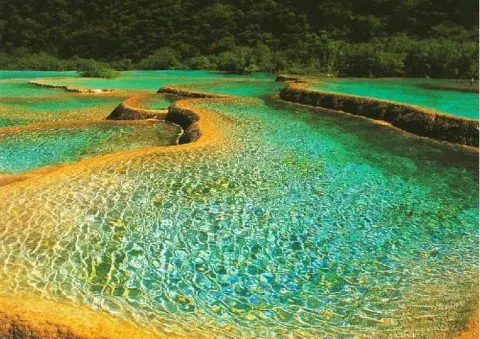
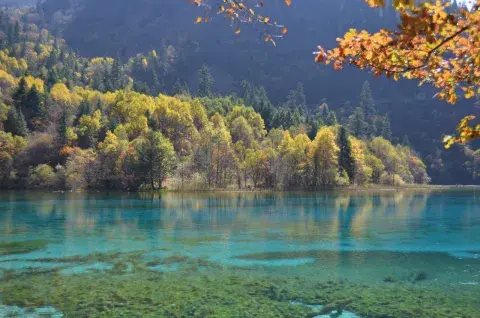
There is a chinese saying: "九寨归来不看水." It means: You have no wish to visit any other lakes after viewing the Jiuzhaigou Valley. The colourful lakes and snow mountains in Jiuzhaigou make it like a fairyland in the world, espacially in autumn, the leaves change colour into yellow, orange, red...make...

There is a chinese saying: "九寨归来不看水." It means: You have no wish to visit any other lakes after viewing the Jiuzhaigou Valley. The colourful lakes and snow mountains in Jiuzhaigou make it like a fairyland in the world, espacially in autumn, the leaves change colour into yellow, orange, red...make the whole valley looks like a colourful painting!

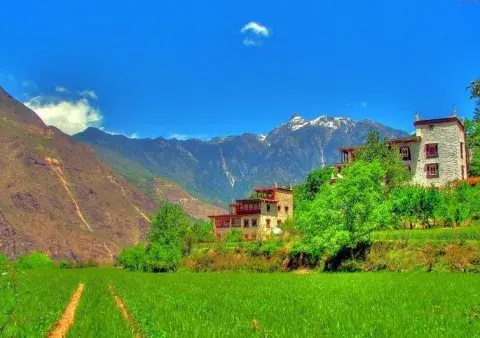
Jiuzhaigou takes it's name from the nine tibetan villages in the valley. Jiu means nine, zhai means village, gou means valley.

As a most popular scenic spot in China, the per day visitors number was once up to 30,000 in the national day of 2013! This made a big trouble for the park at that time, so as such popular place to go in China, you'd better not to go there in chinese national holiday, otherwise you can only see people mountain and people sea(人山人海)!

And the last thing to remind you is: even the park is close at 5:30pm, but usaully the workers in the park will ask you to take the last sightseeing bus at 4:30 in the park to go down  if you are still at somewhere far from the gate , because it is really a big park, it gonna take you quite a long time to visit along the way back. So if you want to visit the whole spots in the park, better to hurry up when visiting.
 

Mt.Siguniang( four girls)

Mt. Siguniang( Four Maidens Mountain) is situated  in the middle of Mt.Qionglai Range in the buffer zone between the west Sichuan Plateau and the mountainous area on the rim of Sichuan Basin, where Xiaojin County and Wenchuan County of Aba Tibetan and Qiang Autonomous Prefecture in Sichuan P...

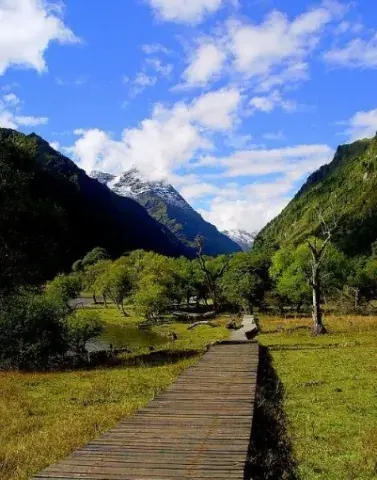
Mt. Siguniang( Four Maidens Mountain) is situated  in the middle of Mt.Qionglai Range in the buffer zone between the west Sichuan Plateau and the mountainous area on the rim of Sichuan Basin, where Xiaojin County and Wenchuan County of Aba Tibetan and Qiang Autonomous Prefecture in Sichuan Province meet. The whole scenic area covers 2,000 square kilometers.

The name of Siguniang( four maidens , means the guardian deity of mountains in the Jiarong dialect of Tibetan language. In fact, the mountain is comprised of four peaks standing side by side like four girls. The peak of the Fourth Sister, with a summit elevation of 6,250 meters above sealevel, is the highest of Mt.Qionglai Range. Of all the mountains in Sichuan, it ranks second only to Mt.Gonga, “King of Mountains in Sichuan”, which is 7,556 meters above sea level. Its reputation is “Queen of Mountains in Sichuan”. The other three peaks, Mt. Third Sister, Mt.Second Sister, and Mt. Elder Sister, are 5,664, 5,454, and 5,355 meters above sea level.

As a region inhabited by the Tibetan, Qiang, Hui, Yi and Han People, with the Tibetans as the major ethnic group, Mt. Siguniang also nurthres and cherishes the old and simple folk customs of the ethnic minorities.