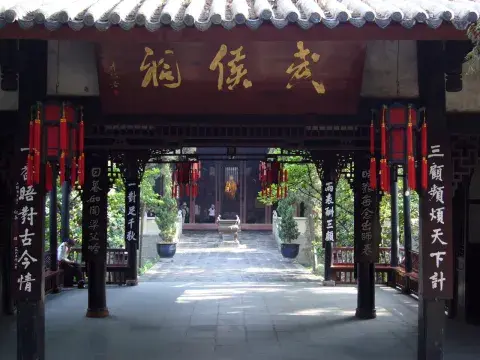
The Wuhou Temple actually features three main sections. The Temple of the Han Dynasty Emperor Zhao Lie, the Wuhou Shrine dedicated to the 50 heroes of the Shu Kingdom, and the Temple of the Three Righteous Men. From the main gate you cross through a courtyard, and then reach another courtyar...
The Wuhou Temple actually features three main sections. The Temple of the Han Dynasty Emperor Zhao Lie, the Wuhou Shrine dedicated to the 50 heroes of the Shu Kingdom, and the Temple of the Three Righteous Men. From the main gate you cross through a courtyard, and then reach another courtyard featuring the 50 heroes of the Shu Kingdom. The 50 heroes are displayed behind glass around the four sides of the courtyard. The seated figures have long hair and traditionally long beards or goatees, and are adorned with colorful robes. Two main figures regarded as the Shu Kingdom's most prominent heroes are featured across the courtyard with larger statues. Liu Bei (161-223 AD), formerly known as Xuande from Hebei province, was the general credited with establishing the kingdom. His strategist and later the kingdom's Prime Minister, Zhu Ge Liang (181-234 AD), is next to him. Mention either of these names to a Chengdu local and they will be very pleased and even impressed that a foreigner possesses such knowledge.
The Wuhou Temple park is actually quite large. Take an entire afternoon or morning to wander around the park and get the most out of the Y60 admission price. The park's vegetation is extremely well-kept and simply gorgeous to look at. The park maintains Bonsai, Peach, Pine, and Bamboo trees just to name a few. There is a turtle pond, a goldfish pond, and of course a few teahouses. Bring a book, some snacks, or some playing cards and bask in the fresh scents of the seemingly endless gardens.
Directions: The Wuhou Temple is located on Wuhouci Dajie. It is a main street and the temple's large red walls are hard to miss. Take the southbound no. 1 bus from the city center. After you cross the river, just hop off when you see the unmistakable red walls.