


The Stone Forest
The Stone Forest lies in the hinterland of the Middle Yunnan Plateau, 103°11″—103°29″ east longitude and 24°40″—24°56″ north latitude. Located in Shilin Yi Auto...
The Stone Forest lies in the hinterland of the Middle Yunnan Plateau, 103°11″—103°29″ east longitude and 24°40″—24°56″ north latitude. Located in Shilin Yi Autonomous County, it’s over 70 kilometers away from Kunming. The climate belongs to the subtropical low latitude monsoon climate, with an average temperature of 16℃. It’s a large-scale comprehensive tourism area incorporating natural scenery, national customs, leisure and holiday, and scientific research.
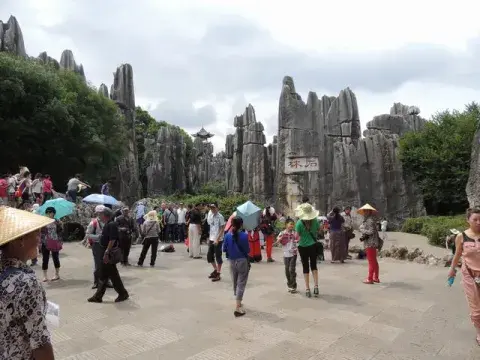
As the essence of the world’s karst, the Stone Forest is well-known for “grandness, rarity, danger, elegance, quietness and vastness”. It is dubbed as “the first wonder of the world” and “a natural museum of physiognomy” and enjoys a good reputation in geology circles for its remote history, wide variety, and large scale. It took shape 270 million years ago, experienced long geological evolution and complex geographical change and became the precious geological relic it is today. It includes numerous physiognomy types of the world such as the stone forest of Malaysia, America and Africa. It seems that the stone forests of all the world assemble here. With well-structured stone teeth, peak clusters, water-eroded caves, karst lakes, waterfalls and underground rivers, it’s a typical plateau karst ecological system and a solid panoramic picture.
Covering an area of 1100 square kilometers and having a protection area of 350 square kilometer, there are all kinds of unique natural sceneries. According to the lay-out and features of the scenery, the scenic area is divided into eight sub areas: the Stone Forest Scenic Area, Heisongyan (Naigu) Stone Forest, Zhiyundong Cave, Changhu Lake, Feilong Waterfall (Dadieshui) Scenic Area, Kuishan National Forest Park, Yuehu Lake, and Qifengdong Cave. Among these, the Stone Forest Scenic Area (the key scenic area), Heisongyan Scenic Area, Feilong Waterfall Scenic Area and Changhu Lake Scenic Area have been developed and opened to tourists. In the Stone Forest Scenic Area, the key area, over 100 scenic spots familiar to tourists such as “Shilinshengjing (the highlight of the Stone Forest)”, “Qianjunyifa (in a most dangerous condition)”, “Phoenix Combing Wings” and Ashima are all here. Entering the scenic area is like entering the tunnel of time. You can feel the great works of Nature. Traveling in the maze below the sea, you can see barranca and stone peaks, just like a lively and grand natural painting.
In addition, there are many peripheral sights and potential scenic areas to be developed gradually for the people.
The charm of the Stone Forest lies not only in the natural sights but also in the customs of the Sani people of Shilin County, for it is “the hometown of Ashima”. In the endless stone peaks and red earth of Shilin, there are also precious national and historical culture resources. Sani People, a branch of Yi, have lived here for over 2000 years and are famous for their diligence, bravery and warmth. Yi culture typical of Ashima has rich connotations and great influence. What Ashima represents is not only the image of Shilin, but also that of Yunnan tourism. In Ashima culture, the most influential are “one poem”, “one film”, “one song” and “one festival”. The ancient narrative poem Ashima written in Yi characters has been translated into over 20 languages; adapted from this poem is China’s first stereo film Ashima which enjoys a great reputation in the world; the Sani song Please Stay here, You Guest from afar is famous in the world; and the Torch Festival of Yi, which falls on the 24th of the 6th month of the lunar year and incorporates wrestling and bullfighting, is dubbed as the “Oriental Carnival”.
The Stone Forest Scenic Area has the following titles approved by relevant international and national departments
▲China Key Scenic Area (State Council, 1982)
▲Demonstration Site of Chinese Civilized Scenic Areas (Central Office of Civilization, the Ministry of Construction and National Tourism Administration, 1999)
▲State AAAAA Scenic Area (National Tourism Administration, 2006)
▲Chinese Geological Park (the Ministry of Land Resources, 2001)
▲Demonstration Unit of Chinese Protection of the Legal Rights and Interests of Tourism Consumers (Consumer Protection Fund of China, Scenic Area Association of China, 2001)
▲Quality Management System Authentication ISO 9001:2000, Environment Management System Authentication ISO14001:1996, Professional Health and Safety Management System Authentication GB/T28001:2001
▲Famous Tourism Brand of China (China Tourism Newspaper)
▲World Geological Park (UNESCO, 2004)
▲World Heritage (UNESCO, 2007)