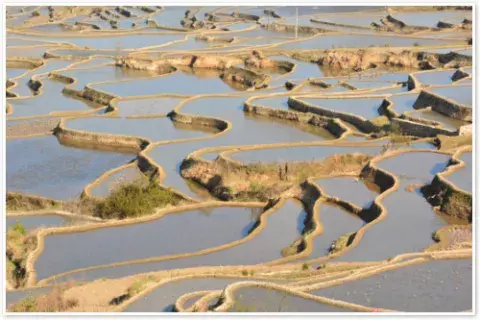
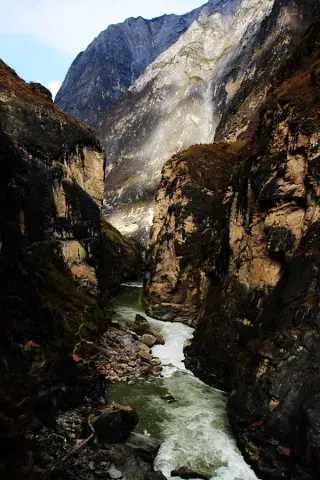
Yuanyang County (yuán yáng xiàn 元阳县) is located in Honghe Prefecture (hóng hé zhōu 红河州), Yunnan province (yún nán shěng 云南省), China. It is well known for its spectacular rice-paddy terracing. It covers an area of 2200 square kilometres and has a population of approximately 365,000 (2002), of which 88% belong to ethnic minorities and 95% is associated with agriculture.
Geography
Yuanyang county lies at an altitude ranging from 140 along the Red River up to nearly 3000 metres above sea level in the Ailao mountains (āi láo shān 哀牢山) and is situated about 50 km north of the border with Vietnam.
The climate of Yuanyang county is mainly central sub-tropical monsoon with wet summers and dry winters. Average temperatures range from 26 Celsius down in the Red river valley to 4 Celsius in the upper reaches of the mountains.
Due to recent highway construction, Old Yuanyang can now be reached in about 7 hours by direct bus from Yunnan's capital Kunming (kūn míng 昆明), situated 300 km to the north of the county, a trip which only a few years ago, would take 10 hours or more. Buses also connect Yuanyang with the town of Hekou (hé kǒu 河口) and the border crossing with Vietnam (6 hours).
Vertical distribution of the various ethnic minority groups
The Hani (hā nízú 哈尼族) and Yi (yí zú 彝族), the creators of the monumental rice terraced mountains which have made Yuanyang famous, are the original inhabitants of these regions. Both their languages belong to the Tibeto-Burman group. Their villages can mainly be found between 1300 to 1600 metres above sea level.
The Dai (dǎi zú 傣族) moved here 700 years ago. The Zhuang (zhuàng zú 壮族) 400 years ago. Both their languages belong to the Kradai language group. Their villages are situated in the warmer areas below 700 metres elevation, near and along the rivers. Their main crop is rice grow in paddy fields.
The Miao (miáo zú 苗族) and Yao (yáo zú 瑶族) (of the Hmong-Mien language group) are fairly recent arrivals to the region, only settling here 200 and 270 years ago. Their villages are in the cooler and drier upland areas, between 1600 and 1800 metres above sea level, where they grow maize.
Travel in Yunnan
Yuanyang County (yuán yáng xiàn 元阳县) is located in Honghe Prefecture (hóng hé zhōu 红河州), Yunnan province (yún nán shěng 云南省), China. It is well known for its spectacular rice-paddy terracing. It covers an area of 2200 square kilometres and has a population of approximately 365,000 (2002), of which 88% belong to ethnic minorities and 95% is associated with agriculture.
Geography
Yuanyang county lies at an altitude ranging from 140 along the Red River up to nearly 3000 metres above sea level in the Ailao mountains (āi láo shān 哀牢山) and is situated about 50 km north of the border with Vietnam.
The climate of Yuanyang county is mainly central sub-tropical monsoon with wet summers and dry winters. Average temperatures range from 26 Celsius down in the Red river valley to 4 Celsius in the upper reaches of the mountains.
Due to recent highway construction, Old Yuanyang can now be reached in about 7 hours by direct bus from Yunnan's capital Kunming (kūn míng 昆明), situated 300 km to the north of the county, a trip which only a few years ago, would take 10 hours or more. Buses also connect Yuanyang with the town of Hekou (hé kǒu 河口) and the border crossing with Vietnam (6 hours).
Vertical distribution of the various ethnic minority groups
The Hani (hā nízú 哈尼族) and Yi (yí zú 彝族), the creators of the monumental rice terraced mountains which have made Yuanyang famous, are the original inhabitants of these regions. Both their languages belong to the Tibeto-Burman group. Their villages can mainly be found between 1300 to 1600 metres above sea level.
The Dai (dǎi zú 傣族) moved here 700 years ago. The Zhuang (zhuàng zú 壮族) 400 years ago. Both their languages belong to the Kradai language group. Their villages are situated in the warmer areas below 700 metres elevation, near and along the rivers. Their main crop is rice grow in paddy fields.
The Miao (miáo zú 苗族) and Yao (yáo zú 瑶族) (of the Hmong-Mien language group) are fairly recent arrivals to the region, only settling here 200 and 270 years ago. Their villages are in the cooler and drier upland areas, between 1600 and 1800 metres above sea level, where they grow maize.
Photographers and Chinese tourists flock here in droves to watch sunrises and sunsets turn the terraces into pools of gold, red and silver. Even in poor weather they can be breathtaking. Fog rolling into the terraced valleys leaves hill-top villages the only things visible, and the effect can be dramatic, like islands floating in the clouds.
There are three buses daily from Kunming to Yuanyang (Y90, 6½hrs, 10.40am, 7.30pm, 8pm). Other destinations include Hekou (Y37, four hours) and Gejiu (gè jiù 个旧) (Y22, one hour).
Getting there & away
Buses from Xinjie (xīn jiē 新街) back to Kunming leave at 10.12am, 5pm and 9pm. Or, you can forge on to Xishuangbanna (xī shuāng bǎn nà 西双版纳). At the time of research, there were no direct buses to Jinghong (jǐng hóng, 景洪). To get there, take the 7.30am bus to Luchun (lǜ chūn 绿春) (Y25, four hours), there you’ll have wait to get the Jiangcheng (jiāng chéng 江城) bus at 4pm (Y31, five hours). By the time you arrive, there’ll be now more buses but you can stay at the hotel attached to the bus station which has cheap rooms (dm/d Y10/60). Buses to Jǐnghóng (Y50, 8½ hours) start running at 6am.