HCM Agricultural Villages

HCM Agricultural Villages is a village with an area of over 150,000 square meters, located on the dirt roads of Cu Chi Province distance from Ho Chi Minh City about 35 km
Where full convergence of the culinary culture of the Cu Chi people in particular and the food culture of Vietnam in g...

HCM Agricultural Villages is a village with an area of over 150,000 square meters, located on the dirt roads of Cu Chi Province distance from Ho Chi Minh City about 35 km
Where full convergence of the culinary culture of the Cu Chi people in particular and the food culture of Vietnam in general .Specially where visitors can not hear noisy from Vehicle But they will hear the sound from Cow ,Buffalo and many Birds sing a song in Our Villages with  the following special Places
Regional wandering cattle
Cu Chi is famous for its cattle. Here visitors will see herds of wandering cows on the field, understand more about hard Life of Local People but friendly and honestly
Regional buffalo plowing
Although science and technique are development. But Local people still keep the tradition of the ancestors. Buffalos are plowing on the fields. Here visitors will better understand the proverbs of my fathers "Buffalo buffalo oh I say this / out field buffalo buffalo plow with us / plow is the rural / buffalo mine there, who would take over ...".
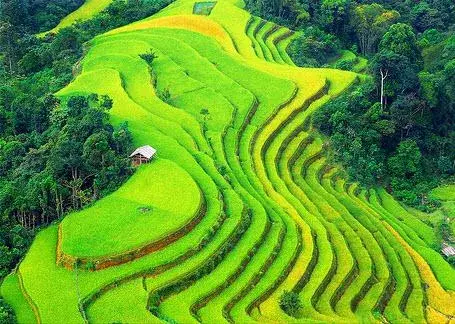
Regional rice
Visitors will discover and better understand the process of rice cultivation by local people
Area planted vegetables, mushrooms, fruit and herbs
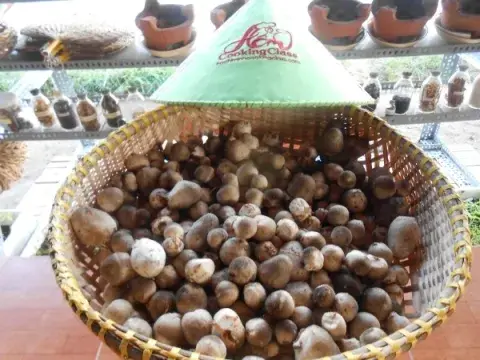
Visitors will visit and discover vegetable garden, mushrooms, fruits and herbs with an area of over 15,000 square meters. Understand more about the process of growing vegetables, mushroom cultivation method, to explore strange new fruits and special understanding how to use of herbs for health and processing methods into their daily food
Not only that visitors will become Real Famers on Vietnamese Traditional Hat and Bamboo Basket with Scissors to Pick up Vegetables, Mushrooms, Fruits and Herbs on the Garden to use For Cooking with Professional Chef
Fish, prawn lake areas and Activities from Chicken and Duck
Where the Visitor will see some lovely prawn, fish on the lake and many activities from Chicken and Duck on Rice Fields
Birds sing a song and working to find insect in our Villages
Starting from 6 am – 9pm where visitors can hear a great sound from the birds sing a song and working hard to find insect in our villages
Activities from Local People
Starting from 5am to 6pm everyday where visitors can see many activities from local people in our Villages and join with them if they want such as feeding the cow, picking up vegetables such as cucumber, okra, bitter melon, squash ,white radish ….

Regional teaching cooking class and restaurants
With an area of over 200 square meters with a capacity of over 200 guests for cooking class and 300 guests for Restaurant is the guide for visitors nutritious food processing after tourists picking raw materials in the garden
With Our Professional Chef .Visitors will have great opportunities to understand the basic ways to complex ways about Vietnamese Food in Particular and the world of Food in General with Great Cooking Tip .To makes the food extremely healthier and delicious Then Enjoy what they have done with Nice surprise desserts and Great Certificate, Recipes and souvenirs from HCM cooking class

Hoi An Ancient Town

Hoi An, an exceptionally well-preserved example of a traditional Asian trading port, is an outstanding material manifestation of the fusion of cultures over time in an international maritime commercial centre.
The town is a special example of a traditional trading port in South-East Asia ...

Hoi An, an exceptionally well-preserved example of a traditional Asian trading port, is an outstanding material manifestation of the fusion of cultures over time in an international maritime commercial centre.
The town is a special example of a traditional trading port in South-East Asia which has been completely and assiduously preserved: it is the only town in Viet Nam that has survived intact in this way. Most of the buildings are in the traditional architectural style of the 19th and 20th centuries. They are aligned along narrow lanes of traditional type. They include many religious buildings, such as pagodas, temples, meeting houses, etc., which relate to the development of a port community. The traditional lifestyle, religion, customs and cooking have been preserved and many festivals still take place annually.


Archaeological finds and excavations have shown that there was a port and trading centre of the local Sa Huynh people along the Thu Bon River as early as the 2nd century BC. This continued to expand, especially during its most flourishing period from the late 16th to the early 18th centuries. It was through Hoi An that Christianity penetrated Vietnam in the 17th century.


By the end of the century, the rise of other ports on the coast of Vietnam, in particular Da Nang, and silting of its harbour, led to the final eclipse of Hoi An. As a result of this economic stagnation, it has preserved its early appearance in a remarkably intact state, the only town in the country to have done so. The ancient town is situated on the north bank of Thu Bon River. There is a street running east-west along the river's edge and three further streets parallel to the river. They are intersected at right angles by streets and alleys. Within this area there are houses (often combined with shops), religious monuments such as pagodas, temples, communal houses and family cult houses, a ferry quay and an open market.


The architecture of Hoi An, which is almost entirely of wood, is of considerable interest. It combines traditional Vietnamese designs and techniques with those from other countries, above all China and Japan, whose citizens settled there to trade and built houses and community centres to their own designs.
The typical house conforms to a corridor plan, the following elements occurring in sequence: house, yard and house. The buildings are:
family cult houses, dedicated to the worship of ancestors;
the community houses, used for worship of ancient sages, founders of settlements, or the legendary founders of crafts;
the pagodas are almost all from the 19th century, although inscriptions show them to have been founded in the 17th and 18th centuries. They conform to a square layout and decoration is largely confined to the elaborate roofs. In the case of the larger examples, they constituted nuclei of associated buildings with religious and secular functions. Some of the larger pagodas also served as meeting halls. These are located along the main street (Tran Phu).


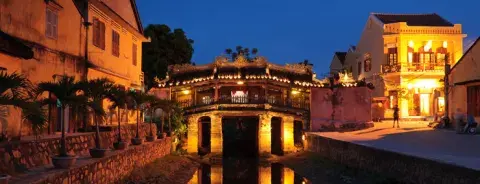
There is a fine wooden bridge, reminiscent of Japanese examples, with a pagoda on it. It has existed from at least the early 18th century, as an inscription indicates, but it has been reconstructed many times. There is also a number of ancient tombs in Vietnamese, Japanese and Chinese style within the buffer zone.


Ha Long Bay

Ha Long Bay, situated in the Gulf of Tonkin, includes some 1600 islands and islets forming a spectacular seascape of limestone pillars. Because of their precipitous nature, most of the islands are uninhabited and relatively unaffected by human influence.
The geomorphology of Ha Long Bay i...

Ha Long Bay, situated in the Gulf of Tonkin, includes some 1600 islands and islets forming a spectacular seascape of limestone pillars. Because of their precipitous nature, most of the islands are uninhabited and relatively unaffected by human influence.
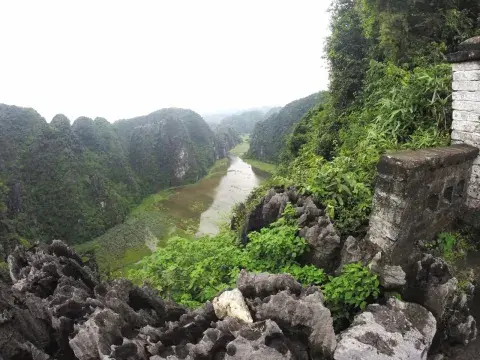
The geomorphology of Ha Long Bay is known as a drowned karst landscape due to the exceptional combination of its limestone karst features which have been subject to repeated regression and transgression of the sea over geological time. The limestones of Ha Long Bay have been eroded into a mature landscape of fengcong (clusters of conical peaks) and fenglin (isolated tower features) karst features, modified by sea invasion at a later stage.
The smaller islands are fenglin towers of 50m to 100m high with height. Many have vertical walls on all or most sides and these continue to evolve by rock falls and large slab failures.
Marine invasion of Ha Long Bay has added an extra element to the normal process of lateral undercutting of the limestone towers and islands. The most conspicuous feature being the main notch cut into the entire rocky coastline. Notches are a feature of limestone cliffs worldwide, but those of Ha Long Bay are exceptionally well developed and, at many sites, extend into arches and caves. This process of undercutting and subsequent erosion maintains the steep faces of the fenglin karst towers and thereby perpetuates the spectacular nature of the landscape.
A distinctive feature of Ha Long Bay is the abundance of lakes within the larger limestone islands.
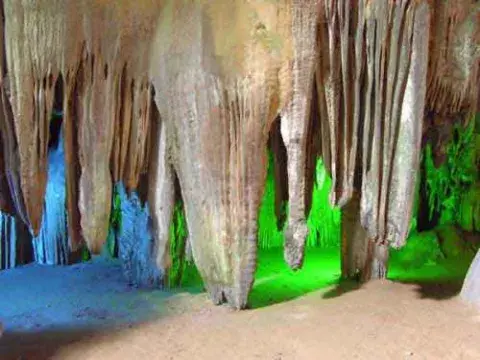
Extensive limestone caves represent another important feature of Ha Long Bay, with three main types able to be identified: old phreatic caves formed below the water table of the time; old karstic foot caves formed by lateral undercutting of cliffs at base level; and marine notch caves formed at sea level where rock structures are powerfully eroded and eventually reduced to a wave cut platform.
In summary, Ha Long Bay possesses a tremendous diversity of caves and other landforms which derive from the unusual geomorphological process of marine invaded tower karst. These areas provide a unique and extensive reservoir of data for the future understanding of geoclimatic history and the nature of karst processes in a complex environment.