Ho Chi Minh Mausoleum

President Ho Chi Minh is a Vietnamese leader who made sacrifices for the country's freedom.
In fact, he desired that his body be cremated and his ashes be scattered throughout three regions of Vietnam: the North, the South, and the Central. However, the government decided to embalm President...

President Ho Chi Minh is a Vietnamese leader who made sacrifices for the country's freedom.
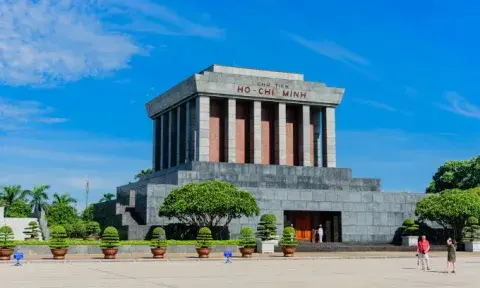
In fact, he desired that his body be cremated and his ashes be scattered throughout three regions of Vietnam: the North, the South, and the Central. However, the government decided to embalm President Ho's body and construct this mausoleum as his final resting place so that international tourists and Vietnamese residents from all over Vietnam could pay their respects. The construction of the Ho Chi Minh Mausoleum in Hanoi began on September 2nd, 1973, at the center of Ba Dinh Square, where President Ho used to read the Declaration of Independence on September 2nd, 1945.

When you arrive at the mausoleum, you will walk through a scanner entrance to ensure that no prohibited objects (including water and other liquids) are brought inside; this is where you will be given a tote handbag to store your recording devices and iPads or smart tablets. Give your bag to the security guards near the entrance and you'll be given a plastic keychain with a number on it. Don't lose the keychain because you'll need it to retrieve your belongings at the end of your visit to the mausoleum. Phones are permitted, but please be courteous, turn them off, and avoid taking pictures in inappropriate locations.

Visiting Ho Chi Minh Mausoleum in Hanoi is a golden opportunity to learn about the struggles and uprisings of Vietnamese people during the war-torn years, as well as how the country's leader at the time - President Ho - led the country through the country's sorrow years.

Main Attractions of Ho Chi Minh Mausoleum

  • Complex Ba Dinh Square
  • Ho Chi Minh Mausoleum
  • The Presidential Palace Ho Chi Minh
  • Stilt House Ho Chi Minh Museum
  • One Pillar Pagoda

The Temple Of Literature

1. History

The Temple of Literature, located to the south of Thang Long's Imperial Citadel, was founded in 1070, nearly 1000 years ago, by Emperor Ly Thanh Tong as a temple to worship the Chinese philosopher Confucius.

The Temple of Literature is one of Hanoi's most important monument...

1. History

The Temple of Literature, located to the south of Thang Long's Imperial Citadel, was founded in 1070, nearly 1000 years ago, by Emperor Ly Thanh Tong as a temple to worship the Chinese philosopher Confucius.

The Temple of Literature is one of Hanoi's most important monuments.

In 1076, his son founded the Imperial Academy as a royal school for only the elite, such as princes, nobles, and bureaucrats.

The Imperial Academy, Vietnam's first university, was open for about 700 years and educated hundreds of well-known scholars and mandarins. Despite constant wars and disasters, the Temple of Literature has retained its architectural and cultural significance.

2. Architecture

Temple of Literature, which covers an area of over 54000 square meters and is surrounded by an ancient brick wall, consists of five courtyards in various styles. The entire area is divided into several major sections, which are described below.

The First Courtyard – Đại Trung Môn

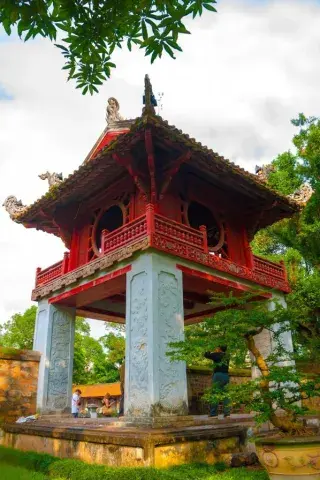
The Second Courtyard – Khuê Văn Các

The Third Courtyard – Thien Quang Well

The Fourth Courtyard – Đại Thành Môn

The Fifth Courtyard – The Grounds of Imperial Academy