Nha Trang Cathedral

NHA TRANG CATHEDRAL


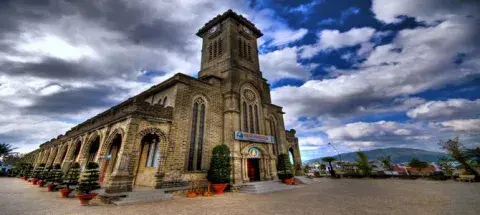
One of the destinations that you should not be overlooked when it comes to the coastal city of Nha Trang Vietnam is the stone church, the address on the 12m height between the city center.

Every year, Nha Trang city, attracts man...

NHA TRANG CATHEDRAL


One of the destinations that you should not be overlooked when it comes to the coastal city of Nha Trang Vietnam is the stone church, the address on the 12m height between the city center.

Every year, Nha Trang city, attracts many tourists to visit and vacation. In addition to the famous scenic beach with beautiful white sand beach, the famous island of Hon Tre, Hon Tam to complete the game on the sea, resort Vinpearland, Vung Ro Bay, Long Beach Cam Ranh. There are many points to the culture and history are on in the city.

Located at a height of 12 meters between the city center, cathedral Nha Trang is the place attracts many tourists, the filming and photography at home and abroad. The official name of the church is the Cathedral of Christ the King, but often people in the area mentioned is called a simple stone church, the church Nha Trang, Nga Sau church. More common still is the church called Mt. The church is one of the architectural features unique French style.

Ideology spread beautiful lifestyle of Catholics in Nha Trang, cleric Louis Vallet (1869 – 1945) spent his enthusiasm for building the church. After he died, his grave is located at the foot of the church.

September 3, 1928, the church was constructed on a small mountain called snout Mount Cotton. The name of the church as well, hence the mountain. Interesting point is to create space on the mountain, it has been used about 500 mines crust.

The church was built entirely in the style of the West by the Catholic church. Architecture is similar to the church in Sapa and some other places in Nha Trang Vietnam. A bell hangs high in the middle third bell is easily identifiable points of the Western Catholic Church.

The church is a beautiful space to be the photographer and film favorite. These couples also choose to place the church shooting their wedding photos. Church open to all weekdays between 8 am and still maintain the lead lecture in the morning and afternoon.

Ponagar Temple

PONAGAR TEMPLE NHA TRANG


Po Nagar is a Cham temple tower founded sometime before 781 and located in the medieval principality of Kauthara, near modern Nha Trang in Vietnam. It is dedicated to Yan Po Nagar. The goddess of the country. Who came to be identified with the Hindu...

PONAGAR TEMPLE NHA TRANG


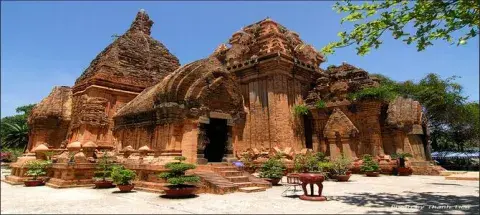
Po Nagar is a Cham temple tower founded sometime before 781 and located in the medieval principality of Kauthara, near modern Nha Trang in Vietnam. It is dedicated to Yan Po Nagar. The goddess of the country. Who came to be identified with the Hindu goddesses Bhagavati and Mahishasuramardini and who in Vietnamese is called Thiên Y Thánh Mâu.

A stele dated 781 indicates that the Cham King Satyavarman regained power in the area of “Ha-Ra Bridge”, and that he restored the devastated temple. From this inscription can be deduced that the area previously had come under temporary foreign dominion, and that foreign vandals had damaged the already existing temple. Other steles indicate that the temple had contained a mukhalinga decorated with jewelry and resembling an angel’s head. Foreign robbers, perhaps from Java, “men living on food more horrible than cadavers, frightful, completely black and gaunt, dreadful and evil as death” had arrived in ships, had stolen the jewelry and had broken the linga. Though the king had chased the robbers out to sea, the treasure had been lost forever. The steles also indicate that the king restored the linga in 784. A stele dated 918 by the Cham King Indravarman III states an order to build a golden statue to the goddess Bhagavati. Later steles report that the original statue was stolen by the Khmer, and that in 965, the king replaced the lost statue with a new one. A stele dated 1050 says that offerings of fields, of slaves, of jewelry and of precious metals were made to the statue. Later steles indicate the celebration of a cult in honor of the goddess Yan Po Nagar, as well as the presence of statues dedicated to the principal deities of Hinduism and Buddhism.
In the 17th century, the Viet people occupied Champa and took over the temple tower, calling it Thiên Y Thánh Mâu Tower. A number of Vietnamese legends regarding the goddess and the tower have come into being.
The Po Nagar complex is situated on Cù Lao Mountain. It consists of three levels, the highest of which encompasses two rows of towers. The main tower is about 25 m high.
Durga, the slayer of the buffalo-demon, is represented on the pediment above the entrance to the temple.

The temple’s central image is a 1.2m tall stone statue of the goddess Yan Po Nagar sitting cross-legged, dressed only in a skirt, with ten hands holding various symbolic items. According to Vietnamese scholar Ngô Vǎn Doanh, these attributes show that Yan Po Nagar was identified also with the Hindu goddess Mahishasuramardini or Durga, the slayer of the buffalo-demon. Another sculpture of the goddess as Mahishasuramardini may be found in the pediment above the entrance to the temple: it depicts the four-armed goddess holding a hatchet, a lotus and a club, and standing on a buffalo. This sculpture belongs to the Tra Kieu style of Cham art from the end of the 10th century or the beginning of the 11th century.

Ban Gioc Waterfall

Ban Gioc waterfall is invaluable gift granted to Cao Bang by the nature. It is regarded as the most beautiful waterfall of Vietnam. It is situated in Dam Thuy Commune, Trung Khanh District, 89 kilometers north of Cao Bang Town along Provincial Road 206 and 26 kilometers from the Chinese town of T...

Ban Gioc waterfall is invaluable gift granted to Cao Bang by the nature. It is regarded as the most beautiful waterfall of Vietnam. It is situated in Dam Thuy Commune, Trung Khanh District, 89 kilometers north of Cao Bang Town along Provincial Road 206 and 26 kilometers from the Chinese town of Trung Khanh). The waterfall originates from Quay Son River (China) and downstream flows back to China. On the Viet Nam side, the river has a picturesque scenery, fresh environment with grass cover, evergreen forest, bobbing white clouds mingling with the peaceful atmosphere of villages of mountainous ethnic minorities. On the other side is the neighboring nation of China.
 
With a height of 53 meters and a width of 300 meters, the waterfall is divided into 3 layers consisting of 12px and 15px upper flows. 15px water blocks fall into limestone steps, making a curtain of white sprays. Far from the waterfall, visitors can hear the roaring of waterfall resounding through a 15px area. Rising from middle of the waterfall is a 15px water mound covered with trees, splitting the river into three white silk strips. On hot summer days, it is still cool here. Every early morning, the sun shines through steam creating a sparkling rainbow.

With the splendid natural beauty, the waterfall of Ban Gioc is becoming Cao Bang’s biggest tourist attraction.
Tam Giang Lagoon

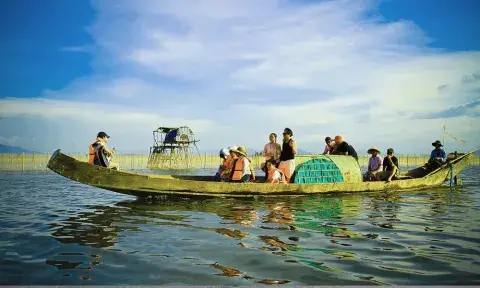
The Thua Thien Hue plain along the sea coast has many lagoons, such as those of Tam Giang, Thuy Tu, Lap An, into them are converged the water of almost all the rivers of the province of Thua Thien Hue before going to the sea, through the mouths of Thuan An, Tu Hien, or through the great lagoon of...

The Thua Thien Hue plain along the sea coast has many lagoons, such as those of Tam Giang, Thuy Tu, Lap An, into them are converged the water of almost all the rivers of the province of Thua Thien Hue before going to the sea, through the mouths of Thuan An, Tu Hien, or through the great lagoon of Lang Co.

Tam Giang and Cau Hai are the 2 biggest lagoons with fresh water, the 2 most representative lagoons in Vietnam with a length of 70 km for the whole of the two, they form an ideal habitant for many sea species all along the province.

The lagoon of Tam Giang has a depth of 2 - 4m, in some places, of 7m, the immense water surface is an area of important economic activity bringing high income with its sea products. Yearly thousands tons of sea products are brought on here (fish, shrimps and others). In the recent years, the cultivation and raising of sea products, mainly the raising of shrimps and cultivation of "gracilaria" has developed in this zone of lagoons. Today the province is researching on investment for building a bridge through the Tam Giang lagoon in order to have favorable conditions to develop the economy and tourism of this region.