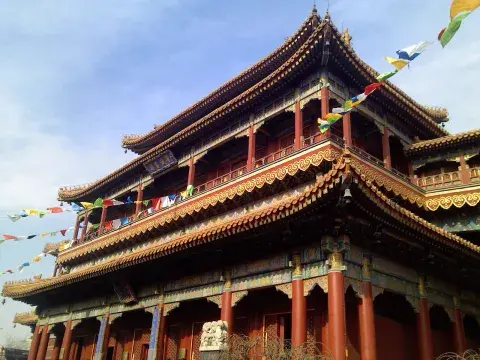
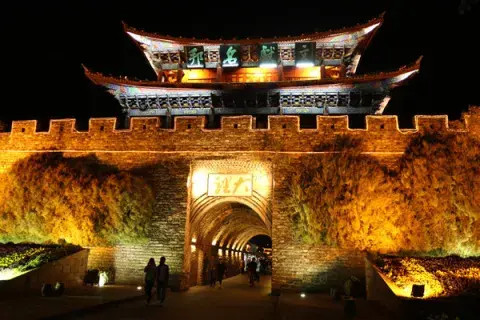
In ancient China, few cities existed without a city wall. The city wall and the city gate have a close relationship with the city's establishment. The city wall, surrounding the residential area, is the most basic constituent of a city. Beijing's city wall is a masterpiece owing to its grand verve and spirit. It is not only the brick deposit for defense, but also a great ancient project embodying the beautiful physique of Beijing. It is a symbol of the time when humanity made a step towards civilization. The city wall of Beijing was a fortification built around 1435. It was 23.5 km long. The thickness at ground level was 20m and the top 12m. The wall was 15m high, and it had nine gates. This wall stood for nearly 530 years, but in 1965 it was removed to give way to 2nd Ring Road and the loop line subway of Beijing. Only in the southeast, just south of Beijing Railway Station, stands one part of the wall. Beijing was the capital city of the last three dynasties (the Yuan, Ming and Qing) as well as two northern dynasties (the Liao and Jin) in the history of China, as such, Beijing is often referred to as an "ancient capital of Five dynasties". It had an extensive fortification system, consisting of the Palace city, the Imperial city, the inner city and the outer city. Specifically including the many gate towers, gates, archways, watchtowers, barbicans, barbican towers, barbican gates, barbican archways, sluice gates, sluice gate towers, enemy sighting towers, corner guard towers and moat. It had the most extensive defense system in Imperial China. After the collapse of the Qing Dynasty in 1911, Beijing's fortifications were dismantled one by one, the Palace city has remained largely intact, becoming the Palace Museum; the Imperial city's fortifications has Tian'anmen and several sections of imperial city wall remaining intact; the inner city with Zhengyangmen's gate tower and watchtower, Deshengmen's watchtower, the southeastern corner guard tower, and a section of the inner city wall near Chongwenmen remaining intact; and nothing of the outer city remaining intact, with Yongdingmen completely reconstructed in 2004. During the Ming and Qing dynasties, the protection and renovation of the wall and moat systems of Beijing were extensive. No holes may be drilled, no arches made, and if any section has been damaged, even if missing just a single brick, were swiftly reported to the authorities and subsequently repaired. The Inner city walls of Beijing had the city walls of Yuan's Dadu as a foundation. In the first year of the Hongwu era, after the Ming troops entered Dadu, General Xu Da directed Hua Jilong to build an additional city wall of rammed earth south of the original Dadu's northern city walls. Later it was covered with stones and bricks, forming a second defense to the Dadu original. In the 4th year of the Hongwu era, Dadu's northern city walls were completely abandoned, dismantled and its materials used to reinforce (heighten and widen) the new northern wall a few kilometres south. Moreover, he ordered Zhang Huan to measure the original Yuan Dadu Imperial city's perimeter, which amounted to 1.206 zhang (approximately 4.020 metres); he also ordered Ye Guozhen to measure the southern city's perimeter which amounted to 5.328 zhang (approximately 17.760 metres), the southern city was the remnants from the Jin Dynasty's capital Zhongdu. The old Beijing's city gate and city wall, basically rebuilt in the Ming Dynasty (1368-1644), was composed of four cities including the Forbidden City as the core, the palace wall in the periphery, the inner city and the outer city. The inner city has nine city gates (in turn from east to west: Dongbian Gate, Guangqu Gate, Zuo'an Gate, Yongding Gate, You'an Gate and Guang'an Gate), whereas the outer city has seven city gates (Xuanwu Gate, Fucheng Gate, Xizhi Gate, Desheng Gate, Anding Gate, Dongzhi Gate, Chaoyang Gate and Chongwen Gate). Each city gate has a different function. For instance, Chaoyangmen is used for grain to pass through, Chongwenmen is for wine, Xuanwumen is for the prisoner van, Fuchengmen is for coal and so on. The main function of the city wall is military defense, and it played an extremely vital role in guarding the stable city life and promoting city development. The city wall in the capital is not merely a fortification, but also a symbol of a dominant centre, dignity and heavenliness, a political, economical and cultural center and the link reuniting the regional culture. These all give the cultural connotation of the city wall and city gate in Beijing. Many city walls in Beijing have been torn down in the process of urban construction after the founding of the People's Republic of China. Only a few vestiges are available for people to visit so that they can recall their Chinese cultural heritage. Therefore, it is all the more significant to visit the city wall and city gate during a Beijing trip.