Longji rice terraces – A must-see sights in Guilin!
Longji rice terraces also called Dragon's backbone rice terraces. As the slope of the whole mountain looks like Dragon's backbone while overlook from the mountain top. Longji rice terraces is one of the most famous rice terraces in China even in the world. The entire terraced rice fields covers an area of 66 square kilometers and with an elevation from 380meters to 1100meters above the sea level.
Tourists could be immediately attracted by these amazing terraced rice terraces once entered the rice terraces scenic area, These remarkable rice terraces were firstly built by the local Zhuang people and Yao people begin from Yuan Dynasty (AD 1279-1368) and finished at Qing Dynasty(AD 1640-1912) which with a history of 600 years from generation to generation. These rolling hills were covered by the rice paddies is really incredible as they wrap around the hillsides and flow down the valley. It also shows how did the local people try their best to make the most use of the scarce arable land and water resources in the mountainous area.
The best time to visit Longji rice terraces is from Late spring to late Autumn(May –Oct),In spring, When all of the rice terraces were irrigated,These rice terraces looks like thousands of layered mirrors by the reflection of water. In summer,The rice terraces looks like the vast of green grasses because of the bright green rice plants. In Autumn, It looks like a golden ocean while the rice plants turns yellow. Hence,Different season,Different scenery, it has been fascinated with by lots of photographers year after year.
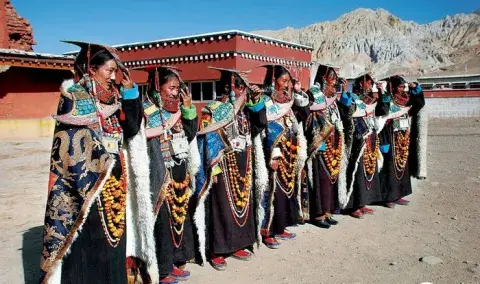
Except the Magnificent rice terraces, Tourists could also get an insight of the local minority people's culture, Such as the local Zhuang and Yao people's constructions (wooden houses), diet custom and traditional costumes. For example, you will have a chance to see the local ladies' long hair show in Huangluo Yao village,Have a try the local people's bamboo rice and smoked pork in Ping'an village, and Admire their talent for building featured wooden houses.
How to get there:
Longji rice terraces is belong to Longshen county, It's 28km from Longshen county seat and 90km from Guilin city, Tourists could take an express bus to Longshen county from Guilin Qintan bus station for 2hours,The tourists could get off the bus at Heping town which on the way to Longji rice terraces,Then switch to another local bus to Ping'an village from Heping town for 30minutes.