
Tianmen mountain

                                                 &nb...

                                                                                            Tianmen Mountain
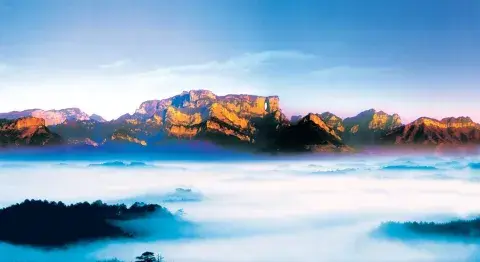
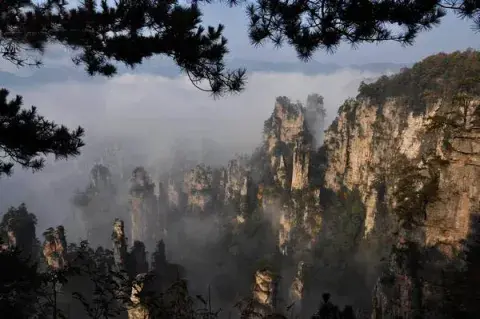
  Genenral Introduction As the saying goes: “In Dayong lies Tianmen Mountain, with a distance of only three point three chi to the sky. He who wants to ascend to heaven should seat the sedan without ceiling, or ride the horse without saddle.” Tianmen Mountain ,1518.6 meters above sea level, stands loftily on the south of Lishui River. It is 1300 meters high above the Zhangjiajie City proper and 8 kilometers from the city that Tianmen Mountain is a unique one. Looking at it from the city proper, you can see that the major peak looks like a big Chinese character “山” (means “mountain”). If the 16 peaks of Tianmen Mountain are watched connectedly, they also present the fantastic image of the character “山”.


  Tianmen Mountain has a forest with an area of 80 hectares, among which includes a primitive sub-forest area of 33 hectares, with an 80% rate of coverage. Owing to its moderate climate and plentiful rainfall, Tianmen Mountain has such a favorable natural environment for the growth of various plants and the multiplication of rare birdss and animals. Many kind of precious species of trees, like dove tree, Chinese tulip trees etc, survive in the area. It is also an eden of rare birds and animals: muntjac, wild boar, wild goat, golden pheasant, musk deer and rhesus monkey. In 1992 this area was evaluated as Tianmen Mountain National Forest Park. The main scenic spots of Tianmen Mountain consist of Tianmen Cave, Tiancao Waterfall, Guigu Cave and Temple of Tianmen Mountain etc.Now ,Tianmen mountain is also a 5A scenic area,as famouse as Zhangjiajie national forest park.Attracted hundreds of thousands of people!

Oriental Pearl TV Tower

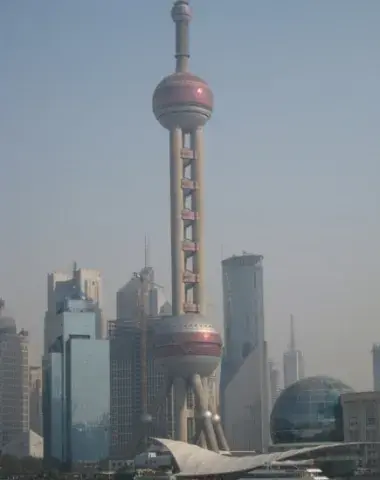
After two years of life as an expat, I finally succumbed to the delights of the Oriental Pearl TV Tower. I gaze upon the tower everyday from my office which is located on the Bund, but I wasn’t sure I would ever go in. I guess I figured it was a little too sad to finally visit the tower aft...

After two years of life as an expat, I finally succumbed to the delights of the Oriental Pearl TV Tower. I gaze upon the tower everyday from my office which is located on the Bund, but I wasn’t sure I would ever go in. I guess I figured it was a little too sad to finally visit the tower after spending so much time in Shanghai already, something like being the oldest kid at summer camp. However, one day I simply put my reservations aside and purchased my ticket to view Shanghai from the heavens.

 
The tower is the 3rd tallest in the world, and as my guide proudly told me, the biggest in Asia. I purchased the most expensive ticket for 100RMB, which gave me access to all floors including the Space Module at an astounding 350 meters above the ground.
 
At the entrance both visitors and their bags must pass through a metal detector. Once through security visitors are ushered through the tower with military precision by beautiful uniformed Chinese women. These guides provide information in both Mandarin and English.
 
The first stop is the sightseeing floor at 263 meters. Shanghai, so big and sprawling, is often difficult to piece together and trying to work out relative location is wholly impossible. Still, from this viewpoint the mega-city is both amazing and beautiful. Cries of “I can see my hotel!” from foreign tourists echo throughout the floor

The next stop is the space module. I paid the extra 30 RMB to go to this level and in all honesty, it just wasn’t worth it. The module is about as space age as my grandmothers chintz, and its two floors are decorated to look like a Park Avenue apartment. It even has marble staircases!
 
From the space module visitors can either head back down to the middle deck or down to the sightseeing floor at 90 meters. This floor was my favorite as it gave me the opportunity to view the scenery, get a bit of wind in my hair and offer respite from constant Beijing Opera offerings. Listening to Shanghai is entertainment in itself.
 
Lastly, the tower is home to truly amazing Shanghai History Museum. Using model displays, TVs, and sound, the museum winds you effortlessly through Chinese history, including honest accounts of the turbulent times  surrounding the opium trade and foreign invasions.
 
The Tower offers boat rides at 50 RMB (70RMB VIP), but I do not recommend the ride. I actually tried to take the boat cruise, but the boat’s dock is not located next to the tower. The only counsel the ticket office could offer was, “Walk straight ahead!” Fearing I would end up in Beijing, I decided against the ride, but to each their own.
 
I left the tower with the obligatory T-shirt, key ring, and fridge magnet feeling thoroughly satisfied. This is a must for any traveler to Shanghai and is well worth the entrance fee.
 
Take metro line 2 to lujiazui. The tower is open  until 9pm.  

Take Metro Line 2 to Lujiazui(陆家嘴) Stop.

Zhangjiajie National Forest Park- Wulingyuan world natural heritage

Zhangjiajie National Forest Park situates in northwest of Hunan province, south of Yangtze river, central China, 320 KM away from its capital city- Changsha, it become famous just because of its beautiful mountainscape, unique rock formation-quarz sandstone, very different from the limestone moun...

Zhangjiajie National Forest Park situates in northwest of Hunan province, south of Yangtze river, central China, 320 KM away from its capital city- Changsha, it become famous just because of its beautiful mountainscape, unique rock formation-quarz sandstone, very different from the limestone mountains in Guilin,and granite stone mountain in yellow mountain, Zhangjiajie National Forest Park dedicated to public in 1982's as national park,approved by state council as the first national park of China in 1982,some artists like Mr. Wuguanzhong came to Zhangjiajie in 1970's at the invitation of local artist friends, at that time, the place called Zhangjiajie village or Qingyan mountain, he was totally overwhelmed by the unprecedented scenery, he went all out shooting photos, painting, he wrote a very famous article (hidden scenery gem unknown to the world), that draw alot of public attention in China mainland and Hong Kong, people don't believe there is true place in this planet, just mind creation of artist works, it light up people interests to find the place,people come to Zhangjiajie, find themself lose in the world of high rise skyscrapper in nowdays modern cities,come to the world of ancient ocean period 3.8 hundred million years ago, the rock peaks rise up 400 or 500 meters from the valley level, alot of ancient trees grow on the rocks, the greenery is very abundant, the plantation coverage is 98%, alot of rare birds, animals and plants live here, criss cross valley networks in the mountains, water falls, lakes and caves.
before Zhangjiajie National Forest Park become tourism destination, it belongs to 3 different counties like Dayong, Sangzi, and Cili, now the mountains united as one scenic district called Wulingyuan that listed as world natural heritage by UNSCO, the highlights are Huangshizhai(Yellow Stone Stronghold),  Golden Whip Brook,Yaozizhai,Yuanjiajie,Yangjiajie, Tianzi Mountain. Become world sightseeing destination.

Confucius Temple (Fuzimiao)

Situated in the south part of Nanjing and surrounded by the Qinhuai River, the Confucius Temple (Fuzimiao) is one of the city’s most popular attractions.  Confucius Temple consists of a cluster of symetrically arranged buildings and covers an area of over 26,000 square meters.&nbs...

Situated in the south part of Nanjing and surrounded by the Qinhuai River, the Confucius Temple (Fuzimiao) is one of the city’s most popular attractions.  Confucius Temple consists of a cluster of symetrically arranged buildings and covers an area of over 26,000 square meters.  The temple is home to excellent examples of both Ming and Qing dynasty architecture. However, the biggest draw for most Nanjing locals is the great food and shopping.

History

Confucius Temple was founded in 1034. In antiquity, the temple was a site where people could make sacrifices to Confucius (孔子, Kong Zi), arguably China’s most celebrated ideologist and educator. The temple also served as a marketplace for merchants as well as a center where culture and arts thrived.

In 1985, the municipal authorities decided to "renovate" Confucius Temple in order to keep up with the times.  A series of tourist shops, snack bars, restaurants and hotels set up shop here with the goal of enabling Confucius Temple to better express a combination of traditional and modern beauty.

There are many places of historical interest  within Confucius Temple, such as Jiangnan Gongyuan (江南贡院) and Wuyi Xiang (乌衣巷).  Jiangnan Gongyuan was the largest imperial examination place in ancient China. Constructed during the Song dynasty, potential government officials were examined and selected here. Wuyi Xiang, or “Black Clothes Lane”, was named after the Wu soldiers, who wore black uniforms. During the Jin dynasty, Wuyi Xiang became the residence of Minister Wang Dao, followed by Minister Xie An, and finally a few of Nanjing’s noble families.  During the Tang dynasty, a famous Chinese poet named Liu Yu Xi wrote a poem here: Gone are the swallows at Wang-Xie’s Mansion into the houses of the common.

Shopping

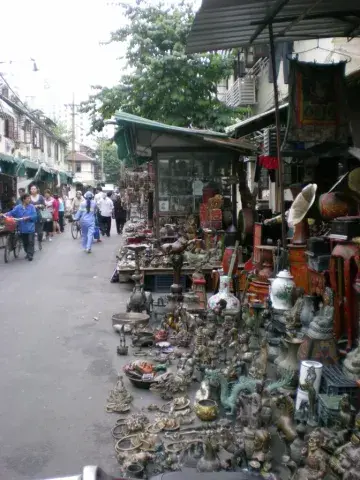
In addition to common boutiques, there are many shops in Confucius Temple that feature local folk crafts and commodities, unavailable in other parts of the country. Tourists can buy various Nanjing specialties including Nanjing brocade, Jinling gold foil, Jinling folding fans, wood carvings, Rain flower pebbles, Nanjing dried salted duck, Yuhua tea and much more. Generally speaking, the initial price quoted by the peddlers will be much higher than the price you can bargain down to, so it’s advised to learn how to bargain Chinese style before making purchases.

Food

It is worth the trip here just for the food, because Confucius Temple boasts a variety of delicious snacks. Duck blood and bean-starchy vermicelli, Jellied bean curd, fried scallion pancakes, beef soup, beef-stuffed Guo Tie (lightly fried dumplings), spiced broad beans, Huangqiao Sesame Seed Cake are just a few of the delicacies on hand.  All of these treats are mouth watering, yet not too expensive.

Boat Rides

An evening cruise on the Qinhuai River is a wonderful experience. Nanjing skyscraper’s neon city lights light up the river at night. Many kinds of boats are available for rent. Paddle boats are a cheaper option. However, "Qibanzi", a type of boat with a roomy cabin and cane chairs on the deck, is a little bit expensive, but less tiring and more comfortable.

Getting There

Take the No. 1 bus.  The No. 1 bus stops at every Subway station from Nanjing Railway Station Station to Xinjiekou.  If you are far away first take the Subway to Xinjiekou and then take the No.1 from there. 

Any cab driver in the city will know how to get to "Fuzi Miao".

Confucius Temple during Lantern Festival

Lantern Festival is held on the 15th day of the Chinese New Year.  From the first week of the Chinese New Year, Confucius Temple begins to get busier and busier until the climax of the Lantern Festival.  The crowds become so large and busy during the Lantern Festival that hundreds (if not thousands) of police officers are required to control the throngs of people.


Confucius Temple during the Lantern Festival.  Photo taken by Ishw.


Another shot of Fuzimiao at night during the Lantern Festival.


The main square shown in this picture is divided in two by a
wall of police officers during the Lantern Festival.


The mascots for the 2008 Olympic Games in Beijing