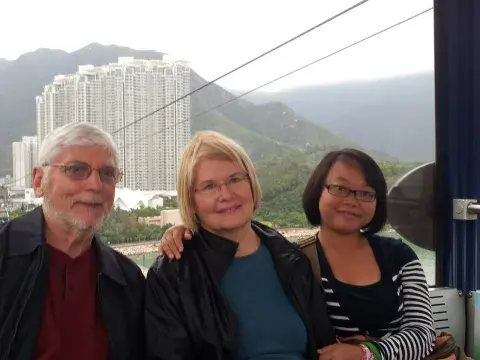


Tian Tan Buddha (Big Buddha)

Tian Tan Buddha (Big Buddha)
One of Hong Kong’s premiere attractions is the world’s tallest outdoor seated Buddha; the great looming statu...

Tian Tan Buddha (Big Buddha)
One of Hong Kong’s premiere attractions is the world’s tallest outdoor seated Buddha; the great looming statue of the Buddhist deity Sakyamuni. Seated on a summit in Lantau, the Buddha measures over 100 feet in height and weighs 275.5 tons. There is a large automated bell within the Buddha that rings 108 times everyday, with the number ’108’ symbolizing escape from 108 troubles of mankind. For a closer look at the statue and its surrounding views, you will have to ascend 260 or-so steps. It is well worth the effort though, as there is a museum at the top and you will be able to look out over the spectacular view of the surrounding Ngong Ping plateau and Lantau Peak.
Tip:
A lively time to visit the Buddha is on the Buddha’s Birthday, a public holiday in late April or May. Each year thousands of people make the pilgrimage which makes for an inspiring scene at the site. However, if you seek a quiet, peaceful moment with the Buddha, try to avoid visiting on Sundays or public holidays.
Po Lin Monastery
Known as the ’Buddhist Kingdom of the South,’ this extensive monastery is one of the main Buddhist monasteries in Hong Kong. Po Lin can be translated as ’precious lotus’ (with the lotus flower being the Buddhist symbol of purity). The monastery itself was founded by three monks in 1920 and was renamed and developed into the Po Lin Monastery that now exists today in 1924. Although many monks still seek refuge there today, the area attracts much more outside visitors these days.
Tip:
Visitors should not bring meat or alcohol to the area as a measure of respect.
Dining:
There are three good-value vegetarian restaurants around the area. You can buy meal tickets at the entrance to the Buddha statue and this ticket gives one access to the displays inside the Buddha and what is basically the monk’s canteen. For the carnivorous, Buddhists chefs specialize in mock meat dishes, which is basically sweetened to-fu.
Tea Gardens
To the west of the Buddha statue are some Tea Gardens, which have their own plantation. A quaint Tea Garden café serves up simple dishes and tea, with the dated overhanging parasols providing shade and relief from the sun. The café also sells tea leaves fresh from the bush. To get there walk from Po Lin Monastery and follow the signs to the Tea Gardens entrance.
The Wisdom Path
From the Tea Gardens, a 15 minute walk along a hiking trail will bring you to the Wisdom Path. Recently refurbished, here there is a large outdoor installation representing of the Buddhist prayer; the Heart Sutra. The prayer is creatively displayed on escalating wooden pillars. Together, the pillars form the symbol of ’Infinity,’ which exemplifies the limitless and boundlessness of Buddhism and enlightenment.
Estimated duration of the trip:
Sightseeing and lunch: 4 hours
Directions:
There are numerous ways to reach the Buddha, with the recently added and popularly acclaimed Ngong Ping 360 Cable Car providing the most scenic and effortless route.
The longest, but most ecological route involves taking a ferry to Lantau from Central. Take the MTR to Hong Kong Station / Airport Express Line, but leave the station at exit E1, towards the signs for the IFC Mall and the outlying islands ferry pier. After exit E1 walk through the IFC Mall to the outlying islands Ferry Pier 6. Take the ferry to Mui Wo, Lantau Island, then bus 2 from the bus terminus outside the pier.
Or alternatively, the most mediocre route is to take the Tung Chung line in the MTR to the end of the line - Tung Chung Station. Get out at exit B and walk towards the bus terminus to find bus 23 from Tung Chung to Po Lin Monastery.

XiTang Ancient Town
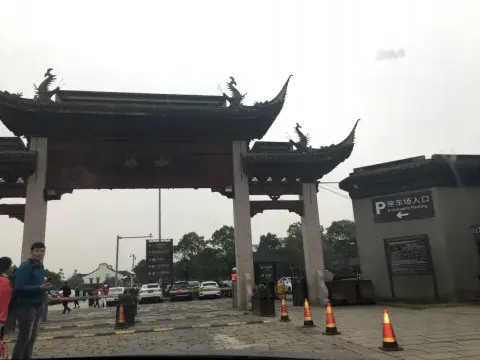
Xitang ancient town is a famous watery region at China just like Zhouzhuang village.It's a 5A Tourist attraction in China.Xitang has 1300 years history.The ancient town have lots architecture made by wood where surrounded by water.There are many hotels and restaurants in this ancient to...
Xitang ancient town is a famous watery region at China just like Zhouzhuang village.It's a 5A Tourist attraction in China.Xitang has 1300 years history.The ancient town have lots architecture made by wood where surrounded by water.There are many hotels and restaurants in this ancient town.Living in here make us feel we are having an ancient Chinese life.

Temple of heaven
The Temple of Heaven Park is located in the Chongwen District, Beijing. Originally, this was the place where emperors of the Ming Dynasty (1368 - 1644) and Qing Dynasty (1644 - 1911) held the Heaven Worship Ceremony. It is the largest and m...
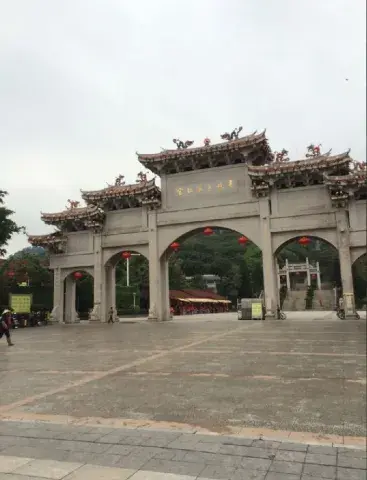
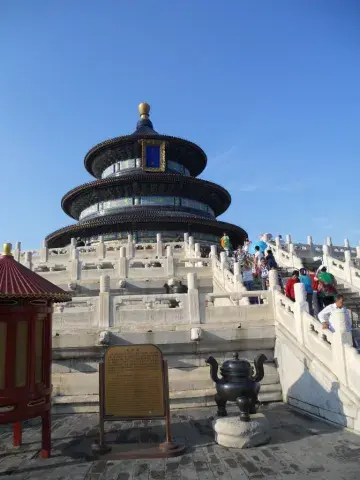
The Temple of Heaven Park is located in the Chongwen District, Beijing. Originally, this was the place where emperors of the Ming Dynasty (1368 - 1644) and Qing Dynasty (1644 - 1911) held the Heaven Worship Ceremony. It is the largest and most representative existing masterpiece among China's ancient sacrificial buildings. First built in 1420, the 18th year of the reign of Emperor Yongle of the Ming Dynasty (1368 - 1644), it was enlarged and rebuilt during the reigns of the Ming emperor Jiajing and the Qing emperor Qianlong. In 1988, it was opened to the public as a park, showing ancient philosophy, history and religion. Its grand architectural style and profound cultural connotation give an insight into the practices of the ancient Eastern civilization.
Covering an area of 2,700,000 square meters (3,529,412 square yards), it is larger than the Forbidden City. As the 'Sons of Heaven’, Chinese emperors were precluded from building a dwelling for themselves that was greater than the earthly residence dedicated to Heaven hence the difference in overall size of the two complexes. The temple is enclosed by a long wall. The northern part within the wall is semicircular symbolizing the heavens and the southern part is square symbolizing the earth. The northern part is higher than the southern part. This design shows that the heaven is high and the earth is low and the design reflected an ancient Chinese thought of 'the heaven is round and the earth is square'.
The Temple is divided by two encircling walls into an inner part and outer part. The main buildings lie at the south and north ends of the middle axis of the inner part. The most magnificent buildings are the Circular Mound Altar (Huanqiutan), the Imperial Vault of Heaven (Huangqiongyu) and the Hall of Prayer for Good Harvest (Qiniandian) from south to north.
Take subway line 5 arrive staision at Tiantandongmen get out from exit A

Bai Lu French Church
Bailu tourist attraction, located in northwestern sichuan province Bailu township Peng Zhoucity, deep in the longmen mountains. Bailu tourist attraction has beautiful elegance of the green peaks andgreen water, and magnificence, constructing peculiar glacial boulder klippe...
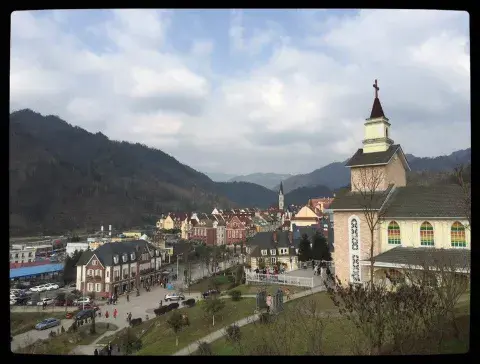
Bailu tourist attraction, located in northwestern sichuan province Bailu township Peng Zhoucity, deep in the longmen mountains. Bailu tourist attraction has beautiful elegance of the green peaks andgreen water, and magnificence, constructing peculiar glacial boulder klippe, and the differences, intertwining large water-eroded cave. Bailu township, mountains green water show, the air is fresh, pleasant climate. In mountainous overlapping, ravines crossbar, Bailu river like a white build running tunnel from north to south, on both sides of the green peaks relatively out, graceful, Bailu top like a JuZhong abrupt between mountains, majestic steep klippe, various water-eroded cave, the longmenshan geopark dress up unripe brightness.
First of all, take a shuttle bus to Pengzhou county from Chengdu Wukuaishi bus terminal about 1 hour, then take a shuttel bus to Bailu town from Pengzhou bus terminal about 1.5 hous.

Ci JI Temple- Temple of Bao Sheng Emperor
Bao Sheng Dadi or Baosheng Emperor ( literally means life protection emperor) (979-1036) was born in . Pai-chiao Village of Tung-an County in Quanzhou. , His name was Wu Ben Hua, a descendant of Zhou dynasty Emperor Tai Bo. After the fall of the Zhou dynasty, all the loyal family was scattered al...
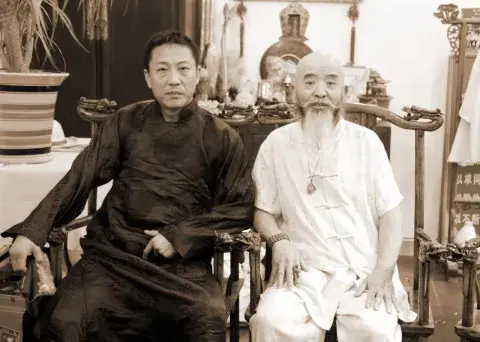
Bao Sheng Dadi or Baosheng Emperor ( literally means life protection emperor) (979-1036) was born in . Pai-chiao Village of Tung-an County in Quanzhou. , His name was Wu Ben Hua, a descendant of Zhou dynasty Emperor Tai Bo. After the fall of the Zhou dynasty, all the loyal family was scattered all over in exile. To avoid being traced, they changed their family name to Wu. For several generations, the family members seek refuges in Buddhism, thus able to survive for nine generations. Wu Ben’s father name was Wu Tong and his mother name was Huang Shi.
During his lifetime, Baosheng Emperor devoted himself to medical miracles. After his ascension, Dadi repeatedly displayed his divine powers, which assisted the nation as well as the people. When Sung Kao-tzung was the crown prince and sent to be a hostage at the Jin Court, it was Dadi’s divine presence that saved Kao-tzung and escorted him back to China. After Kao-tzung had ascended the throne, he ordered the founding of a temple (the ancestral temple for Baosheng Emperor) and bestowed the title of Great Tao Immortal on Dadi.
Bao Sheng Dadi saved a lots people’s life. Public people respect him very much and worship him as a Buddha after his death.

Dujiangyan Panda base
Dujiangyan panda base is located in Daguan Town, near Mt,Qingcheng . 18 km away from Dujiangyan city . It is a professional organization specializing in giant panda rescue and disease prevention in China
Dujiangyan panda base is a charitable orga...
Dujiangyan panda base is located in Daguan Town, near Mt,Qingcheng . 18 km away from Dujiangyan city . It is a professional organization specializing in giant panda rescue and disease prevention in China
Dujiangyan panda base is a charitable organization devoted to giant panda research and protection , covering an area of 760 acres. Built with help of sponsors from Hong Kong 's special administrative region council . Together with the Wolong and Ya'an Panda bases, these three bases constitute a platform that allows demonstration of in-situ and ex-situ conservation of giant pandas. The goal is to make full use of Giant panda's characteristic resources and international brand to balance effective ecological protection with social economic development . The strategy " one center, three bases" . will effectively promote long term development of the giant panda conservation and protection of the eco-system.
here you can hold panda for photos and experience panda keeper for one day from 8:30 am to 4:00 pm

Daocheng
Daocheng is located in the south of Ganzi Tibetan Autonomous Prefecture, 800 kilometers from Chengdu. Daocheng and Yading Nature Reserve has an area of 56,000 hectares.
with beautiful glaciers, snow-capped mountains, forests and lakes, Daocheng displays a charming landscape. Th...
Daocheng is located in the south of Ganzi Tibetan Autonomous Prefecture, 800 kilometers from Chengdu. Daocheng and Yading Nature Reserve has an area of 56,000 hectares.
with beautiful glaciers, snow-capped mountains, forests and lakes, Daocheng displays a charming landscape. The glaciated rock knobs and fault basins are scattered in the highland, which witnesses the biggest glacial vestige in China. The Yading Natural Reserve ,with its 3 snow-scapped peaks towering proudly into the sky, is a famous Buddhist holy land, which is inspired by the local religion and exotic customs. almost isolated from the outside world, the quiet mountains and limpid rivers lie in Daocheng and make it known as an unearthly heaven of peace. far away from the hustle and bustle of the world, therefore it is called "the last Shangri-la", a peace of rare and pure land in the world.
Daocheng is know as Shangri-la
in 1928, Joseph Rock, an American missionary, reached Daocheng from Lijiang of Yunnan Province. He found this was a peaceful and beautiful land, which was far awar from the turmoil of the world. he published his photos taken here in the American magazine National Geographic, and aroused people's interest. The place he reached, he believed, was Zhongdian of Yunnan, but later, experts proved it was Daocheng of Sichuan Province.
in 1934, the American writer Hilton, based on Joseph Rock's experience and his imagination, wrote a novel entitled the Lost Horizon, in which a place as peaceful as a fairyland was vividly described. in the story,Conway and three other westerners were hijacked by a mysterious man. The plane crashed in a place named " Shangri-la", where the Tibetans and the Hans got along well, lived a long life, and different religions of Confucianism, Taoism, Buddhism, Christianity and Islam coexisted harmoniously. The book caused a great sensation in the west, for the people disliked war and longed for a happy life in Shangri-la. The name of the place contributed a new word to the English language, "Shangri-la" , a synonym for "the Garden of Eden" . later, it was adopted as a brand name for hotels and restaurants .

Longji Rice Terrace (Ping'an Village) Hiking Routes
Longji rice terrace(Ping’an vllage) Hiking routes guideline
Longji rice terrace is located in the northwest part of Guilin city. It’s about 2.5hours drive from Guilin city to Longji rice terrace at Ping’an village parking lot. Longji rice terrace is hidden in t...
Longji rice terrace(Ping’an vllage) Hiking routes guideline
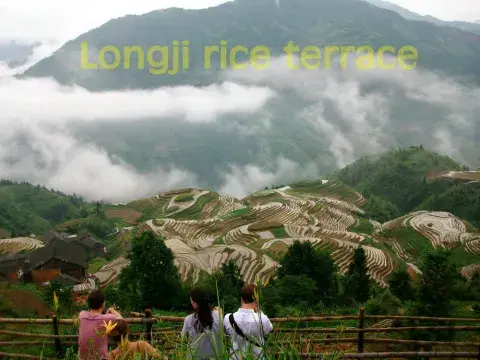
Longji rice terrace is located in the northwest part of Guilin city. It’s about 2.5hours drive from Guilin city to Longji rice terrace at Ping’an village parking lot. Longji rice terrace is hidden in the route mountain area which with an elevation of 300meters to 1100meters. Longji rice terrace is digged and built by the local Yao minority people and Zhuang Minority people start from 13 century to the end of 19 century with a history of 650years.
Due to the tough natural environment and behindhand agricultural technology, All of the rice terraces are made by hand by the local people for generations. All of the rice terraces are built on the slope of the mountain range.The rice terrace wrapped around the mountain slope from the mountain bottom to the summit of the mountain which look like numbers of silks and ribbons while see afar. Especially, In spring season, While all of the rice terraces are flooded with water. The rice terraces are just like numerous mirrors by their reflection. In Summer season, You will see the rice terrace just like layered green grassland. In Autumn season, you will see the golden rice terraces which truly terrific. In winter season, You will see the silver rice terraces just like covered with cotton. Hence, The rice terrace is one of the remarkable sights in Guilin area.
Besides the outstanding rice terrace landscape, It’s also fascinating to discover the local ethnic minority people’s culture, such as their typical construction, costume, diet, custom, tradition,daily people’s life while wander around the local village etc.
As to hiking route in Longji rice terrace at Ping’an village. There are two view points in Longji rice terrace. View point one also called nine dragons and fiver tigers. View point two also called seven stars with the moon. Because view point two is earlier to get there from the parking lot(Ping’an village entrance), So most of tourists especially many Chinese tour groups could hike up to view point two. View point one is more far and more challenged to reach than view point two. So, there are not too many tour groups means less tourists. But normally, View point one provide a much better view of the rice terrace as well as Ping’an village from there due to its higher position. So, There are some popular hiking routes in Longji rice terrace base on above introduction.
Hiking route one:
Hiking start from the parking lot(Ping’an village entrance) – Ping’an village(Pass by) – View point two - Ping’an village – Parking lot
Hiking route two:
Hiking start from the parking lot – Ping’an village – View point two – Hike to View point one through a paved mountain path – hike down to Ping’an village- Parking lot.
Hiking route three:
Hiking start from the parking lot – Ping’an village – View point one - Hike to View point two through a paved mountain path – Ping’an village – Parking lot.
If you have physical problem(Included disease,knee problem, fat shape,etc), If you also want to enjoy the wonderful rice terrace landscape, Then,there are another solution for you.
The local people built a paved road from the parking lot to View point one which take 5minutes drive. If you are not able to do the hiking trip, Then you may request the driver take you up to view point one,Then you could see the rice terrace landscape from view point one directly without taking 1hour hiking up to the view point one through the steep stone steps. If you would like to do some limited hiking, You can also hike down to Ping’an village or hike to view point one then down to the village before arrive the parking lot. It’s also a good solution.
Of course, If you stay two nights in Ping’an village, There are more hiking trips you could consider to do.
Hiking route A: Ping’an village – Longji old Zhuang village – Ping’an village
Since there is a old Zhuang people’s village with many well preserved houses named Longji old Zhuang village near to Ping’an village, It’s about 40minutes hiking from Ping’an village with downhill path to Longji old Zhuang village.After hang around Longji old Zhuang village,Then you can hike back to Ping’an village
Hiking route B: Ping’an village – Dazhai village
From Ping’an village To Dazhai village, It’s about 20km and 4-5hours hiking through a up and down mountain trail. It’s a more difficult hiking trip with a lot of challenge. But if you are quite fit, energetic and keen on outdoor activity, This hiking trip is just for you. Attention, If it’s rainy,The hiking trail could be more muddy and slippery. It become more dangerous to do the hiking trip. It’s better to skip it. It’s better just do some hiking trips nearby Ping’an village.