
Golden Temple Park
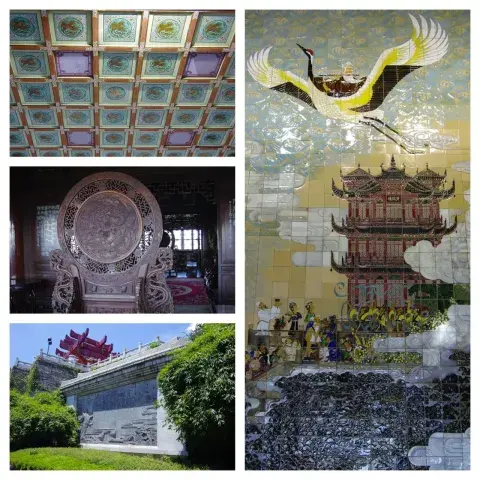
Golden Temple Park (Jindian gongyuan) includes two of Kunming’s most notable temples. Taihe Temple is Yunnan’s most active and important Taoist temple. The Golden Temple, from the Ming Dynasty, also Taoist is made almost entirely of bronze, weighing 280 tons, and is the heaviest and b...
Golden Temple Park (Jindian gongyuan) includes two of Kunming’s most notable temples. Taihe Temple is Yunnan’s most active and important Taoist temple. The Golden Temple, from the Ming Dynasty, also Taoist is made almost entirely of bronze, weighing 280 tons, and is the heaviest and best preserved of China’s four largest bronze temples.
How to get there: Golden Temple Park is located on Phoenix Song Mountain, 8 km northeast of Kunming, near the World Horticultural Exposition Gardens. A 15 RMB cable car will take you to the Golden Temple from the Expo Gardens. Bus 10 will take you there from Yuantong Temple. A taxi from the center of town will cost 20 - 30 RMB.
Find it on the map
Kunming City Zoo
Kunming is not world famous for its zoo. The zoo is probably what one would consider a "standard Chinese zoo" and comes outfitted with all of the required amenities, including lots of steel bars, cages, and of course, concrete. There are a few nice parts of the zoo, es...
Kunming is not world famous for its zoo. The zoo is probably what one would consider a "standard Chinese zoo" and comes outfitted with all of the required amenities, including lots of steel bars, cages, and of course, concrete. There are a few nice parts of the zoo, especially the undeveloped area, and it might make a nice sunny afternoon if you can handle the borderline animal cruelty. If parents with younger children are running out of ideas, a family might also enjoy the zoo. Be advised though, it is rumored that a Chinese child was mauled to death by a tiger from one of the shows at the zoo last year. The author is not aware of the current status, but as of recently people were welcome to take photographs with some of the big cats (for a fee of course) at the zoo with little safety precautions taken.
How to get there: The Kunming City Zoo is between Yuantong Dong Lu and Yuantong Jie near Yuantong Temple, not too far from Yunnan University. Tell a taxi driver "Kunming Dongwu Yuan."
Find it on the map


Green Lake Park
Green Lake Park (Cuihu gongyuan) is downtown Kunming’s nicest (and only) park. Compared to lakes in other cities, like Xi Hu in Hangzhou, Green Lake Park is not all that special. However, it is a nice place to take a sunny afternoon stroll and is conveniently located betwe...
Green Lake Park (Cuihu gongyuan) is downtown Kunming’s nicest (and only) park. Compared to lakes in other cities, like Xi Hu in Hangzhou, Green Lake Park is not all that special. However, it is a nice place to take a sunny afternoon stroll and is conveniently located between Yunnan University and the Bird and Flower Market.
The entrance fee to the islands in the park is 2 RMB. It is probably worth the entrance fee, but there is nothing inside that is so wonderful - mostly old people playing majiang and hanging out. If desired, one could rent a paddle boat to take out on the lake.
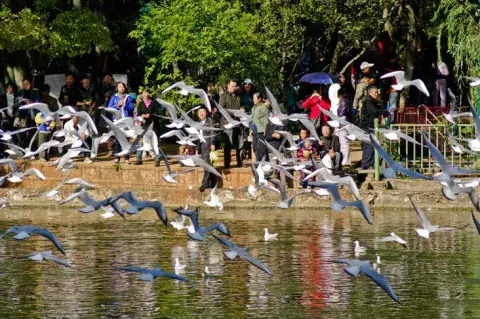
Green Lake is pleasant all year round, but the best time to visit is during the winter when red-beaked gulls from Siberia migrate south and make their home in Cuihu and Dian Chi for the coldest months of the year (Dec - Feb). During that time it tends to get a bit chilly in Kunming, but the temperature rarely drops much below freezing (0 degrees C / 32 F). The road bordering the park is lined with restaurants, cafes, tea houses, hotels, and bars.
How to get there: Green Lake Park is located in Downtown Kunming near Yunnan University. There are many buses that will get you there, including the number 1, 101, and 133. On the number 1 bus, get off at the Yunnan University stop and walk south. The 133 circumnavigates the park, stopping in 3 places around Green Lake. Take bus 101 from the train station, which will also circumnavigate the park. From Yunnan University walk south - Green Lake is located between Dong Feng Xi Lu and Hua Shan Xi lu, Wenlin Jie and Renmin Zhong Lu. If you take a taxi, tell the driver "Cuihu gongyuan."
Find it on the map
The Peak
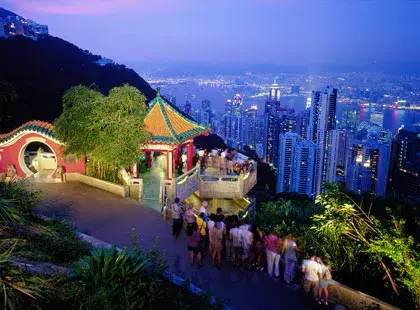
Back in the days before Disneyland and soaring cable cars, the Peak was the prime destination for visitors to Hong Kong. The timeless spot has alwa...
Back in the days before Disneyland and soaring cable cars, the Peak was the prime destination for visitors to Hong Kong. The timeless spot has always offered the best views of Hong Kong with the site taking in an average of six million visitors every year. With the Peak Tower having recently undergone a makeover, Hong Kong’s premier tourist destination has become sexy again.
The Peak Tram
For a classic Hong Kong experience, try viewing skyscrapers whilst traveling up an almost vertical gradient on a tram. The Peak Tram is a historic funicular railway operating since 1888. The tram ascends 373 meters from the Lower Peak Tram Terminus in Central to The Peak. The steepest inclination is 27 degrees at May Road. If you have the heart to stand up from your seat, gravity automatically kicks in and you will actually be standing at a 45 degree angle on the way up - a really unique experience which will have the rest of the passengers staring at you in awe. Measuring 1365 meters, the tram is the shortest, yet most beautiful route to The Peak. The Peak Tram is computer-controlled. All safety devices are checked automatically before each ascension begins, just in case you have any safety concerns about traveling up a 27 degree incline in a tram - not something you experience every day.
- Hours of Operation: Everyday, including all public holidays, from 7:00 am to midnight, departing every 15 minutes.
- Roundtrip fare: HK$30 for adults / HK$9 for children / HK$14 for seniors
- One way fare: HK$20 for adults / HK$6 for children / HK$7 for seniors
Tips: Adjacent to the Peak Tram, The Lion Pavillion offers some of the clearest views of the skyline. They are the just off the right on the start of a trail that goes round the Peak.
The Peak Hong Kong Nature Walk
Looking to share a romantic moment with a loved one or get the kids outdoors and produce an indelible memory for the family? Then take a leisurely stroll along one of the nature trails originating at The Peak Tower. While you relax amidst lush green vegetation you can savor the glorious panoramic views of Hong Kong. Choose among one of the following four routes:
(1) Mount Austin Playground (5 to 10 mins) - an ideal picnic area for families
(2) Victoria Peak Garden (30 to 40 mins) - located 554 meters above sea level, this excellent resting place offers a view of the whole of Hong Kong
(3) Hong Kong Trail, a circuit of The Peak (45 to 60 mins) - an easy, scenic trail for all ages.
(4) Pok Fu Lam Country Park (35 to 45 mins) - where you can find a stream cascading towards Pok Fu Lam Reservoir
Tips: If time allows, do the Hong Kong Trail during the daytime, so you can soak in the optimum vantage point from Lugard Road Lookout. At night choose one of the many themed restaurants providing the stunning view.
How to get there
The Peak
- Bus 15 - Exchange Square in Central (daily from 6:15 am to 12:15 am, HK$8.8)
- Green minibus no. 1: City Hall in Central (daily, HK$7.4)
The Peak Tram Terminus on Garden Road
- Bus 15C: Star Ferry Pier in Central (daily 10:00 am to 11:45 pm, HK$3.2)
- On foot: from Central MTR station exit J2, walk about 10 minutes
Estimated duration
Sightseeing only: 3 hours
Sightseeing + dinner: 5 hours
Further info
The Peak Lookout Restaurant
Lan Kwai Fong
Lan Kwai Fong
Lan Kwai Fong is located on the south end of Queen’s Road Central and above the winding D’Aguilar and Wyndham Streets. It is definitely the place to party, with many famous bars and clubs concentrated up, down, and either side of the elongated hil...
Lan Kwai Fong
Lan Kwai Fong is located on the south end of Queen’s Road Central and above the winding D’Aguilar and Wyndham Streets. It is definitely the place to party, with many famous bars and clubs concentrated up, down, and either side of the elongated hilly stretch of tarmac. You will find a great mix of people and cultures, with locals and expatriates enjoying many liquidated happy hours in the area. The Lan Kwai Fong restaurant group owns many bars in the area, but they most certainly do not have a monopoly, so check our list of top bars and nightlife entertainment to see some of our favorite specially selected watering holes (rigorously scientifically tested and proven to be so).
Tips
Holidays such as Halloween, Christmas, or New Year’s draw enormous crowds to Lan Kwai Fong. Arrive early to snag a table on a balcony for your party. From these choice seats, you can most comfortably enjoy the festivities.
Tipping is not compulsory, but most restaurants will add 10% service charge onto the bill.
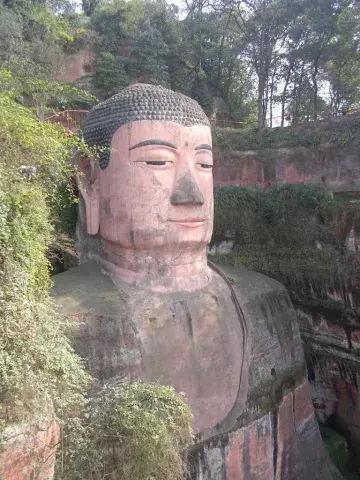
Ming Tomb, Plum Blossom Hill and Purple Cloud Lake
Lying on the west side of the southern foot of Purple Mountain (Zijin Shan, 紫金山), the Ming Tomb Scenic Area contains the Ming Tomb as well as Purple Cloud Lake and Plum Blossom Hill.
Not...
Lying on the west side of the southern foot of Purple Mountain (Zijin Shan, 紫金山), the Ming Tomb Scenic Area contains the Ming Tomb as well as Purple Cloud Lake and Plum Blossom Hill.
Note: There are many different English translations of ’明孝陵’, including “Ming Xiaoling Mausoleum,” “Xiaoling Tomb of the Ming Dynasty,” “Ming Xiaoling,” “Xiaoling Tomb,” and “Ming Tomb.” We will call it the “Ming Tomb” to keep it simple, but keep in mind that you may come across the other translations.
Ming Tomb
Nanjing became the capital of China when Zhu Yuanzhang founded the Ming Dynasty in 1368. During his reign, Zhu Yuanzhang built the great city walls of Nanjing, the imperial palace, and his future tomb - the Ming Tomb in Nanjing. The Ming Tomb is a certified UNESCO World Heritage Site and is a must-see for travellers to Nanjing.

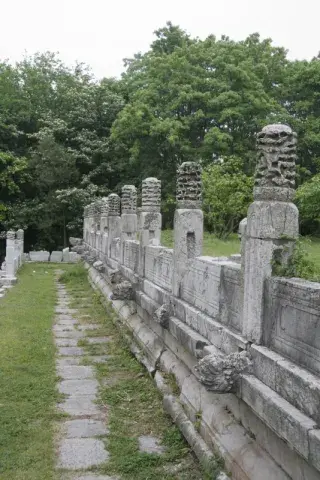
Leading up to the impressive Ming Tower is the long, winding “sacred path”. You will also pass other impressive structures including Square City (built in 1413), Imperial Tablet Hall (1699), and the Sacrificial Palace (1383). The first two legs of the path are lined with pairs of stone statues of lions, camels, elephants, unicorns, xiezhi, and kylin as well as four pairs of ministers and generals who have accompanied the buried majesty in perpetuity.
Zhu Yuanzhang and his wife are actually not buried in the tower (which is why it is called a tower and not a mausoleum). Instead they are buried behind it in the treasure mound – a forested hill that is surrounded by a 7 meter high, 1000 meter long circular wall of bricks.
Plum Blossom Hill
Plum Blossom Hill takes its name from the pink plum blossoms that blanket the hill when they are in bloom. To the south of Plum Blossom Hill across the sacred avenue are Plum Blossom Valley and a youth hostel.
Purple Cloud Lake
Purple Cloud Lake is an ideal spot to spend an afternoon relaxing outdoors. Not suprisingly, “No Swim” signs lining the edge of the lake are no deterrence to many locals that enjoy the waters. That being said, it should be known that many people have drowned in the lake’s deep waters.

How To Get There
The Ming Tomb area is quite easy to locate. It is a good starting place from which to move on towards the hiking trails further up the mountain and to other tourist attractions located along the south face of Purple Mountain.
Bus #20, 游1 (travel 1, you 1), 游2 and 游3 all stop at several locations bordering the Ming Tomb scenic area. The Square City bus stop is the best place to start a scenic walk up the sacred path towards the Ming Tower. The bus stations on the east of the scenic area are convenient for leaving the area or for reaching other sections of Purple Mountain.
Unknown to most, there is actually a way to get to Ming Tomb area from a path above. This path splits off from the hiking trail that connects the observatory with the mountain top. See the Purple Mountain article for more info.
On the final leg of the path up to the Ming Tower there is a shop that sells excellent detailed maps of the entire Ming Tomb area.
Purple Mountain

Purple Mountain is known as the “lung of Nanjing” and for good reason. This massive, forested park area situated within Nanjing boasts fresh and cool air compared to the muggy, polluted ...
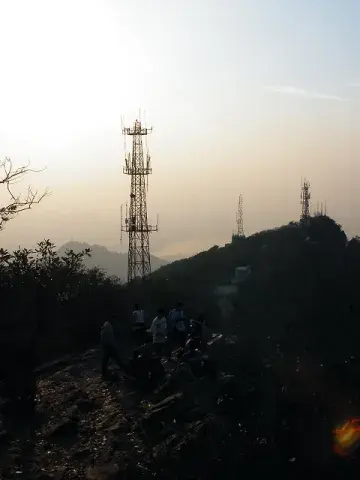
Purple Mountain is known as the “lung of Nanjing” and for good reason. This massive, forested park area situated within Nanjing boasts fresh and cool air compared to the muggy, polluted city center.
There are loads of tourist attractions within Purple Mountain. Each of these destinations may be considered a go-to destination on its own. It is not possible to visit every last site on Purple Mountain in one day or even in a couple of days.
Most of the main tourist attractions are on the south side of the mountain. Hiking trails crisscross the mountain in every direction.
Hiking
The mountain contains a huge network of paths. There are several entrances and from each entrance, paths converge and criss-cross all the way to the top of the mountain. Neither English nor Chinese maps encompass the entire network of paths on Purple Mountain. Signs along the paths on Purple Mountain are difficult to decipher even for people fluent in Chinese.
Taiping Road Entrance and the Tramline
The most popular spot to begin a hike is close to the entrance of the tramline. This route starts at the westernmost point of the mountain area and is a relatively easy hike.
There are many buses that stop at White Horse Park (白马公园) on Taiping Road (太平路) and Longpan Road (龙蟠路). Buses that stop at White Horse Park include numbers 125, 44, 79, 48, 308 and 315.
From the White Horse Park bus stop a 15 minute walk up the road takes you to the tramline station and marks the official beginning of the trail. Buses 20 and Y3 (游3) travel right past White Horse Park on Taiping Lu (太平路) and up to the tramline entrance.
The Tramline
The tramline runs from 9:00am-4:30pm Monday to Friday and 8:30am-5:30pm Saturday and Sunday. The ride takes about 30 minutes to reach the mountain top and about 15 minutes to reach the observatory. Tram tickets cost 25 yuan per adult and 15 yuan for children under 1.3 meters tall.

The tramline in the late afternoon.
Hiking from the Tramline Entrance Area to The Observatory and Mountain Top
 Walking up the slowly ascending road to the observatory takes 45 minutes if you maintain a brisk pace and do not take any breaks. If you are not sure whether or not you want to hike all the way up the mountain, remember that you will have another opportunity to hop on the tramline from the observatory. If you want to continue hiking, follow the small, unkept path just to the left of the entrance to the observatory. This path leads to a 3-path intersection. Turn right and walk about 50 meters to get to the tramline. Keep going straight to head for the main peak of the mountain. From this point on, just keep heading upwards on the main path or on one of the several smaller trails. Hiking up the main path should take another 45 minutes without breaks. Another spot on the main path leads down towards the Ming Xiaoling Tomb.
Yingtuo Village Entrance

On the northwest side of Purple Mountain, the Yingtuo Village entrance leads to a steeper and more direct route to the peak. Thin stairways lead all the way to the top of the mountain. However, these stairs can become fairly busy when the weather is pleasant.
To find the Yingtuo Village entrance, follow Bancang Street (板仓街) to Yingtuo Cun, (Yingtuo Village, 樱驼村). The entrance is rather insignificant (see picture). If you don’t watch for the road you might think it’s just another alley.
There’s not much fanfare about
the Cherry Village Entrance.
the Cherry Village Entrance.

The trails are busy when the weather is nice.
Linggu Pagoda to The Mountain Peak
 A gently sloping cement and stone road leads all the way from the mountain peak to the Linggu Pagoda. It takes 1.5 hours to walk this route if you do not take breaks. Likely because there are no notable viewpoints along this route, it is very lightly travelled.
Mountaintop Park (山顶公园)
The park at the top contains a large Buddha statue and a small clearing. Tickets to this park cost 4 yuan. Tickets are free for children under 1 meter, adults over 70, and people with physical handicaps. Those seeking only the premiere, most worthwhile attractions can certainly skip this one.
Tips
For 120 yuan you can purchase a year card that allows you to access all of the attractions listed below except for Underwater World. This card is well worth the money even if you are only planning to visit these attractions once. The card can be purchased at the entrances to any of these areas, however you must bring a passport sized photo. If you do not have a photo you can pick up 8 photos for 20 yuan at a store near the ticket booth for Sun Yat-sen’s Mausoleum. You can also pick up photos at a booth which is in front of Underwater World and near one of the entrance gates to the Ming Xiaoling Scenic Area.
Water and other refreshments cost about twice as much on the mountain as they do nearer to the ground. For example, a bottle of water costs 2 yuan near the bottom but costs 3.5 yuan at the top.
Nanjing is almost always foggy and/or smoggy, but if you plan on staying in Nanjing for an extended period of time, try to wait for a clear day to hike up the mountain.
Tourist Attractions
Most tourist attractions are on the south side of the mountain. Most can be reached by bus and some require a short hike as well.
Ming Xiaoling (明孝陵)
Plum Blossom Hill (梅花山)
Purple Cloud Lake (紫霞湖)
Sun Yat-sen Museum (孙中山纪念馆)
Music Stage (音乐台)
Linggu Temple and Linggu Pagoda (灵谷寺和灵谷塔)
Beamless Hall (无梁殿)
Tomb of Tan, Yankai (谭延闿墓)
Meiling Villa (美龄宫)
Purple Mountain Observatory (紫金山天文台)
Underwater World (海底世界)