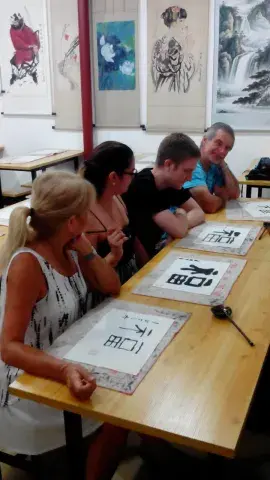
Chinese calligraphy (Brush calligraphy) is an art unique to Asian cultures. Shu (calligraphy), Hua (painting), Qin (a string musical instrument), and Qi (a strategic boardgame) are the four basic skills and disciplines of the Chinese literati.
Regarded as the most abstract and sublime for...
Chinese calligraphy (Brush calligraphy) is an art unique to Asian cultures. Shu (calligraphy), Hua (painting), Qin (a string musical instrument), and Qi (a strategic boardgame) are the four basic skills and disciplines of the Chinese literati.
Regarded as the most abstract and sublime form of art in Chinese culture, "Shu Fa" (calligraphy) is often thought to be most revealing of one's personality. During the imperial era, calligraphy was used as an important criterion for selection of executives to the Imperial court. Unlike other visual art techniques, all calligraphy strokes are permanent and incorrigible, demanding careful planning and confident execution. Such are the skills required for an administrator / executive. While one has to conform to the defined structure of words, the expression can be extremely creative. To exercise humanistic imagination and touch under the faceless laws and regulations is also a virtue well appreciated.
By controlling the concentration of ink, the thickness and adsorptivity of the paper, and the flexibility of the brush, the artist is free to produce an infinite variety of styles and forms. In contrast to western calligraphy, diffusing ink blots and dry brush strokes are viewed as a natural impromptu expression rather than a fault. While western calligraphy often pursue font-like uniformity, homogeneity of characters in one size is only a craft. To the artist, calligraphy is a mental exercise that coordinates the mind and the body to choose the best styling in expressing the content of the passage. It is a most relaxing yet highly disciplined exercise indeed for one's physical and spiritual well being. Historically, many calligraphy artists were well-known for their longevity.
Brush calligraphy is not only loved and practiced by Chinese. Koreans and Japanese equally adore calligraphy as an important treasure of their heritage. Many Japanese schools still have the tradition of having a student contest of writing big characters during beginning of a new school year. A biannual gathering commemorating the Lanting Xu by Wang Xi Zhi (The most famous Chinese calligrapher in Jin dynasty, ) is said to be held ceremonially in Japan. There is a national award of Wang Xi Zhi prize for the best calligraphy artist. Not too long ago, Korean government officials were required to excel in calligraphy. The office of Okinawa governor still displays a large screen of Chinese calligraphy as a dominating decor.
In the West, Picasso and Matisse are two artists who openly declared the influence by Chinese calligraphy on their works.