
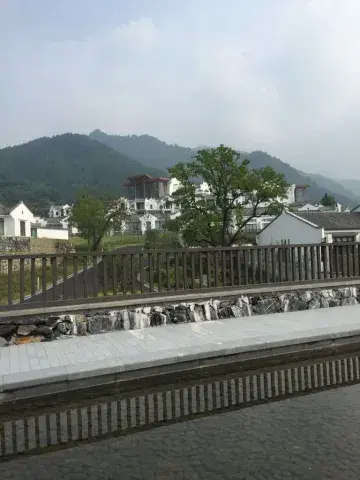

Yuyin Garden
Yuyin Garden (Yuyin Shanfang or literally Yuyin Mountain House) is located on North Street, South Village Town, Panyu District in Guangzhou, 11 miles (17 kilometers) from the city center. Built in 1864, it was originally the private garden of Wu Bin, a successful candidate in the imperial examina...
Yuyin Garden (Yuyin Shanfang or literally Yuyin Mountain House) is located on North Street, South Village Town, Panyu District in Guangzhou, 11 miles (17 kilometers) from the city center. Built in 1864, it was originally the private garden of Wu Bin, a successful candidate in the imperial examinations during the Qing Dynasty (1644 - 1911). Covering an area of 1,911 square yards (1,598 square meters), it boasts little and dainty features and a very well-organized layout. It is one of the four famous gardens in Guangdong Province and a level 4A scenic spot.
Small as it is, it is complete with everything: pavilions, bridges, lotus pool, rock hills and beautiful flowers. Bas reliefs and decorations on the buildings are all made by experienced craftsmen. A few minutes’ walk after entering the main gate, you will see the entrance to the inner garden with a Chinese couplet on it describing the lovely scenery – ‘flowers spread all around the small yard like red raindrops; trees shade every corner like green clouds’.
There is an arch bridge named ‘Huan Hong Kua Lv’ (Red Flowers with Green Trees) in the middle of the garden. When shadows of moon, arch bridge and people appear together in the lotus pool below, the scenery is called ‘Hong Qiao Ying Yue’.
The West Part of the Garden
Separated by the arch bridge, the western part of the garden is centered by a rectangular lotus pond made by stone. North to the lotus pond is the main hall named Shenliu Hall (Willow Hall), while to the south is the Linchi Pavilion (Waterside Pavilion). Shenliu Hall, as the main building of the whole garden, was used to receive guests. Well-decorated by a number of gems, such as a 32 piece mahogany fan painting and fine wood carvings, etc, it is of typical architectural style of Guangdong Province. In the front there is an old tree on both sides. When flowers are in full bloom, they seem like red raindrops which are very attractive. The Linchi Pavilion was a study of the host in the past. The host liked bamboo very much, but the garden is small. Finally, the owner came up with a good idea: planting bamboo between walls to conserve land and control the overspreading of bamboo as well. Thus it can also protect the garden from any dust coming from outside.
The East Part of the Garden
The octagonal pool, being special for its shape is in the middle of the east part. Situated in the pool is an octagonal pavilion named ‘Ling Long Shui Xie’. It used to be a place for writing poems and drinking wines. There are windows in each of the eight directions, so it is the best place for visitors to view the scenery. All eight angles of the roof are decorated by different carved ornamentations. To the southeast of the pavilion are rockeries along the walls of the garden; to the northeast are two small pavilions and to the north is ‘Wo Piao Lu’, a place for resting. Around the pool, there are many old trees such as chimonanthus tree and metasequoia glyptostroboides.
Yu Garden
Yu Garden, also known as Ladies’ Building is located to the south of Yuyin Garden. It was built by Wu Zhongyu, the fourth-generation grandson of Wu Bin in 1922. Now, it is a part of the Yuyin Garden. It was a place for ladies to play the Zheng and paint, etc. The first floor is a boat hall; the second floor is a glass floor from which you can overlook the whole scenery of the Yuyin Garden.
Near the Yuyin Garden, there is the ancestral shrine of the Wu’s family to in memory of the ancestors.
South Sea God Temple
The South Sea God Temple (Temple of South Sea God) is situated in Miaotou Village, Huangpu District in Guangzhou on the southern coast of China, facing the South China Sea. It was built in 594, and is the only preserved, and the most complete and biggest group of buildings among the four ancient ...
The South Sea God Temple (Temple of South Sea God) is situated in Miaotou Village, Huangpu District in Guangzhou on the southern coast of China, facing the South China Sea. It was built in 594, and is the only preserved, and the most complete and biggest group of buildings among the four ancient temples of the sea god in China. In ancient times there was a dock nearby. As an important site of the ancient Maritime Silk Road and a place for worshipping Zhu Rong, the God of the South Sea, the temple attracted many merchants from both home and abroad who stopped at the dock and offered sacrifices to the god for safety and good luck. Emperors of all dynasties also dispatched their officials to offer sacrifices. Today, each year between February 11th and 13th according to the lunar calendar, the temple fair attracts thousands of people, and is thus one of the biggest temple fairs in Guangzhou. Visitors coming to Guangzhou usually go there to worship.