Tin Hau Temple
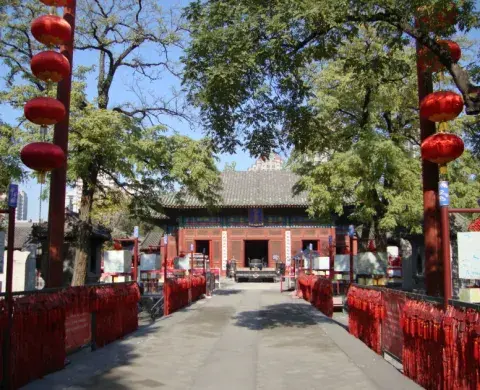
Tin Hau Temple is one of Kowloon’s oldest temples. It is dedicated to Tin Hau, the goddess of seafarers. It is located a few blocks northeast of the Jade Market . Like many oth...
Tin Hau Temple is one of Kowloon’s oldest temples. It is dedicated to Tin Hau, the goddess of seafarers. It is located a few blocks northeast of the Jade Market . Like many other Chinese temples, incense and crowds of worshippers cause jovial congestion. An incense spiral that should burn for 10 days costs HK$130.
Fortune Sticks
Inside the temple you will witness many worshippers shaking a tube of fortune sticks in front of the goddess Tin Hau. The fortune sticks are also known as ’chim’. Seeking the will of God by using the fortune sticks is called ’kau chim’ (’kau’ means request). There are altogether 100 chim sticks contained in the tube which is usually made of bamboo. Shake the tube until one chim stick falls out. According to the number on the stick in combination with your date of birth, a fortune-teller can make predictions based on numerology.
Tip:
You will find a long row of fortune-tellers through the last doorway on the right from the main entrance of the temple. Signs indicate which fortune-tellers speak English (which means you have no excuse for not trying!).
Estimated Duration of trip:
1 hour
Also see these nearby attractions:
Symphony of Lights
Sometimes – quite often in fact – experiences in HK can be ethereally dreamlike. The Symphony of Lights is just one of those experiences. In a nut shell, the Symphony of Lights is basically a timed light...
Sometimes – quite often in fact – experiences in HK can be ethereally dreamlike. The Symphony of Lights is just one of those experiences. In a nut shell, the Symphony of Lights is basically a timed lightshow combining interactive lights on top of 43 key buildings. Every night at
It is not called a Symphony for nothing because the lightshow is in fact composed of five parts; ‘Awakening’, ‘Energy’, ‘Heritage’, ‘Partnership’ and ‘Celebration’. These themes are represented in the lightshow. For example in the third scene ‘Heritage’, traditional lucky red and gold colours are displayed across buildings on both sides of the harbour, complemented by the introduction of music using Chinese musical instruments.
The best viewing locations to watch the show from include the Golden Bauhinia Square Promenade in Wan Chai, the Avenue of Stars and Tsim Sha Tsui Promenade in


Underwater World
Underwater World features an array of aquariums and live performances by dolphins and sea lions. The highlight is a pedestrian walkway that tunnels through a large aquarium that includes sharks, rays, fish and one very big turtle. For a 200 yuan fee, visitors ca...
Underwater World features an array of aquariums and live performances by dolphins and sea lions. The highlight is a pedestrian walkway that tunnels through a large aquarium that includes sharks, rays, fish and one very big turtle. For a 200 yuan fee, visitors can actually dive into the aquarium.
In 2007 they started a new exhibit called "Polar World". This includes a polar bear, arctic foxes, penguins and at least one sickly looking reindeer.
Some signs are only in Chinese but others include English or "Chinglish". Chinese cafeteria food is available for 15 yuan per person.
Take bus 9, Y1 (游1), 20 or Y3 (游3).
Underwater World is on the south side of Purple Mountain within walking distance of Ming Maosoleum (Ming Xiaoling).
Hongshan Forest Zoo
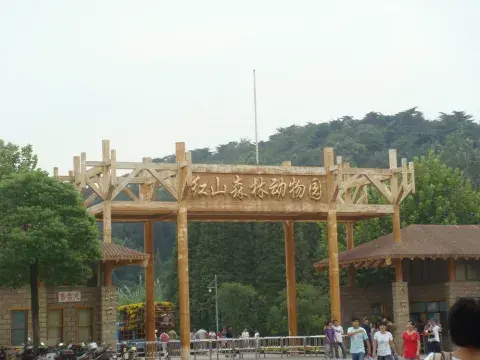
As expected, the Hongshan Forest Zoo’s are so poor that most Western visitors will likely choose to avoid this place. While every last cage isn’t inhumanely small, some cages are so small that animals frantically pace back and forth. The zoo is located on a large pl...
As expected, the Hongshan Forest Zoo’s are so poor that most Western visitors will likely choose to avoid this place. While every last cage isn’t inhumanely small, some cages are so small that animals frantically pace back and forth. The zoo is located on a large plot of land, so in theory it should be possible for the zoo administration to expand the living spaces of the animals.
Besides the subar animal living conditions, the signs are rarely in English. Strangely, the only signs that are written in fluent English are written only in English and say “Do not feed or tease animals”. Perhaps these signs are an attempt to make English-speaking visitors think the zoo actually puts effort into restricting uneducated patrons from throwing fruit and bottles at or to the animals. The signs are actually the 2nd most entertaining part of this zoo. “Please cherish life” next to the tiger cage takes the cake.
Hongshan Zoo Pagoda
The most entertaining and harmless part of the zoo is the pagoda (大状观阁) at the top of Hongshan Hill. None can deny that the pagoda provides one of the best views of Nanjing city, or at least the northern portion of the city. From the top of the pagoda, Purple Mountain and Xuanwu Lake to the northwest are easily within view. Entrance to the pagoda is 2 yuan.

Hongshan Zoo Pagoda


Views from Hongshan Pagoda
How to get there:
East Entrance – Located on Hongshan Road (红山路). Buses No. 22, 24, 40, 66 and 74.
North Entrance – Located on Heyan Road (和燕路). Subway or Buses No. 8, 30, 35, 54, 64, 72, 77 & 308. The most popular way to get to the zoo is to take the Subway to the Hongshan Zoo Station. After exiting the Subway station walk about one block southwest down Heyan Road.
Nanjing Museum
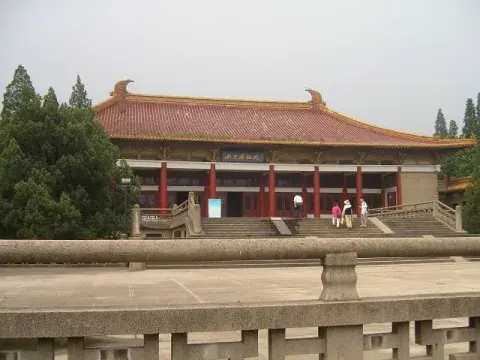
Located at the southern foot of Purple Mountain (Zijin Shan, 紫金山), Nanjing Museum is a highly-regarded, comprehensive collection of history and art. The museum was established in 1933 as the National Central Museu...
Located at the southern foot of Purple Mountain (Zijin Shan, 紫金山), Nanjing Museum is a highly-regarded, comprehensive collection of history and art. The museum was established in 1933 as the National Central Museum, on the suggestion of Mr. Cai, Yuanpei. Mr. Cai, Yuanpei was a famous scholar at that time, and was once the president of Peking University
The museum covers an area of 13 hectares and consists of two main buildings, one of which is for history, and the other for art. The museum features exhibits displaying bronze ware, porcelain ware, jade, embroidery, pottery, lacquer ware, folklore, modern art, and calligraphy & painting.
The Nanjing Museum boasts a collection of more than 420,000 pieces, including 2,000 rare and valuable ones. The valuable calligraphy and painting works date back to the Song and Yuan dynasties. The bronze wares represent both the Western Zhou dynasty period (11th century-711 BC) and Spring and Autumn Period (770-476 BC). All of these are treasures are well worth study and appreciation.
Estimated Duration of a Trip: 5 hours for a thorough visit
Take bus 5, 9, or 27.
Be sure not to confuse Nanjing Museum with Nanjing City Museum which is in Chaotian Palace.