1. Hutong's Origin
The word "hutong" is Mongolian in origin, meaning a "water well". In the old time with the digging of new wells, came the new communities. Later it was referred to as narrow streets or lanes formed by quadrangle courtards.
The word " hutong" with the meaning of narrow lanes was formed during the Yuan Dynasty in the 13th century when the Mongols, led by Genghis Khan, occupied Beijing, then the capital of the Jin Dynasty. In 1260 Kubla Khan, grandson of Genghis Khan, established the Yuan Dynasty. Kubla Khan chosed Beijing as his capital 1264.
During the takeover by the Mongols, the old city had been largely demolished, and so he decided to rebuild the city. When the new city was finished, there were clear definitions of streets, lanes and hutongs. A 36 metre wide road was called a "big street". An 18 metre wide one a "small street", and a 9 metre wide lane was called a "hutong".
Surrounding the Imperial Palace, hutongs were established throughout the Yuan (1206-1341), Ming (1368-1644) and Qing (1644-1911) Dynasties. Most of the hutongs we see today were built during the Ming and Qinq. You only still find a very few hutongs preserved from the Yuan Dynasty.
2. Hutong's names
Like streets, hutongs have their names. Some have had only one name since their establishment and others have had a few names throughout their history. Beijing was once a consumer city. A lot of hutong names are linked to the names of food.
Some hutong names are connected to the names of the places, the temples, daily necessities, trades, light industry, plants, people's names and even government's organs.
Food names, such as Miancha Hutong ( noodle and tea )
Temples, Baoguosi Hutong ( Baoguo Temple )
Daily necessities, Caomao Hutong ( straw hat )
Place names, as Inner Xizhimen Hutong
Plants, such as Liushu Hutong (Liushu means willow)
Light industry, as Damuchang Hutong ( big wood factory )
People's names, as Songguniang Hutong ( Ms Liu )
Government organs, as Jingcha Hutong ( Police Bureau )
3. Hutong Development
When the new city of Yuan Dynasty was established, it is recorded that there were about 390 roads formed by the rows of quadrangles. Some of were called streets and lanes, and some "hutongs". There were over 900 hutongs listed in Qing Dynasty. The records were increased to 1,330 by 1949.
Now many of the old hutongs have been turned down and replaced by the high buildings and wide roads of today's Beijing. Many citizens have to leave the narrow lanes where their families have lived there for generations, and residing in apartment buildings with modern facilities.
However,some of Beijing's ancient hutongs still survive, due to the local government's protection policy and people's request. Many have been listed as protected areas. So these ancient neighborhoods today provide a glimpse of the real life in the capital city as it has been for generations.
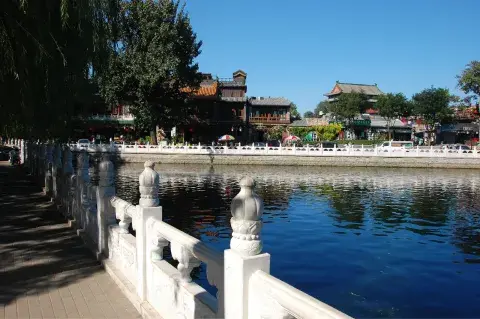
Many hutongs are being restored and renovated. In Beijing, there are mainly two hutong areas well preserved - Shichahai area in Dongcheng District and Qianmen area in Xuanwu District. The hutongs in the area of the Bell Tower and Shichahai Lake are especially well preserved which attract lots of tourists who travel the hutongs by pedicabs.
4. Siheyuan (quadrangle courtyard) and its layout
It is a private residence very popular in China, but most common in Beijing. Siheyuan literally means a courtyard house, a house enclosed by four walls, called a quadrangle courtyarrd. In Chinese history, the Siheyuan building was the basic system of the building for housing, palaces, temples, and government offices.
In 1264, Kubla Khan chosed Beijing as his capital. Then he began the large scale of city coonstruction which saw the emergence of the residential quadrangle courtyards along with the palaces, government office buildings, street blocks and hutong in Beijing.
There are three kinds of Siheyuan - small, medium and big courtyard houses. For small and simple Siheyuan, the main gate is open to the south; the main rooms in the north for grandparents are facing south; the corner rooms for grandchildren; the west rooms and east rooms are for sons or daughters; the rooms by the main gate facing north are used as the living room or studio.
For medium and big courtyard houses, there are more than one yard, two, three or even more yards with lots of rooms for some high ranking officials or rich merchants. The layout of a typical courtyard is actually a vivid showcase of traditional Chinese morality.
Why such a layout? Well, the four buildings in a single courtyard get different amount of sunlight. The northern rooms receives the most, thus using as the living room and bedroom for the eldest, usually the Siheyuan owner. The eastern and western rooms get less, and used as the rooms for the young or the guests. The southern rooms, just opposite the owner's rooms, get the least sunlight, and usually served as the rooms for service staff or studios.
The northern, eastern and western rooms are linked by pretty decorated passages. These passages are used as shelters from the sunshine during the day, and offer a cool shade and have a good view of the courtyard at night. Behind the northern rooms, there would often be an independent building for unmarried daughters.
In the old China, unmarried girls were not allowed directly to be seen in the public, hence living in the most secret building in the courtyanrd house. What's more, a Sheyuan has a scientific, human-oriented feature.
The wall in the north-western building are normally higher than the other walls to stop the inner building from the cold winds, blowing from the north-west side in the winter. The curved eaves helps the the accumulated rainwater flow along the curved rather than dropping direcctly down. The ridge-type rooftop gives much shade to have the rooms escape from the heat in the summer.
5. Siheyuan (quadrangle courtyard)'s present and future
Many of the city's residents in still live in the traditional courtyards within the second ring road, which features the limits of old Beijing. Part of the central part of Beijing is composed of hutongs or narrow lanes caused by the quadrangle courtyards. The well preserved residential quadrangles are mainly scattered over the East District, West District of the city.
However, Beijing faces much problem of housing shortage. Beijing is a city that is growing both spatially with its population growing at a fast rate. Many old quadrangle courtyards are being torn down to address problems of overcrowding, replaced by modern apartment blocks. So quite a few of those who have lived in the courtyards for generations have now moved to high-rise apartments of blocks in new residential areas.
As Beijing advances into one of the world 's metropolises, laws have also been formulated in Beijing to protect its 25 hutong ( lanes ) and quadrangle courtyards in the ancient areas, rangging from Prince Gong's Mansion to the common houses that have still kept the most complete forms of the courtyard dwellings.
6. Reasons to visit Beijing old hutong and courtyard
1) A stroll along shady Chengxian Street, the east-west roadway, starting about 700 years ago with its structures built in line with ancient Chinese customs,once one of the China's most important humanist centers.- the Confucius Temple and Guozijian (Imperial College). On the street, you will visit "Rongbu Tang" with a century old craftsmanship at its boutique store on Chengxinjie Street. The title of Rongbu Tang is given to a famous craftman - Tang Qiliang, a well-known elder craftsman in making toys with downy materials including wool and cotton (rongbu) which is listes as the intangible cultural heritage in China.
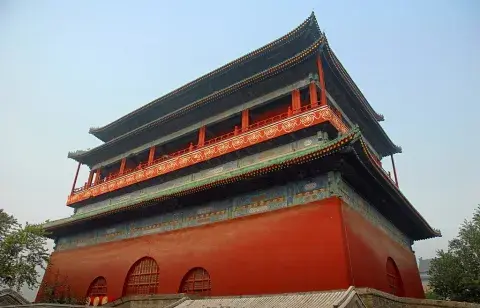
2) Ascending the 4-meter high and two-story Drum Tower dating from 1420, seeing the big drum tower and having bird's eye view of the surrounding communities of hutongs and siheyuan - existing traditional Beijing.
3) Walk along Yandai Xiejie ( Tobacco Pipe Lean Street ), a quaint 800-year-old hutong located directly north of Yinding Bridge between Qianhai and Houhai and the south of the Drum Tower, used to be well-known for sellers of long-stemmed pipes, hence the name. Standing on the Silver Ingot Bridge ( Yinding Bridge ) , a narrow channel joining Qianhai Lake and the Houhai Lake, the hub of Shichhai area with surrounding quiet hutongs
4) Visiting the Prince Gong' Mansion. It was once the private living place of He Shen, a favorite minister of Emperor Qianlong of the Qing Dynasty (1644-1911), it was first constructed in 1777. In 1851, the mansion was offered to Prince Gong by Emperor Xianfeng (1851-1862), hence the name. Now it is the most well preserved mansion in Beijing.
5) Experiencing some typical hutongs in the Shichahai area like Da Jinsi Hutong Tao, the most famous hutongs keeping the original layout of Hutong Area and also visit a local nursery.
6) Taking a boat cruising on the Shichahai Lake in the center of old Beijing. The lake is the only remaining water system, dating back to the Yuan Dynasty (13th Century). The lake is a scenic area with 34 hectares which is surrounded by former princes'houses, well kept Chinese courtyards and residencess of celebrities.
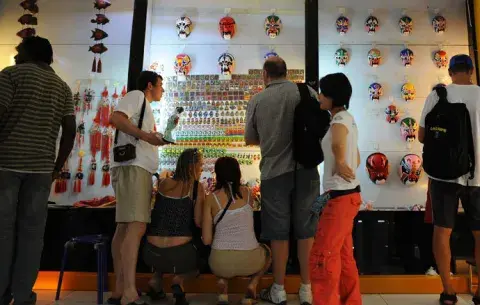
7) Interviewing with Mr.Dacheng Bai, a local folk craftsman, famous for making "Zongren Bai", a traditional "Zongren", a kind the figurines of drama characters made of the hair of a pig or a horse, cloth and silk, listed a city-level intangible cultural heritage in Beijing.
8) Immersing with an ordinary family courtyard home, having lunch there and exploring the real local life in Beijing. In addition, you can have a hand-on experience with Beijing Opera make-up and performance learning!
9) Visiting the former residence of Mr.Mei Lanfang (1894 - 1961),the best known Beijing Opera master ever, the greatest artist the world, founder of one of the three greatest acting methods created by Shakespeare Stanislavsky and Meilanfang.
10) Visiting the former residence of Soong Ching Ling ( 1890-1981 ), once a garden of one of the Qing Dynasty princes's mansions. She was late Honorary Chairman of the People's Republic of China, be known as "the Mother of China".