Yunnan Province Attractions
Yunnan University Hotel (2-star)
Yunnan University Hotel is strategically located in one of the better areas of Kunming for travelers. Located in the Yunnan University Foreign Language Center right next to Yunnan University, the hotel is right down the road from many of the better restaurants, cafes, and bars in Kunming as...
Yunnan University Hotel is strategically located in one of the better areas of Kunming for travelers. Located in the Yunnan University Foreign Language Center right next to Yunnan University, the hotel is right down the road from many of the better restaurants, cafes, and bars in Kunming as well as a 5 minute walk to Green Lake Park. The hotel is not the nicest place to stay in Kunming but the rooms it offers are perhaps the best deal you can find. A room with 2 beds, private bathroom with bathtub, and tv goes for 100 RMB per night. You will not be able to find a better deal for a room like that in an area of town that you would actually want to stay in. Next door is another Yunnan University Hotel that has recently been renovated and offers nicer, more expensive rooms.
Yunnan Province Articles

The Yi People
Yi ethnic group is the largest among ethnic groups in Yunnan Province,with a population of 4.69 million,totaling about 60% of the whole Yi population in China.
...Yi ethnic group is the largest among ethnic groups in Yunnan Province,with a population of 4.69 million,totaling about 60% of the whole Yi population in China.
The Yi ethnic groups has over 100 branches.In Han language,"Yi"means solemn,ancientness and ample food and clothing.The Yis have their own language and writing system,a branch of the Tibetan-Burma Stock of the Sino-Tibetan Language Family.Yi people belive in primitive religion,which shows the characteristics of animism and ancestor worship.They especially worship fire and regard it as a sacred object.They regard tiger as their totem and belive that after death,kind people will turn into tigers after a baptism of cremation.The fire pit is where the God of Fire lives.Some Yi people belive in Daoism,Buddhism and Christianity.
some recommendation of Hanyangling Mausoleum
I have been there many times. I think it is better to read some books first before you go to museum, especially some information about the Han dynasty which is second great dynasty after Qin dynasty....
I have been there many times. I think it is better to read some books first before you go to museum, especially some information about the Han dynasty which is second great dynasty after Qin dynasty. The Han culture, Han majority people and Han character (Chinese character) all came from the great era. Around that area, nine emperors mausoleum of Han dynasty all were established due to the Chinese traditional Feng Shui(geomantic omen)theory. The Hanyangling (brightness tomb) is one of these.
The highlight of Hanyangling is naked terra-cotta figures that represent the royal life of Han family. The all museum were subsidized by French government. It is known of living museum in China, tourists can go on the big showcase that is weight bearing. You will see all treasure inch from your eyes.
The museum is divided two main parts. The first one is actual site of mausoleum. The second part is exhibition room where many arts around mausoleum are set out. Between two places these are shuttle cars available.
To my point of view, museum is very good. You can not miss.
Public tourist bus 4 can take to the museum. It start from south gate of Tang paradise
will cost you 4yuan. Entrance ticket is 90yuan.
Snack food - comfort food
If you are coming to China, and travelling around, it is worth bringing some comfort food from your home country, particularly if you are going to traveling long distances.
...If you are coming to China, and travelling around, it is worth bringing some comfort food from your home country, particularly if you are going to traveling long distances.
On trains you can purchase meals or instant noodles, but on buses, apart from stops, you have to cater for yourself.
And on planes, the food is sometimes inedible.
So what to bring?
Just a few snacks, or something that provides energy, nutrition, and comfort. It might be lollies, dried fruit, nuts, or chocolate.
Good for you, and also something to share with others.
Top Yunnan Province Tours
$200 Per Day
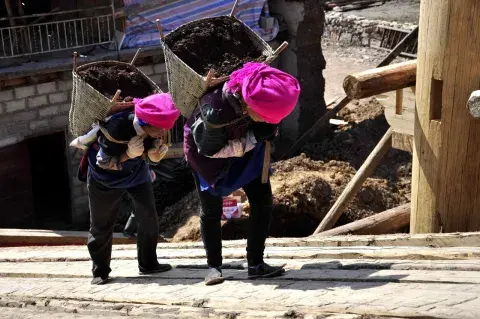
Tibetan village visit- see the real life of Tibetan
location: Napa lake of Shangri-la city
Tibetan village visit.
To see the real life of Tibetan.
They doing the farm work, building new house, and feed the yak.
they are very kinds, some one ask us come in they house have look.
The master made the yak butter tea for us.
every Tibetan buddhist faith.
Every family has his oratory
$300 Per Day
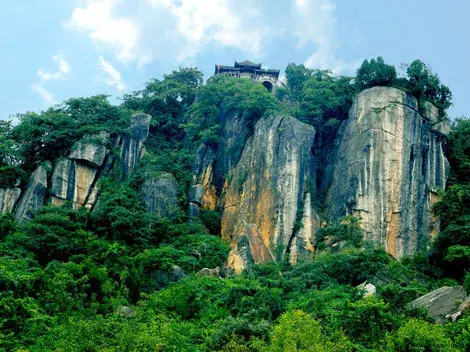
12-Day Famous Daoism Mountain Adventure Tour in China
In this adventure tour, you will visit the China’s four Daoism Mountain!
In this tour, you will visit Mt.Luofou in Guangdong, Mt.Longhu in Jiangxi, Mt.Qincheng in Sichuan, and Mt.Wudang in Hubei, the four mountains are regarded as the Four Famous Daoism Mountains of China.
Including: Guangzhou, Chengdu, Wuhan, Nanchang & Shanghai
Day 1 Guangzhou
Arrive in Guangzhou, the metropolis in south China and transfer to the hotel.
Day 2 Guangzhou...Read more
In this adventure tour, you will visit the China’s four Daoism Mountain!
In this tour, you will visit Mt.Luofou in Guangdong, Mt.Longhu in Jiangxi, Mt.Qincheng in Sichuan, and Mt.Wudang in Hubei, the four mountains are regarded as the Four Famous Daoism Mountains of China.
Including: Guangzhou, Chengdu, Wuhan, Nanchang & Shanghai
Day 1 Guangzhou
Arrive in Guangzhou, the metropolis in south China and transfer to the hotel.
Day 2 Guangzhou
Drive half day to Mount.Luofu, afternoon visit the mountain, including the Chong Xu Guan and the Zhu Ming Cave.
- Mount Luofu: Luofu Mountain, one of the 10 most famous mountains of China, is situated to the northwest of Boluo County, Guangdong Province. The mountain is actually part of a range of 432 peaks, and with over 900 waterfalls, 18 caves, and 72 cliffs. To Daoists, the mountain is known as the Grotto Heaven of Vermillion Brightness and Shining Perfection. Luofu Shan (shan means mountain) is best known as the place where the renowned Daoist Ge Hong (281-341 A.D.) once refined elixirs.
Day 3 Guangzhou
Morning continue visit the mountain, including the Huang Long Guan, Jiu Tian Guan, Shu Miu Guan. In the afternoon, drive back to Guangzhou.
Day 4 Chengdu
Take a morning flight from Guangzhou to Chengdu, meet at Chengdu airport, and transfer to visit the Qing Yang Gong Daoism Palace, and the Giant Panda Breeding Center.
- Qingyang Daoism Palace:Qingyang Temple is one of the most famous Taoist temples in China. It is conveniently located in the northwest part of Chengdu, in the Sichuan Province.The temple was originally built in the Tang Dynasty (618-907), a period when Taoism was flourishing. Most of the parts of the temple that remain in existence are restorations from the Qing Dynasty (1644-1911), including Sanqing Hall, Doulao Hall, Hunyuan Palace, the Eight Trigrams Pavilion, and Wuji Palace.
Day 5 Chengdu
Drive to visit Mt.Qincheng, including the Jian Fu Gong, Chang Dao Guan, Tian Si Cave, Shang Qin Gong, etc. In the late afternoon, drive back to Chengdu.
- Mt.Qincheng: Located east to Chengdu and Dujiangyan with a distance of 68 kilometers and 10-odd kilometers respectively, Mount Qingcheng dominates the Chengdu plain. It is one of the most famous Taoist holy lands in China and listed together with the neighboring Dujiangyan as the World Heritage site. Mount Qingcheng abounds with historic sites and cultural relics as well as natural beauties.
Day 6 Wuhan
Take a morning flight from Chengdu to Wuhan, meet at airport, and transfer to visit the Chang Chun Guan, after dinner, board a night train on soft sleeper from Wuhan to Shi Yian.
- Changchun Taoist Temple:Located south of Shuangfeng Mountain, at Da Dong Men, Wuchang District, Wuhan City, Changchun Taoist Temple is the largest and most well-preserved Taoist Temple in Wuhan. Renowned as a blessed place in the south of Yangtze River for generations, it was listed as a key national Taoist temple by the State Council in 1983.
Day 7 Shiyan
Your train will arrive in Shi Yian in early morning, meet at train station, and drive to visit Mt.Wudang, including Zi Xiao Gong, Tai He Gong, and the Golden Temple.
- Mt.Wudang:The Wudang Mountains are a small mountain range in the Hubei province of China, just to the south of the manufacturing city of Shiyan.In years past, the mountains of Wudang were known for the many Taoist monasteries to be found there, monasteries which became known as an academic centre for the research, teaching and practise of meditation, Chinese martial arts, traditional Chinese medicine, Taoist agriculture practises and related arts.
Day 8 Wuhan
Take a train on soft sleeper from Shi Yian back to Wuhan, meet at Wuhan train station.
Day 9 Yingtang
Take a morning flight from Wuhan to Nanchang, meet at Nanchang airport, and transfer to Ying Tang. Stay at the foot of Mt.Longhu.
- Mt.Longhu:Originally called "Yunjin Mountain", Longhushan Mountain is located in Yingtan City of Jiangxi Province. It is the birthplace of Chinese Taoism. The well-established Taoist culture, green rivers and red mountains of unique beauty and cliff tombs with unraveled mysteries are the "three marvelous features" of Longhushan Mountain.
Day 10 Mt.Longhu
Visit Mt.Longhu, including the Tian Si Fu, Shang Qin Gong, afternoon take a bamboo raft down the Luxi river, enjoy the pretty scenery of the Xian Shui Yian.
Day 11 Nanchang
Drive back to Nanchang, then take an afternoon flight from Nanchang to Beijing, meet at Beijing airport.
Day 12 Beijing
Morning visit Bai Yun Guan in Beijing, after lunch, transfer to airport for your departure flight.
- Baiyun Guan:Beijing Baiyun Guan, meaning the White Cloud Taoist Temple, this is one of the largest and oldest Taoist temples in China, and is home to the Taoist Association of China. Baiyun Guan holds an important position for numerous Taoists.
$1100 Per Day
The Ethnic Discovery of Yunnan
Duration: 8 days/ 7 nights
Destinations: Kunming, Dali, Lijiang, Shangri-La
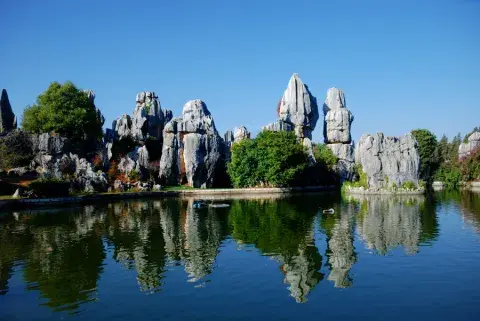
Highlights: There are so many extraordinary places waiting for you to discover in Yunnan. In 8 days, you can feast your eyes on the wonderful natural beauty as well as the historic and cultural heritages in Kunming, Dali, Lijiang and Shangri-La. The Stone Forest, Three Pagodas, Lijiang Old Town, Tiger Leaping Gorge, Ganden Songzanlin Monastery and Nixi Village of Tibetan will highlight your trip.
• Day 1 Kunming
Arrival in Kunming, meet your guide at airport and transfer to hotel.
The capital of Yunnan Province, Kunming is one of China’s noted historical and cultural cities. The city is located in central Yunnan at the elevation of 1894 meters above sea level and is praised as the city of eternal spring.
Rest of the day at leisure
Accommodation:
Kunming Grand Park Hotel
• Day 2 Kunming
Drive along the new express way to the Stone Forest. Stone Forest is 75 kilometers from Kunming and is accessible by a bus ride of 70 minutes. The Stone forest belongs to the typical Karst geomorphology, it consists of innumerable bizarre-shaped ancient limestone cliffs and peaks created by wind and water erosion some 200 million years ago, and this area is praised as the “First Wonder Under Heaven”. It’s inscribed as Nature Heritage by UNESCO.
Drive back to Kunming by the old road, visit a village en route.
Visit the Green Lake Park in the afternoon. Attractions in the neighborhood of Green Lake Park include the former Yunnan Army Academy, believed to be the biggest quadrangle building of China, and people in Kunming enjoying their leisure life in the afternoon.
• Day 3 Kunming - Dali (by public express bus)
Overland drive with seat in public bus from Kunming to Dali, 360 kilometers, or about 4.5 hours.
Standing against the Cangshan Mountains in the west and adjoining the Erhai Lake in the east, embraced by undulating hills around, Dali was the capital of Nanzhao and Dali Kingdom as early as 1,300 years ago. It is home to Bai minority.
Upon arrival in Dali, proceed to visit the Three Pagodas, followed by a guided stroll in Dali old town.
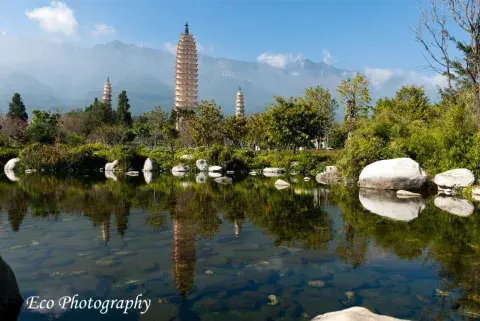
Standing in a way of a tripod on the outskirts of old town, the Three Pagodas were constructed in about 850 and 1050 following the model of the Small Wild Goose Pagoda in Xi’an. For centuries, they are considered landmark of the region.
The Dali Old Town of weathered gray granite stands at 2,100 meters on a long, narrow rice plain between the Cangshan Mountains and the Erhai Lake, a natural configuration that seems specially designed for a good, bountiful life. Format of the old town is like a chessboard with four gates guarding in the directions of east, south, west and north, a design that was adopted by most towns in ancient China.
Accommodation:
Dali Landscape Hotel
• Day 4 Dali - Lijiang (by automobile)
In the morning, overland drive of 180 kilometers, or 3.5 hours, along the new road on private vehicles to Lijiang.
Visit the Bai minority village Xizhou on the way.
23 kilometers north of Dali, Xizhou village has a more mixed population and cosmopolitan background. It grew and flourished in the Ming Dynasty (1368-1644) along with the fortunes of Dali’s renowned tea merchants that traded to Tibet. Family Yan’s courtyard is a good example of traditional Bai houses. And each morning, villagers in Bai dresses gather in a small market to buy and sell their produce and daily wares.
Then continue driving to Shaping. Shaping Market is a local market on every Monday. The local people come to the market from surrounding villages to exchange their daily wares, farming products, traditional clothes, or simply foods and vegetables.
Upon arrival in Lijiang, check in at hotel. Afternoon will be free for your first visit of the old town.
A gathering place of rugged mountain people with the Naxi forming the majority, Lijiang is a small mountain town of stone and tile, laced with swift canals, which was enlisted as an UNESCO World Cultural Heritage in 1999.
Old town of Lijiang is a big area with its center, or Si Fang Jie (Square Street) in the form of an official ink stone, hence its name Dayan (ink stone) Town. It enjoys a long history of over 800 years and unlike most of the old towns in China, there is no city walls due to a superstitious belief of the local ruler whose family name is Mu (tree), when encircled by walls, would be Kun (besieged). Wooden structures, mountains, small rivers and lanes integrate harmoniously in this mountain town.
Accommodation:
Hexi Hotel Lijiang (or similar)
• Day 5 Lijiang
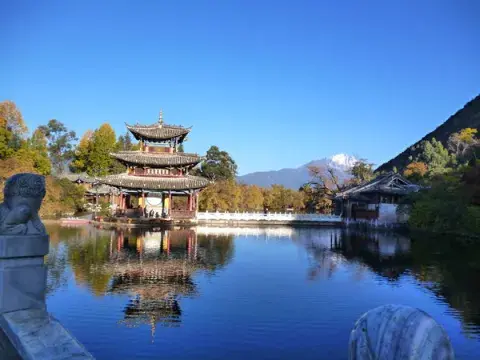
In the morning visit the Black Dragon Pond with Dongba Museum. The Pond provides you opportunity of taking great pictures of the crystal clear pond with backdrop of snow mountains in a distance.
Then, drive out to the Naxi minority villages at the foot of Jade Dragon Snow Mountains.
Visit the Yuhu Village, a simple village of Naxi minority with the Former Residence of Dr. Joseph Rock. Dr. Rock, an Austro-American botanist and explorer who lived here off and on from 1922-1949, is best remembered for the introduction of innumerable plant species to the West and his rigorous works on Naxi ethnology.
Transfer back to your hotel after lunch. Rest of the day for your own discorvery in the Old Town.
Lunch at local Chinese restaurant, dinner at leisure.
• Day 6 Lijiang - Shangri-La (by automobile)
We drive to Shangri-La with stops and visits to the First Bend of the Yangzi River and the Tiger Leaping Gorge on the way.
The village of Stone Drum stands at the First Bend of the Yangzi River, some 70 kilometers west of Lijiang. Approaching to Stone Drum offers a dramatic view of the Yangzi's near-180-degree turn, where the wide, swift waters perform a miraculous about-face. For nearly 20 kilometers the river, first flowing south, then north, runs parallel to itself. Locals say if it were not for their village standing guard at the bend, China would lose the water of the Yangzi to Southeast Asia, like that of the adjacent Mekong and Salween Rivers.
The Tiger Leaping Gorge, or Hutiaoxia in Chinese, is the Yangzi's best-known gorge after the Three Gorges in Sichuan and Hubei. Wedged tightly between titanic cliffs, the river is so narrow here, as legend tells us, that a hunted tiger made his escape to the other side in a single bound. Here, the Jade Dragon Snow Mountains and the Haba Snow Mountains lean close to each other and a large volume of torrent moving between them cutting deeper and deeper into the bottom of the gorge. In some places there is a drop of 3,000 meters to the water.
Arrive Shangri-La in the late afternoon, check in at hotel.
Shangri-La lies in a landscape of rolling hills, snow-capped peaks, virgin forests of spruce, pine and meadow dotted with wild flowers and tranquil lakes. The old town, still entirely in local Tibetan style, is to the south of Shangri-La.
Accommodation:
Shangri-La Moonlight City Hotel (or similar)
• Day 7 Shangri-La
Visit Ganden Songzanlin Monastery in the morning.The Ganden Songzanlin Monastery was founded in the 17th century during the reign of the Great Fifth Dalai Lama only 2 kilometers to the north of county proper. Being one of the thirteen Tibetan monasteries in the Kangba Region, where Tibet, Yunnan and Sichuan join, Ganden Songzanglin Monastery is nicknamed by local the Lesser Potala Palace. Holding about 700 monks and one living Buddha, the monastery is a must-go in the region.
Then make an excursion to Tukawa Village to visit a Tibetan family where the Tibetan builds their houses by wood with big sitting room and Buddhism hall.
Late afternoon at leisure for your own visit of the old town and local market in Shangri-La.
• Day 8 Shangri-La
Free at leisure and departure transfer to airport for next flight.
Service ends.
Tour excludes:
-- Arrival flight to Kunming and airport tax;
-- Departure flight from Shangri-La and airport tax;
-- All dinners, other meals, drinks and personal expenses;
-- Tips to the guide and driver;
-- Any program other than mentioned in our program.