Yunnan Province Attractions
Yunnan Province Articles
The Most Direct Things to Learn About Yunnan
The Most Direct Things to Learn About Yunnan
1. Yuanmou people
...The Most Direct Things to Learn About Yunnan
1. Yuanmou people
At the sound of Yunnan, the first thing pops into people's head is backwardness and ignorance. However, such prejudice is not a complete nonsense, at least not in the past. In the old days when the transportation is not as convenient as today, indigenous people inhabiting this place found it impossible to communicate with others. why? Because ninety four percent of the land is occupied by high plateau and the mountains. No one would ever thought Yunnan should be the cradle of the human being. When Chinese students opened the first page of their history book, they see the name of their ancestor, Yuanmou people. what is Yuanmou? It's a small county under the jurisdiction of yunnan province, where archeologists discovered the very first ancestor for all Asian people which can be dated back to 1.7 million years ago. because of the discovery, the beginning of the history of Chinese people was pushed forward by one million years. and because of this, Yunnan became known to more and more people.We are so proud that we share the same land with our very ancestors.
2. Nie er
1.7 million years natural changes the human efforts have made this land different. Yunnan people remains humble, gentle and carefree regardless of the constant changes of the outside world. As the capital of yunan province, Kunming was granted the fame of spring city. A poet in Ming dynasty used to describe the flowers in Kunming, saying that the weather is always like that in February and March, while the flowers can be seen in four seasons. If you're wondering whether he is exaggerating the facts or not, you can ask those black-headed seagulls from the Siberia who migrated thousands of miles to km to escape the frigid winter.
In Chinese, there is a four-character idiom called Renjiediling,meaning the greatest of a man lends glory to a place. this is especially true for Kunming. Have you heard of the national anthem of China? March of the Volunteers. the song is extremely inspiring, especially during the warring times. I can hardly imagine now how such as a song inject confidence and courage into chinese people. Do you believe that this song was composed by 23 year old young man. His name is Nie er. his name is composed of four ears, this is actually a nickname for him because he has an ear for music. Nie'er did not compose the song in a very peaceful environment. on the contrary, the environment back then was extremely dark and dangerous. he was targeted by the Japanese spies and was forced to go to japan. unfortunately, his life lasts only for twenty three years. as chinese go saying goes, his excellence was jealous by the heaven. Anyway, Nieer is not only the proud of china but also the product of yn.
3. Yunnan Baiyao Herbal Medicine
Ten years before the birth of Nier'er, 1902, a doctor of yi ethnicity called Qu Huanzhang offered Yunnan army a small bottle of white powder. To everybody's surprise, this small bottle of white powder made undeniable contribution during the warring time. When YN soldiers got injured by bruises, bleeding, congestion or even shot by bullets, they would apply some of the white powder on to their wounds or directly drink it, bleeding will be immediately stopped and the inflammation would be diminished. therefore they did not need to be transferred to the rear to receive treatment, instead, they can treat themselves by simply using the small white powder and can go back to the battlefield immediately. Japanese soldiers were surprised, how come those soldiers were still on the battlefield after they got shot? they realized it was this small border of white powder saved the life of so many YN soldiers, therefore they called it indestructable YN soldiers.
so the question is what may the small bottle white powder so magical? the answer lies in the key ingredient in it, that is pseudo ginseng. in chinese we call it three seven, why we used two numbers to name it? this is because its drug efficacy wont't show until three to seven years' growth. Another reason for any of this name is its special structure. generally speaking there are three leaf stalk/petiole, on each of them grows seven leaves. therefore people called three seven.
the famous YN baiyao herbal medicine has won great popularity among chinese customers, they have various products such as sprays for traumatic injuries, toothpaste to stop the bleeding, beverage and even shampoo. Knowing in efficacy of pseudo ginseng, local people use it directly. it can be eaten raw or cooked. it is also the favorite of traditional chinese doctors.
Traditional Chinese medicine holds the opinion that all kinds of illness and sickness are caused by unhealthy blood. well the bitter substance in a pseudo ginseng can cleanse our blood and unclogged our blood vessels thus promote the blood circulation.
can help us control our blood pressure, blood lipid and blood sugar. To sum up, it is useful for all blood-related diseases. Therefore, it is extremely good ingredient for dietotherapy. its powder can be cooked with steam egg, sometimes we also cook it with the chicken.
Currently the formula for the Yunnan Baiyao herbal medicine is classified information, however we do know that pseudo ginseng is a major ingredient in it. as you know, herbal medicine is a major part of traditional chinese medicine ,in a province alone grows more than two thousand kinds of herbal medicines,such as cordyceps, gastrodia, chinese angelica,maca and so forth.
4. Lijiang
When the traveler first come to YN, where is his first choice? dancers definitely Lijiang. This small town lying at the foot of snow jade mountain, boasts of three world relics, namely the world natural heritage-- three parallel rivers, world cultural heritage-- Lijiang ancient town, and the memory of the world--Dongba culture. Despite all this world class titles, Lijiang is still amiable small town ready to receive all the guests from the world.
5. Yunnan cigarette
Every smoker in china knows the cigarette in Yunnan . among all the . Yunnan and a Hongta are the two most popular brands which made YN province a real kingdom of tobacco. currently Hongta corporations and Hongyun corporation are the most powerful tobacco corporations in china.
6. Stone forest
if you have ever pay attention to the logo appearing on tourism you'll see its stone forest and ashima. the reason that the stone forest can enjoy such laurel because the nature has spent 170 million years to created such wonder. It makes us marvel at how powerful nature is and how transients our lives are.
7. Puer tea
Coffee, cocoa and tea are the three most popular beverages in the world. You must have heard how crazy Chinese people love tea. They almost replaced water by tea. someone starts to wonder who is the first man to discover that tea is drinkable, and where is the very first tea tree? Experts found a tea tree with a age of 3200 years in Xishuangbanna which is the oldest tea tree in the world. It tells the world.that Yunnan is the origin.of.tea. Another evidence is the ancient and bizarre ways of drinking tea among indigenous ethnic groups in YN. For example, Bulang people's sour tea, Jinuo people 's cold tea dish, Dai people's bamboo tube tea, Bai people's three-course tea.
then why is the tea in yn called puer tea? puer is now a municipality under yunnan province. It used to be the collecting and distributing center of tea. Gradually all the tea produced in Yunan province was called puer tea.
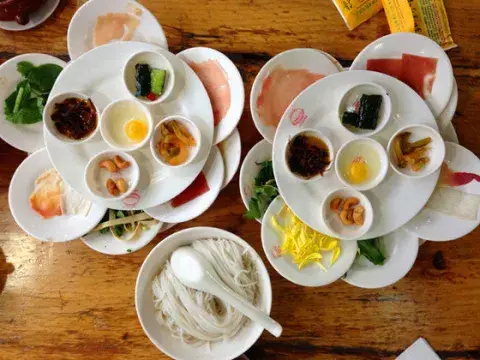
What is Cross-bridge Rice Noodle on Earth?
There is an old saying in China that food is the paramount necessity of people.
The record about the history of Yunnan cusine is quite scarce, however, what we know is that Yunnan people were enjoying steamed rice 10,000 years ago. This is definitelyan amazing thing.
...There is an old saying in China that food is the paramount necessity of people.
The record about the history of Yunnan cusine is quite scarce, however, what we know is that Yunnan people were enjoying steamed rice 10,000 years ago. This is definitelyan amazing thing.
As you may have heard, there are eight styles of cooking in China, however, since Yunnan cuisine rose up too late, it was blocked outside the door of the eight styles. Some say that snacks are not presentable and acceptable on grand occasions nor appeal to refined taste. However, our cross bridge rice noodle did manage to walk itself out and become famous worldwide. Especially on the world expo in 1999, cross bridge rice noodle was presented in a brand-new style in front of people's eyes.
_________________________________________________________________________________
Stories about Cross-Bridge Rice Noodle
There is an interesting story about how the name came into being. It's said that in Qing dynasty, there was a man in Mengzi county in Honghe Prefecture who was preparing for the imperial examination. However, the man was too fond of playing that he barely study. Seeing this, his wife was really worried and she suggested him study alone on an island in Nanhu lake in Mengzi. Since then, the wife persisted in preparing and sending food for the husband everyday and on her way there, she would cross a small bridge. Being touched by what his wife had been doing, the husband decided to strive harder and study industriously. Sometimes he was so preoccupied that he forgot to eat what his wife had brought for him. Such things happened a lot and the health condition of the man deteriorated. The examination day was already around the corner, the wife was so anxious. She decided to kill the only hen in their family and stewed a pot of delicious chicken soup. When the wife was preparing the tidying up the dishes, she found the soup was not even touched. So angry was she and she scolded the husband. Afterwards, she was about to put away the pot. To her surprise, the soup was still very hot. When revealing the lid, she realized that there was a thick layer of oil on the surface which kept the temperature. Being enlightened by this phenomenon, the smar wife devised a new way of eating. She separated the soup from the rice noodle. Thus, the husband could put the rice noodle into the soup whenever he got hungry and the dish wouldn't go cold any more. Finally, the man succeeded in the examination. In order to commemorate what his wife had done for him, he decided to name such dish as cross bridge rice noodle.
There is another interesting story about the cross bridge rice noodle. I assume all of you have heard of Lihongzhang? The story goes that when Lihongzhang was visiting France, the climate was extremely hot. The local French men presented him a popsicle. Having never saw such thing, he noticed the popsicle was steaming. Li thought that the popsicle was hot so he blowed the popsicle again and again before he dare to bite. To his great suprise, the popsicle was really cold. Li lost face in front of those French people. The humiliation sowed the seed of revenge in Li's heart.
Not long from the incident, those French people visited China. As the host, Li treated them with a very special local cuisine, cross-bridge rice noodle. When the soup was served, Li didn't say anything. Since there was no steam rising from it, those French people thought the soup was just cold beverage. So they lifted the bowl and took a deep swig. The result can be imagined. Those people was almost scalded.
The story is not necessarily fun because it might cause injury. However, we did learn one thing from it, that is the soup of the cross bridge rice noodle was really hot. We should be careful when dealing with it.
_____________________________________________________________________________________
How is it made?
It consists of four parts: the soup, the seasoning, the main dish rice noodle and saucers of meat and vegetable.
Soup: the soup was made by stewing bones, hen's meant, and xuanwei ham for a long time; though the soup has no steam but the temperature can reach even 100 degrees.
Seasoning: seasonings include oil chilly, pepper, salt and sugar(MSG味精);
Saucers of meat and vegetables: include pork filliet/pork tenderloin/griskin, chicken breast, cuttle fish, half-cooked pig's kidney, stomach and sliced squid. Vegetables include tine peas豌豆尖, Chinese chive(韭菜), Chinese parsley(芫荽), spring onion, shredded ginger, bamboo shoot slices, beancurd shin.;
Main dish: obviously the main dish is the rice noodle, which was slightly cooked already.
____________________________________________________________________________________
How should we eat it?
First, let's put the pigeon's egg into the soup, then the meat, stir it slightly, then put in lettuce and rice noodle. Then you can put in whatever you like or suites your taste.
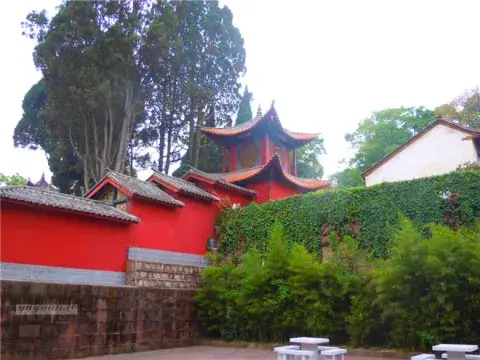
Caoxisi Temple
Caoxisi Temple...
Caoxisi Temple
This temple has a history of eight or nine hundred years.The hall in wooden structures is a building rare in China and "the Huayan Statues of the Three Sages"cared in wood are works of the Song Dynasty.Supported by "dougongs"(wood brakets supporting upturning eaves).the roof -beam kind of building is typical of the architectural style of the Song Dynadty.there is an opening in the central part of the facade of the hall between the rafters and the lintels.it is said that on the Mid-autumn Festival night,the bright moon first casts her light directly on the mirror set on Sakyamuni's forehead through the opning.As th bright moon rises,the moonlight shine from his nose tip to his navel,thus forming "the mutual reflection between the moon and the image of Lord Buddha".Such a wonderful sight is hailed as "Tianhan Baoyue"(Sacred moonlight Streaming in by the Will of Heaven),also called "Caoxi Yunyue".
Top Yunnan Province Tours
$1100 Per Day
The Ethnic Discovery of Yunnan
Duration: 8 days/ 7 nights
Destinations: Kunming, Dali, Lijiang, Shangri-La
Highlights: There are so many extraordinary places waiting for you to discover in Yunnan. In 8 days, you can feast your eyes on the wonderful natural beauty as well as the historic and cultural heritages in Kunming, Dali, Lijiang and Shangri-La. The Stone Forest, Three Pagodas, Lijiang Old Town, Tiger Leaping Gorge, Ganden Songzanlin Monastery and Nixi Village of Tibetan will highlight your trip.
• Day 1 Kunming
Arrival in Kunming, meet your guide at airport and transfer to hotel.
The capital of Yunnan Province, Kunming is one of China’s noted historical and cultural cities. The city is located in central Yunnan at the elevation of 1894 meters above sea level and is praised as the city of eternal spring.
Rest of the day at leisure
Accommodation:
Kunming Grand Park Hotel
• Day 2 Kunming
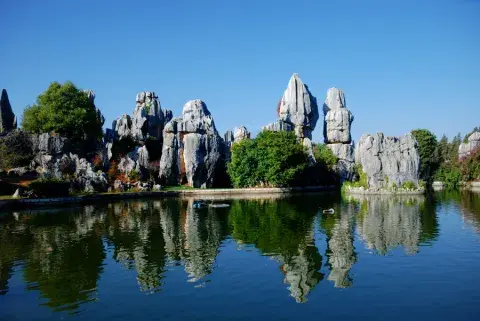
Drive along the new express way to the Stone Forest. Stone Forest is 75 kilometers from Kunming and is accessible by a bus ride of 70 minutes. The Stone forest belongs to the typical Karst geomorphology, it consists of innumerable bizarre-shaped ancient limestone cliffs and peaks created by wind and water erosion some 200 million years ago, and this area is praised as the “First Wonder Under Heaven”. It’s inscribed as Nature Heritage by UNESCO.
Drive back to Kunming by the old road, visit a village en route.
Visit the Green Lake Park in the afternoon. Attractions in the neighborhood of Green Lake Park include the former Yunnan Army Academy, believed to be the biggest quadrangle building of China, and people in Kunming enjoying their leisure life in the afternoon.
• Day 3 Kunming - Dali (by public express bus)
Overland drive with seat in public bus from Kunming to Dali, 360 kilometers, or about 4.5 hours.
Standing against the Cangshan Mountains in the west and adjoining the Erhai Lake in the east, embraced by undulating hills around, Dali was the capital of Nanzhao and Dali Kingdom as early as 1,300 years ago. It is home to Bai minority.
Upon arrival in Dali, proceed to visit the Three Pagodas, followed by a guided stroll in Dali old town.
Standing in a way of a tripod on the outskirts of old town, the Three Pagodas were constructed in about 850 and 1050 following the model of the Small Wild Goose Pagoda in Xi’an. For centuries, they are considered landmark of the region.
The Dali Old Town of weathered gray granite stands at 2,100 meters on a long, narrow rice plain between the Cangshan Mountains and the Erhai Lake, a natural configuration that seems specially designed for a good, bountiful life. Format of the old town is like a chessboard with four gates guarding in the directions of east, south, west and north, a design that was adopted by most towns in ancient China.
Accommodation:
Dali Landscape Hotel
• Day 4 Dali - Lijiang (by automobile)
In the morning, overland drive of 180 kilometers, or 3.5 hours, along the new road on private vehicles to Lijiang.
Visit the Bai minority village Xizhou on the way.
23 kilometers north of Dali, Xizhou village has a more mixed population and cosmopolitan background. It grew and flourished in the Ming Dynasty (1368-1644) along with the fortunes of Dali’s renowned tea merchants that traded to Tibet. Family Yan’s courtyard is a good example of traditional Bai houses. And each morning, villagers in Bai dresses gather in a small market to buy and sell their produce and daily wares.
Then continue driving to Shaping. Shaping Market is a local market on every Monday. The local people come to the market from surrounding villages to exchange their daily wares, farming products, traditional clothes, or simply foods and vegetables.
Upon arrival in Lijiang, check in at hotel. Afternoon will be free for your first visit of the old town.
A gathering place of rugged mountain people with the Naxi forming the majority, Lijiang is a small mountain town of stone and tile, laced with swift canals, which was enlisted as an UNESCO World Cultural Heritage in 1999.
Old town of Lijiang is a big area with its center, or Si Fang Jie (Square Street) in the form of an official ink stone, hence its name Dayan (ink stone) Town. It enjoys a long history of over 800 years and unlike most of the old towns in China, there is no city walls due to a superstitious belief of the local ruler whose family name is Mu (tree), when encircled by walls, would be Kun (besieged). Wooden structures, mountains, small rivers and lanes integrate harmoniously in this mountain town.
Accommodation:
Hexi Hotel Lijiang (or similar)
• Day 5 Lijiang
In the morning visit the Black Dragon Pond with Dongba Museum. The Pond provides you opportunity of taking great pictures of the crystal clear pond with backdrop of snow mountains in a distance.
Then, drive out to the Naxi minority villages at the foot of Jade Dragon Snow Mountains.
Visit the Yuhu Village, a simple village of Naxi minority with the Former Residence of Dr. Joseph Rock. Dr. Rock, an Austro-American botanist and explorer who lived here off and on from 1922-1949, is best remembered for the introduction of innumerable plant species to the West and his rigorous works on Naxi ethnology.
Transfer back to your hotel after lunch. Rest of the day for your own discorvery in the Old Town.
Lunch at local Chinese restaurant, dinner at leisure.
• Day 6 Lijiang - Shangri-La (by automobile)
We drive to Shangri-La with stops and visits to the First Bend of the Yangzi River and the Tiger Leaping Gorge on the way.
The village of Stone Drum stands at the First Bend of the Yangzi River, some 70 kilometers west of Lijiang. Approaching to Stone Drum offers a dramatic view of the Yangzi's near-180-degree turn, where the wide, swift waters perform a miraculous about-face. For nearly 20 kilometers the river, first flowing south, then north, runs parallel to itself. Locals say if it were not for their village standing guard at the bend, China would lose the water of the Yangzi to Southeast Asia, like that of the adjacent Mekong and Salween Rivers.
The Tiger Leaping Gorge, or Hutiaoxia in Chinese, is the Yangzi's best-known gorge after the Three Gorges in Sichuan and Hubei. Wedged tightly between titanic cliffs, the river is so narrow here, as legend tells us, that a hunted tiger made his escape to the other side in a single bound. Here, the Jade Dragon Snow Mountains and the Haba Snow Mountains lean close to each other and a large volume of torrent moving between them cutting deeper and deeper into the bottom of the gorge. In some places there is a drop of 3,000 meters to the water.
Arrive Shangri-La in the late afternoon, check in at hotel.
Shangri-La lies in a landscape of rolling hills, snow-capped peaks, virgin forests of spruce, pine and meadow dotted with wild flowers and tranquil lakes. The old town, still entirely in local Tibetan style, is to the south of Shangri-La.
Accommodation:
Shangri-La Moonlight City Hotel (or similar)
• Day 7 Shangri-La
Visit Ganden Songzanlin Monastery in the morning.The Ganden Songzanlin Monastery was founded in the 17th century during the reign of the Great Fifth Dalai Lama only 2 kilometers to the north of county proper. Being one of the thirteen Tibetan monasteries in the Kangba Region, where Tibet, Yunnan and Sichuan join, Ganden Songzanglin Monastery is nicknamed by local the Lesser Potala Palace. Holding about 700 monks and one living Buddha, the monastery is a must-go in the region.
Then make an excursion to Tukawa Village to visit a Tibetan family where the Tibetan builds their houses by wood with big sitting room and Buddhism hall.
Late afternoon at leisure for your own visit of the old town and local market in Shangri-La.
• Day 8 Shangri-La
Free at leisure and departure transfer to airport for next flight.
Service ends.
Tour excludes:
-- Arrival flight to Kunming and airport tax;
-- Departure flight from Shangri-La and airport tax;
-- All dinners, other meals, drinks and personal expenses;
-- Tips to the guide and driver;
-- Any program other than mentioned in our program.
$70 Per Day
Lashihai-migratory birds'heaven
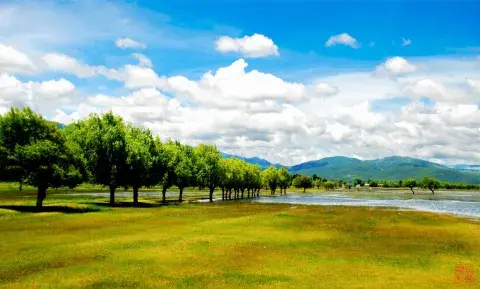
Today we have a funny vocation in Lashihai lake. Lashihai is in the center of the Lashi Dam and it is the first natural reserve area of Yunnan province named “wetland”. The avifauna in Lashi wetland can be divided into 4 communities: water surface area, swamp, agricultural farmland and forest vegetation. We can choose different areas to have a visit. Also, because of its special geography location, unique climate and distinctively ecological environment, Lashihai Lake is an ideal hibernating ground for migratory birds. If you like this kind of birds, you can come here in winter....Read more
Today we have a funny vocation in Lashihai lake. Lashihai is in the center of the Lashi Dam and it is the first natural reserve area of Yunnan province named “wetland”. The avifauna in Lashi wetland can be divided into 4 communities: water surface area, swamp, agricultural farmland and forest vegetation. We can choose different areas to have a visit. Also, because of its special geography location, unique climate and distinctively ecological environment, Lashihai Lake is an ideal hibernating ground for migratory birds. If you like this kind of birds, you can come here in winter.
Then, let’s talk about our vocation. In the morning, we ride a horse along the Tea-horse road. What is the Tea-horse road? In the ancient times, because the representative commodities trade on this road were tea and horses after Tang and Song Dynasty, it was called Tea-horse Road. The ancient “Tea-horse” road was a major old route for trading tea and horse between the inland agricultural region and the remote nomadic region. So, when we walk along the road ,we can have a feeling with deeply historic and cultural. Lashi Lake is a beautiful place for us to go.actually,we have a lot of fun there.Also,if we want,we can have a barbecue there.After the lunch,wo go boating by ouselves.it also makes many fun.

$300 Per Day
4-day Lijiang Scenery and Ancient Culture Tour
Day 1
In the morning visit the Black Dragon Pool park, and visit the Dongba Culture Museum inside the park. Next transfer to visit Yuhu Village and the Former Residence of Joesph Rock....Read more
Day 1
In the morning visit the Black Dragon Pool park, and visit the Dongba Culture Museum inside the park. Next transfer to visit Yuhu Village and the Former Residence of Joesph Rock.
--The Black Dragon Pool is a charming and tranquil park and pool system in the north east of Lijinag on the northern edge of Lijiang’s famous Old Town. The Black Dragon Pool is the head waters of the Yushui River that provides water for the Old Town. If you are visiting Lijiang’s Old Town, the Black Dragon Pool is a must see and a great way to relax and enjoy beautiful natural scenery after the hustle and bustle of the Old Town.
Charming autumn scenery of Black Dragon Pool
--Yuhu Village is the last village in the Lijiang Basin at the foot of Jade Dragon Snow Mountain. The houses were made of a unique stone called "monkey head" by Naxi people.There is a Yuhe Lake beside the village. Water in this lake comes from he melted snow in the mountains. The holy water from this holy mountain of the Naxi makes this small village very mysterious.
After lunch visit Baisha Village and Baisha Naxi Embroidery Institute, then drive to visit Yufeng Monastery.
--Baisha Village is a small village near Dayan town. It is also one of the first settlements of Naxi ancestors. The ancestors of the Naxi people crossed the Jinshajiang River, came down from Jade Dragon Snow Mountain and finally entered Lijiang Basin. The first place Naxi tribes arrived in Lijiang was Baisha. Here, Naxi Ethnic groups set up the first settlement and created their Dongba culture.
Mysterious Naxi fresco in Baisha village
In the evening you can choose to wander around the old town of Lijiang, which is much more charming when night falls.
Day 2
A whole day tour of holy Jade Dragon Snow Mountain begins
In the morning visit Ganhaizi Meadow, take the sightseeing bus to visit Baishui(White Water) River, which is a green water river because water from the Glacier Park of Yulong Snow Mountain; After that, take the chairlift to visit the Yak Meadow(3700M) in the Yulong Snow Mountain. You will enjoy Impression Lijiang Ethnic Show in the outdoors theater infront of Jade Dragon Snow Mountain. Impression Lijiang is directed by Zhang Yimou who is one of the most famous director in the world.Then return to Lijiang city.
You can take a cable to visit the Jade Dragon Snow Mountain if you car not good at climbing
--Jade Dragon Snow Mountain stretches a length of 35 kilometers (22 miles) and a width of 20 kilometers (13 miles). Looking from Lijiang Old Town in the south which is 15 kilometers (nine miles) away, the snow-covered and fog-enlaced mountain resembles a jade dragon lying in the clouds, hence, the name Jade Dragon Snow Mountain. The highest peak named Fan Peak (Shanzidou in Chinese) which is about 5596 meters above sea level. There are three cable cars in the mountain, the fist to the Glacier Park(4500M),the second to Spruce Meadow(3200M),the third to Yak Meadow(3700M).
Day 3
In the morning, dive 6 hrs on the spectacle mountain road to visit the mysterious Lugu Lake. On the way, enjoy the beautiful view among the huge mountains and rivers. You can start your walking halfway from Jin’anqiao Bridge to Shudi along the road at the bank of Yangtze River for you will see the beautiful canon and Yi ethnic people’s villages in the steep mountains. After 1 hour walking in the canon, you can continue the driving and stop in many Yi villages.
Late afternoon, take the canoes to visit Liwubi Island and Snake Islet in Lugu Lake.
Breathtaking scenery of Lugu Lake
In the evening, take part in Mosuo Bonfire Party with ethnic dance and singing performance.You will dance and sing with Mosuo boys and girls around a big bonfire in the outdoors theatre.
Day 4
A full day Luguhu Lake tour.Enjoy the sunset wonder of Luguhu Lake in Luoshui Village. Then drive back to Lijiang.