Xiangtan city of Hunan province

Relics from the Daxi culture indicate that people inhabited the Xiangtan area in the 3rd millennium BC.  Shang Dynasty bronzewares have been found in the region, as well as tombs from the Warring States period. During the Three Kingdoms Period, the kingdom of&nb...

Relics from the Daxi culture indicate that people inhabited the Xiangtan area in the 3rd millennium BC.  Shang Dynasty bronzewares have been found in the region, as well as tombs from the Warring States period. During the Three Kingdoms Period, the kingdom of Eastern Wu built a city in the west of modern Xiangtan City and organized the Hengyang Commandery (衡陽郡) around it. In 749, the Tang Dynasty organized the area as Xiangtan County, centered at modern Yisu River (易俗河). By the time of the Northern Song Dynasty, Xiangtan's good access to both land and water trade routes had established it as the major commercial center of the region.

Ming and Qing DynastiesEdit

Xiangtan prospered throughout the Ming Dynastyand Qing Dynasty upon an economic foundation of trading in rice and traditional Chinese medicinal ingredients, and was sometimes referred to as "Little Nanjing" or "Golden Xiangtan". Prior to the Second Opium War, Xiangtan was a central transfer point for import and export goods going to and from ports in Canton, Shanghai, and Wuhan, supported by approximately 200,000 inhabitants.

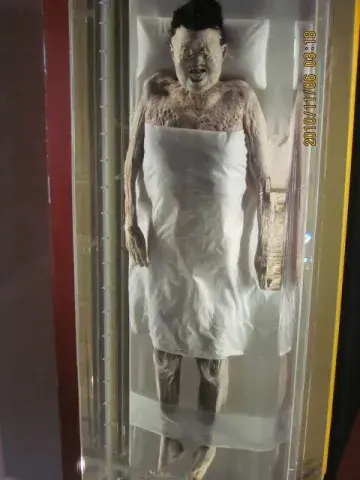
Mawangdui Han tomb mummy

In 1971, a group of construction workers began digging on the slopes of a hill named Mawangdui, near the Chinese city of Changsha. Since the workers were about to construct a spacious air raid shelter for a nearby hospital, they were digging deep into the hill. Before 1971, the Mawangdui hill was...

In 1971, a group of construction workers began digging on the slopes of a hill named Mawangdui, near the Chinese city of Changsha. Since the workers were about to construct a spacious air raid shelter for a nearby hospital, they were digging deep into the hill. Before 1971, the Mawangdui hill was never considered a place worth the attention of archaeologists.

However, this changed when the workers stumbled upon what appeared to be a tomb hidden beneath many layers of soil and stone. The construction of the air-raid shelter was canceled and, several months after the workers’ accidental discovery, a group of international archaeologists began excavating the site.

The tomb turned out to be so massive that the excavation process lasted for nearly a year, and the archaeologists needed help from as many as 1,500 volunteers, mostly local high-school students. Their painstaking work paid off because they discovered the majestic ancient tomb of Li Chang, the Marquis of Dai, who governed the province approximately 2,200 years ago, during the rule of the Han dynasty.

The tomb contained as many as 1,000 precious artifacts, including golden and silver figurines of musicians, mourners, and animals, intricately crafted household items, meticulously designed jewelry, and a whole collection of clothes made from fine ancient silk.