The Glass Bridge in Zhangjiajie Grand Canyon

In Zhangjiajie Grand Canyon, the plunging waterfalls, the dense trees, the fresh air, and the mist on the stream make you feel like you are in an otherworldly sort of place. A spring meanders in the canyon, along which are trails built with planks. On the way, you can see the longest and highest ...

In Zhangjiajie Grand Canyon, the plunging waterfalls, the dense trees, the fresh air, and the mist on the stream make you feel like you are in an otherworldly sort of place. A spring meanders in the canyon, along which are trails built with planks. On the way, you can see the longest and highest glass bridge in the world as well as the karst landform in the north temperate zone. You have to walk for over two hours to visit the canyon, so remember to wear sports shoes and bring some food. You are recommended to start at the top of the canyon and move downhill, the following attractions coming into view successively.

A Strip of Sky & Sky Ladder Plank Road
‘A Strip of Sky’ is a narrow valley through which only one person can pass at a time. The valley is over 765 yards (700 meters) long with a drop of 985 feet (300 meters) from the beginning to the end. After passing through the valley, you will see Sky Ladder Plank Road. This road is very steep and the planks are narrow, making it look like a sky ladder. Walking along it for three minutes, you come to the best place to see the entire ‘A Strip of Sky’.

Southern Red Flag Canal
The canal is 3 feet (1 meter) deep and 3 feet wide, but over 6 miles (10 kilometers) long. It directs the spring from the lofty cliffs. The excavation took local people seven years, and many of them sacrificed their life for it. Thanks to the canal, residents of eight nearby villages have water to drink and irrigate the rice fields.

Tip: There is a skidway made of granite slates among the A Strip of Sky, the Sky Ladder Plank Road, and the Southern Red Flag Canal. It takes you only 3-5 minutes, 20 minutes shorter than walking.

Glass Bridge
Zhangjiajie Glass Bridge, built with 99 sheets of glass, is 470 yards (430 meters) long, 6.6 yards (6 meters) wide and 985 feet (300 meters) high, the longest and highest glass bridge in the world. Unlike the Zhangjiajie Tianmen Mountain Glass Bridge, which is inserted on the mountain side with a height of 4,690 feet (1,430 meters), Zhangjiajie Grand Canyon Glass Bridge hangs over a valley. It provides a superb panorama of the entire grand canyon. Standing on it is like floating in the air. Come and have a try if you are brave enough. There is also a rope line nearby, which surely excites your nerves.

Please note that visitors need to book a ticket for the Glass Bridge on its official website at least one day before the visit. Only those who qualify for ticket discounts can buy the ticket on spot. Valid ID certificate like passport is required for purchasing the ticket.

 Some Tips for Walking along the Glass Bridge:
1. The bridge may be closed if the weather is bad.
2. High heels are not allowed on the bridge. One can only bring a cell phone with cover and purse while walking on the bridge.
3. Do not run on the bridge or stand against the rail.
4. Those who have heart disease, high blood pressure and acrophobia are not recommended to set feet on the bridge.

Barrel Cliff & Flying Fox Rushing Downhill
The cylindrical cliff is neither chiseled by human nor eroded by waterfalls, and only grasses grow on it with no trees.  Geologists and botanists cannot explain why. Keep moving 10 yards (10 meters), you can see the Flying Fox Rushing Downhill. On the cliff, a big rock gets in the running waterfall’s way and the water forms a rock cover, which looks like a fox rushing downhill.

Pearl Wall & Waterfall of Butterfly Spring
The spring flows slowly downward along the cliff on which lots of plants grow. Then it forms many pearlescent crystal droplets on those plants. Thus the cliff is called Pearl Wall. After two minutes’ walk, the Waterfall of Butterfly Spring comes into view. It flows past trees and lawns, and butterflies dance there every day, giving it its name.

Swallow Cliff
There are thousands of swallow nests on Swallow Cliff. These rock swallows are smaller than ordinary ones and do not nest in houses. Their nests can be cooked and eaten.
At the end of the canyon, there is a reservoir where you need to take a boat. Ducks play on the reservoir, you may also see egrets flying past.

1. You can take the shuttle bus from Wulingyuan Bus Station to Cili and get off at Grand Canyon, taking about 20 minutes and costing CNY 12.
2. You can take the long-distance bus from Guanghe Mall in Zhangjiajie to Jiangya Hot Spring and get off at the canyon. The bus departs every 60 minutes with a duration of 1 hour and a ticket price of CNY 20.
3. You can also take the direct bus from Zhangjiajie Center Bus Station to the canyon with a duration of 1.5 hours
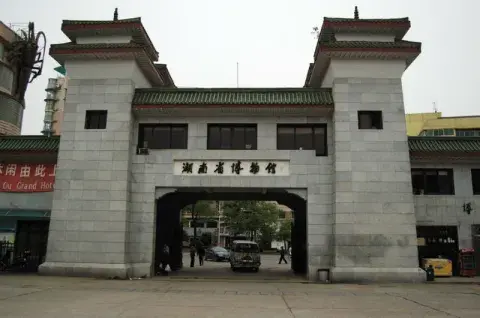
Hunan Provincial Museum

Hunan Provincial Museum is located on No. 50, Dongfeng Lu, Changsha City, next to the Revolutionary Martyr's Park. It covers an area of 50,000 square meters (about 12.2 acres) with a construction area of 20,000 square meters (about 4.9 acres). First built in 1951, the museum was open to the p...

Hunan Provincial Museum is located on No. 50, Dongfeng Lu, Changsha City, next to the Revolutionary Martyr's Park. It covers an area of 50,000 square meters (about 12.2 acres) with a construction area of 20,000 square meters (about 4.9 acres). First built in 1951, the museum was open to the public in July 1974. It has gathered together most curios unearthed in Hunan Province, unfolding the cultural development of Hunan Province throughout thousands of years.

This museum has a collection of more than 110,000 objects, over 763 of which are top grade cultural relics. Most of these objects were discovered by archaeological excavation. What's more, the museum has gathered together nearly all the fine works unearthed in different parts of Hunan Province. According to the various textures, the cultural relics in Hunan Provincial Museum can be classified into the following kinds: bronze, silk paintings and books, lacquers, textiles, ceramics, paintings and calligraphy. These cultural relics include stone implements and pottery from the Neolithic Age, bronze wares of the Shang Dynasty (16th - 11th century BC) and Zhou Dynasty (11th - 221 BC), and celadon wares from the Eastern Han Dynasty (25 - 220) to the Sui Dynasty (581 - 618) and the Tang Dynasty (618 - 907). Some masterpieces by famous scholars like Wang Xizhi, a famous calligrapher from the Tang Dynasty, and Wang Fuzhi, a great philosopher of the late Ming Dynasty (1368 - 1644) and the early Qing Dynasty (1644 - 1911) are also on display. Cultural relics unearthed in Mawangdui Han Tombs are the highlights in the museum.

The following cultural relics unearthed in Mawangdui Han Tombs are highly recommended because of the amazement they have brought to people. The first one is the tomb and corpse of Xin Zhui, circa 2,000 years ago, which is well preserved. Her skin is moist and her organs are still well protected, even after having been unearthed for more than 30 years. The second relic is a T-shaped colored silk painting. It is not only still intact but also has gorgeous color. The contents of this painting are various, giving you a full picture of lives in the Western Han Dynasty (206 BC - 24). The third one is a plain gauze garment. It is about 128 centimeters (about 4.2 feet) long but only weighs 48 grams (about 1.7 ounces). This garment is perhaps the most significant, because it proves the existence of very advanced textile technology in the Han Dynasty (206BC - 220) when China was called 'the country of silk'.

Admission Fee:  Free
The museum issues 5,000 free tickets to visitors from 08:45 to 16:00 on every opening day.
Opening Hours:  09:00 - 17:00 (Tuesday - Sunday);
Closed on Monday and Chinese New Year's Eve
08:45 - 16:00 (time to get tickets)
Bus Route:  Take bus 112, 113, 131, 136, 146, 150, 302, 303, 704, 901 and get off at Hunan Provincial Museum.

Hunan Hongjiang Ancient Commercial City(Huaihua City)

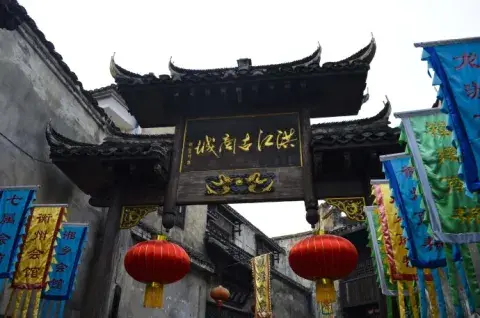
Situated in the conjunction of Yuan River and Wu River in Huaihua, Hunan, Hongjiang Ancient Commercial City originated from the Spring and Autumn Period, took shape in flouring Tang Dynasty and peaked in Ming and Qing Dynasty. It is famous for collecting and distributing China ...

Situated in the conjunction of Yuan River and Wu River in Huaihua, Hunan, Hongjiang Ancient Commercial City originated from the Spring and Autumn Period, took shape in flouring Tang Dynasty and peaked in Ming and Qing Dynasty. It is famous for collecting and distributing China wood oil, timber, paraffin and opium. In ancient time, it is not only a collection and distribution center of Yunnan, Guizhou, Guangxi, Hunan, and Chongqing Province but also a economic, cultural and religious center in southwest of Hunan, which has enjoyed several laudatory titles like “Bright Pearl in Western Hunan”, “Contracted Nanjing” and “Metropolis in Southwest China”. According to textual research done by experts, preserved ancient building of Ming and Qing Dynasty in Hongjiang Ancient Commercial City covers an area of about 200 thousand hectares. Over 380 ancient buildings like temples, armed escort firms, ancient banks, business firms, workshops, brothels, inns, newspaper offices and so on are extraordinary and rare heritages left by our ancestors. If you want to experience life as in ancient China, Hongjiang Ancient Commercial City must be the best choice for you.

Mengdong River Rafting

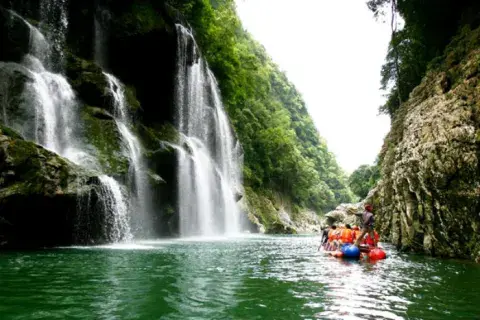
The Mengdong River Scenic Zone is in Yongshun County, Xiangxi Autonomous Prefecture in Hunan, the birthplace of the Tujia nationality. Rivers flow from west to east and there are scattered lakes in the south and north. This configuration provides good conditions for Drifting tours. There are rapi...

The Mengdong River Scenic Zone is in Yongshun County, Xiangxi Autonomous Prefecture in Hunan, the birthplace of the Tujia nationality. Rivers flow from west to east and there are scattered lakes in the south and north. This configuration provides good conditions for Drifting tours. There are rapid streams, dangerous shoals and calm rivers. The drifting covers about 47km. The river flows through steep country with high cliffs and deep valleys. The waterway is narrow and the flow is rapid which makes the tour exciting.

2 hours drive from Zhangjiajie city, Rafting usually take 3 hours. Wide calm river section take another 3 hours ending at Furong town that's well preserved old town famous for its old streets and stilted houses, it is worth visit. Tourists can see many Tujia style houses which are on stilts in the water at both banks. There are also the Xizhou bronze pillars, important cultural relics under the key protection of the state in the ancient town of Furong on the lower reaches of the river. You'll thrill to the excitement of the major rapids of the Mengdong River; there are a few of the rapids that get your heart pounding. The rapids are interspersed with calm stretches, which give you a chance to enjoy the breathtaking scenery. Gentle rapids carve a pathway through mountains and provide plenty of chance to swim, spot wildlife, take the fried the river fish, and just relax.

On the drifting boat, seeing mountains on both sides passing quickly and the stream rolling on with roars, one feels as if they were dropping to the deep valley from the sky, or jumping to the air from the ground, or galloping on horse backs, or riding clouds and mist. With great admiration, one feels shocked first and then delighted. The drifting is extraordinarily thrilling and one will never forget it!

Below are suggested items you should bring for your trip. You will enjoy your trip more if you are prepared for varying weather conditions.
Always Bring:
Swimsuit shorts wool sweaters or synthetic fleece wool socks windbreaker jacket and pants, footwear that can get wet (plus a dry pair for after your trip) dry clothes and towel. Sun screen sunglasses baseball cap or visor.
Cool weather:synthetic long johns wool hat and glovesWet Suit