Millennium City Park (Qingming Riverside Landscape Garden)

Have you ever dreamed of going back in time to Northern Song Dynasty (960-1127) in China and savor the prosperity and culture of those years? If so, come to Millennium City Park (also called Qingming Riverside Landscape Garden) located in the old city of Kaifeng (the former Bianjing) in Henan Pro...

Have you ever dreamed of going back in time to Northern Song Dynasty (960-1127) in China and savor the prosperity and culture of those years? If so, come to Millennium City Park (also called Qingming Riverside Landscape Garden) located in the old city of Kaifeng (the former Bianjing) in Henan Province. Find yourself in the spectacular scenery there and you are sure to realize that dream.

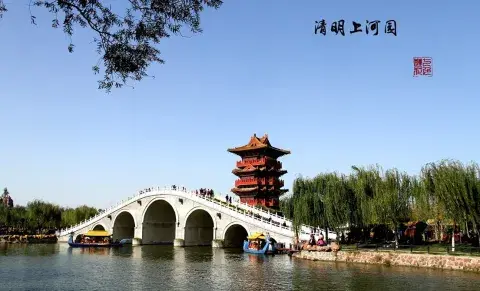
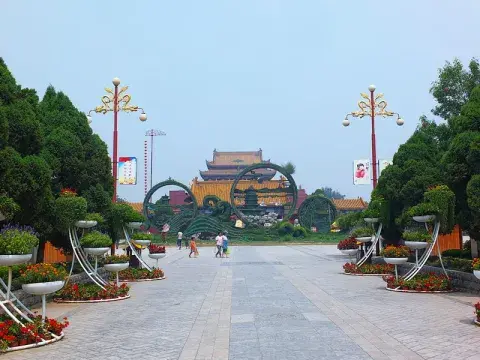
Millennium City Park located on the west bank of Dragon Pavilion Lake is a grand cultural garden. It covers an area of 600 mu (about 98 acres), and the construction area is more than 30,000 square meters (about 7.4 acres). The built area consists of several architectural complexes which are re-creations based on the famous twelfth century painting by Zhang Zeduan of 'The Qingming Festival by the Riverside'. This picture is a painted scroll which is 525 cm (about 17 feet) in length and 25.5 cm (9.5 inches) in width depicting life along Bian River during the Qingming Festival. The scenes in this painting are highly detailed and the spectacle is magnificent. There are large numbers of people and buildings. The people are shown in a variety of contemporary clothes that indicate their social standing and occupations. The lively throng includes many animals and it is not difficult to imagine the sounds in the street scenes where the people are crowded and noisy. We can almost hear someone bargaining with a shop owner while others are cheering entertainers. The picture is like a live symphony of life during the Song Dynasty (960-1279).

When you enter the Millennium City Park, a statue which is 16 meters (about 52 feet) tall comes into view. This figure is none other than the artist Zhang Zeduan, who holds his famous drawing of 'The Qingming Festival by the Riverside'. Now we can find these scenic spots such as City Gate Tower, Rainbow Bridge, distinctive shops and others which are re-created in the Park according to the scenes in the painting.

Dragon Pavilion

Dragon Pavilion is the main part of Dragon Pavilion Park located in the northwest of Kaifeng City, where six dynasties located their capitals. The site where the pavilion is located is the site of many dynasties' imperial palaces and reached its height of prosperity in the Northern Song Dynasty (...

Dragon Pavilion is the main part of Dragon Pavilion Park located in the northwest of Kaifeng City, where six dynasties located their capitals. The site where the pavilion is located is the site of many dynasties' imperial palaces and reached its height of prosperity in the Northern Song Dynasty (960-1127). Then, most of the constructions were destroyed through wars. In the Ming Dynasty (1368-1644), the mansion of an emperor's son was established here with a garden. In the Qing Dynasty (1644-1911) a hall was added, a place where the emperors' tablets were placed, thus getting the name of Dragon Pavilion.

This pavilion, together with other scenic beauties, makes up the Dragon Pavilion Park. This area is the most famous and the largest scenic spot in Kaifeng, with an area of 0.87 square kilometers (214 acres). So it is a must-see when traveling to Kaifeng.

Dragon Pavilion is a typical representative of the cultural and historical heritages of Kaifeng. It is the main part of the constructions in Dragon Pavilion Park. In fact, the pavilion is a grand hall built on a 13-meter (43 feet) blue brick terrace with 72 steps. This hall, a wooden structure built facing south, is 26.7 meters (88 feet) in height, covering 19.10 meters (63 feet) from east to west and 11.90 meters (39 feet) from south to north. It holds many rare cultural relics, and dragons playing with pearls are carved on the ceilings and walls. The pavilion is also a favorable place to overlook all the sceneries of Kaifeng City. In a word, travelers can have a visual feast here.

Yuntai Mountain,Yuntai Geo park or Yuntai shan

I am Yuntai Mountain tour guide,and I provide tour guide service and car rental from Zhengzhou.

The Yuntai Mountain, Yuntai Geo park ,Yuntai shan  is situated in Xiuwu County, Jiaozuo, Henan Province of People's Republic of China. Yuntaishan is a China's national civilized ...

I am Yuntai Mountain tour guide,and I provide tour guide service and car rental from Zhengzhou.

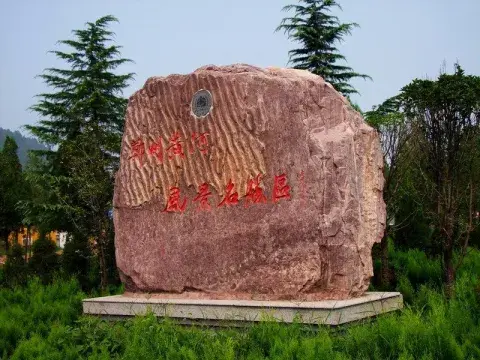
The Yuntai Mountain, Yuntai Geo park ,Yuntai shan  is situated in Xiuwu County, Jiaozuo, Henan Province of People's Republic of China. Yuntaishan is a China's national civilized scenic area and spot, national natural heritage, national forest parks, national macaque nature reserve. Yuntain Mountain also has Asia's highest head drop waterfall.

The Yuntai Geo Park scenic area is classified as a first national AAAAA scenic area by the China National Tourism Administration.On February 13, 2004, Yuntai Mountain as the fifth in the world, the third in the country China, was named the world's first World Geo park by UNESCO and caused attention at home and abroad.

Yuntai Waterfall is 314m high
Situated within Yuntai Geo park, with a fall of 314 metres (1,030 ft), Yuntai waterfall is claimed as the tallest waterfall in China.

Eleven Scenic Areas
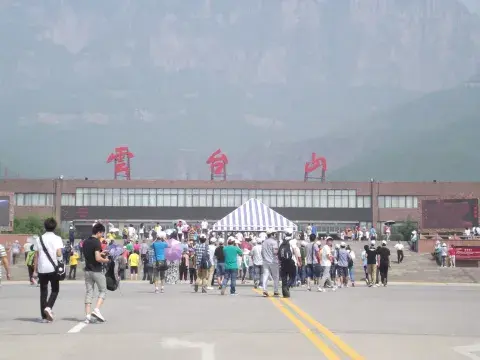
Occupying an area of 190 square kilometers (46,950 acres), Yuntai Mountain has eleven scenic areas: Red Stone Gorge, Tanpu Gorge, Quanpu Gorge, Cornel Peak, Wanshan Temple, Baijia Cliff, Zifang Lake, Macaque Valley, Qinglong Gorge, Fenglin Gorge and Diecai Cave. Each has its own unique features and beauty.

Red Stone Gorge (Hongshi Gorge)

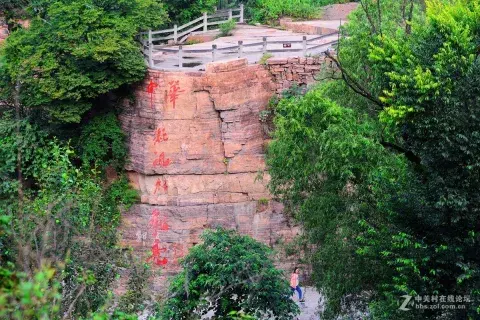
Red Stone Gorge is a valley with steep cliffs of red rocks standing straight up on both sides. It is the geologic relic of a crustal movement that took place 1.4 billion years ago, and rare Danxia landform in northern China. This gorge gathers many springs, waterfalls, streams, pools and gullies, so it is named 'the corridor of superfine landscape' by garden experts. The south side of the gorge is so narrow that it is only one thread wide. Towering cliffs stand facing each other as a gate and torrents scour a gully down the cliffs. Here the White Dragon Waterfall is divided into three sections and drops in level of about 50 meters (164 feet). Myriad springs and waterfalls dash against cliffs, making numerous colorful beads in sunlight like a natural fresco. White stalactites that grow in the quartz sandstones become simple and elegant under the red cliffs. Two emersed red stones look as if two lovers are locked together in a long kiss. Nine dragon pools make a stream whose water is so limpid that many beautiful stones can be seen clearly.

Cornel Peak, Zhuyu peak

Cornel Peak is the highest peak of Yuntai Mountain, which is about 1,308 meters (4,291 feet) above sea level. The great poet of the Tang Dynasty (618-907), Wang Wei, wrote a famous verse 'One misses the relatives the most in holidays' on Cornel Peak. Following ascent of thousands of steps of scaling ladder and plank road built along a cliff to this peak, visitors can see the Taihang Mountain in the north. Lofty mountains extends as far as eyes can see. Also the vast plain in the south, the crisscross fields which appear like a chessboard and the ribbon-like Yellow River can be seen. In a word, the scenery is magnificent from this peak, making people deeply feel the poetic imagery of this line 'seen from the skyscraping peak, other mountains appear to be dwarfed', a line written by Du Fu, the 'Poet Saint' of the Tang Dynasty.

Tanpu Gorge (Xiaozhai Valley)
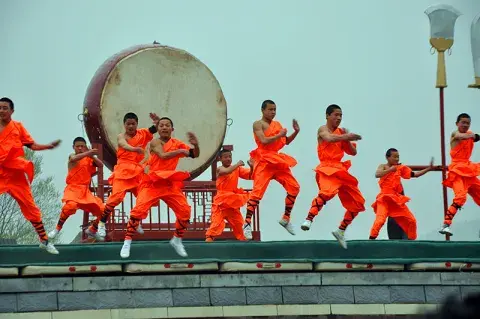
Among the landscape gallery of Yuntai Mountain, Tanpu Gorge is nature's masterpiece. It is famous for 'a spring in three steps, a waterfall in five steps and a pool in ten steps'. The water scenery in this valley is imposing with mountains and unique rocks. Located in the north of Yuntai Mountain, the 1,270 meters (1,389 yards) long gorge travels from south to north. Sheer cliffs and steep mountains at both sides rise skyward in an elegant shape. The still waters in Duxian Pond run deep and the water there is as green as an emerald. It is said that people can become immortal by drinking its water. The lover waterfall falls at three different levels and in each level, two waterfalls blend into a pond as if two sweethearts whisper. A Y-shaped waterfall hangs between two mountains with a drop of more than 10 meters (32.8 feet). Here many deep pools are formed by the cascading waters. Moreover, there is a natural water-curtain cave with crystal beads hanging before the cave. In summer and autumn, bamboo rafting is held here. In the Xiaozhai Valley Square, tourists can see shadowboxing show for free.

Other Scenic Areas
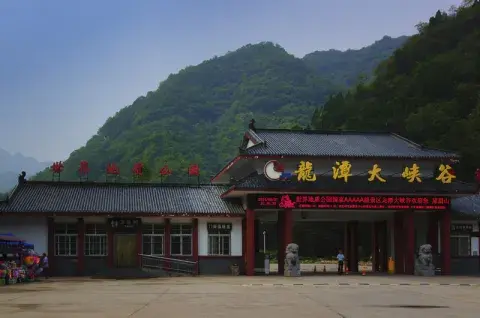
A placid lake, Yuntai MountainQuanpu Gorge contains the largest cataract in the entire country, Yuntai Waterfall which has a drop of about 314 meters (1,030 feet). Seen from afar, the waterfall kisses the blue sky like a skyscraping pillar, producing deafening roars. The Wanshan Temple is situated at the foot of the Hades Nose Peak, which was originally built in the Ming Dynasty (1368-1644). Baijia Cliff Scenic Area is an excellent place for climbing cliffs, where many historical relics are left. The Tianmen Waterfall and a temple pagoda rising on a cliff are two must-sees. The Macaque Valley is a natural reserve for wild macaques who have been trained to put on performances, such as dancing, pulling a cart and military practice. The Blue Dragon Gorge, named as 'the First Gorge in Central Plain', is a good ecological resort because of its thick forest, abundant water and pleasant climate. A vast expanse of misty, rolling waters spread all over the Fenglin Gorge. Elegant islands are scatted in the lake like stars in the sky. Diecai Cave is a highway tunnel linking Henan and Shanxi Provinces. It runs through the Yuntai Mountain, 4,000 meters (2.5 miles) long. Zifang Lake appears like a large mirror reflecting the green mountains around, blue sky and white clouds.
Museum of Luoyang Eastern Zhou Royal Horse and Chariot Pits

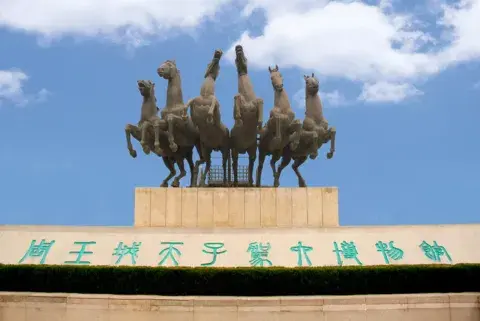
Museum of Luoyang Eastern Zhou Royal Horse and Chariot Pits is worth a visit. The musuem is built over the sacrificial pit area for the emperors in Eastern Zhou Dynasty (770BC – 256BC) with its capital at the site of the present day Luoyang. The burial of the royal horse and chariots here in Luoy...

Museum of Luoyang Eastern Zhou Royal Horse and Chariot Pits is worth a visit. The musuem is built over the sacrificial pit area for the emperors in Eastern Zhou Dynasty (770BC – 256BC) with its capital at the site of the present day Luoyang. The burial of the royal horse and chariots here in Luoyang is earlier than that of terra cotta warriors during Qin Dynasty (221–206 B.C.) in Xian.

The city of Luoyang went through thirteen dynasties and 105 emperors starting Xia Dynasty (2070BC-1600BC), Shang Dynasty (1600BC-1046BC), Eastern Zhou Dynasty(770BC-256BC), Beiwei Dynasty (493AD-534AD), Sui Dynasty (605AD-619AD) and more with a history of over 4,000 years! It should be deifinitely included in your Luoyang tour program.

The museum’s former English name is quite long while it is colloquially called “Tianzi Jialiu Museum”. “Tianzi” means emperors while “Jialiu” means their chariots driven by 6 horses. The dicovery of the Tianzi Jialiu Site has great impact on the Chinese archaeology and history. It is a proof that in the Zhou Dynasty, the emperors had 6 horses to drive their chariots; the vassals 5 horses; the ministers 4 horses; scholar-bureaucrats 3 horses; scholar-officials 2 horses and Common People 1 horse, a kind of strict etiquette formed in Zhou Dynasty, which had been only recorded in ancient books before it was discoved underground in 2002. So the number of the horses indicated the rank and identity of the nobles.