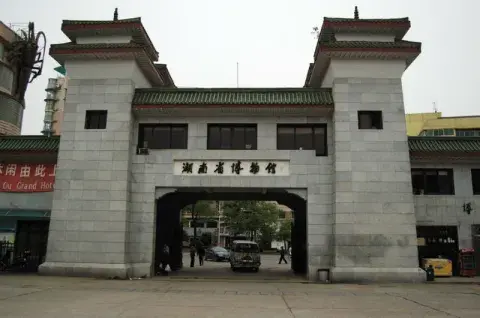
Hunan Provincial Museum is located on No. 50, Dongfeng Lu, Changsha City, next to the Revolutionary Martyr's Park. It covers an area of 50,000 square meters (about 12.2 acres) with a construction area of 20,000 square meters (about 4.9 acres). First built in 1951, the museum was open to the public in July 1974. It has gathered together most curios unearthed in Hunan Province, unfolding the cultural development of Hunan Province throughout thousands of years.
This museum has a collection of more than 110,000 objects, over 763 of which are top grade cultural relics. Most of these objects were discovered by archaeological excavation. What's more, the museum has gathered together nearly all the fine works unearthed in different parts of Hunan Province. According to the various textures, the cultural relics in Hunan Provincial Museum can be classified into the following kinds: bronze, silk paintings and books, lacquers, textiles, ceramics, paintings and calligraphy. These cultural relics include stone implements and pottery from the Neolithic Age, bronze wares of the Shang Dynasty (16th - 11th century BC) and Zhou Dynasty (11th - 221 BC), and celadon wares from the Eastern Han Dynasty (25 - 220) to the Sui Dynasty (581 - 618) and the Tang Dynasty (618 - 907). Some masterpieces by famous scholars like Wang Xizhi, a famous calligrapher from the Tang Dynasty, and Wang Fuzhi, a great philosopher of the late Ming Dynasty (1368 - 1644) and the early Qing Dynasty (1644 - 1911) are also on display. Cultural relics unearthed in Mawangdui Han Tombs are the highlights in the museum.
The following cultural relics unearthed in Mawangdui Han Tombs are highly recommended because of the amazement they have brought to people. The first one is the tomb and corpse of Xin Zhui, circa 2,000 years ago, which is well preserved. Her skin is moist and her organs are still well protected, even after having been unearthed for more than 30 years. The second relic is a T-shaped colored silk painting. It is not only still intact but also has gorgeous color. The contents of this painting are various, giving you a full picture of lives in the Western Han Dynasty (206 BC - 24). The third one is a plain gauze garment. It is about 128 centimeters (about 4.2 feet) long but only weighs 48 grams (about 1.7 ounces). This garment is perhaps the most significant, because it proves the existence of very advanced textile technology in the Han Dynasty (206BC - 220) when China was called 'the country of silk'.
Admission Fee: Free
The museum issues 5,000 free tickets to visitors from 08:45 to 16:00 on every opening day.
Opening Hours: 09:00 - 17:00 (Tuesday - Sunday);
Closed on Monday and Chinese New Year's Eve
08:45 - 16:00 (time to get tickets)
Bus Route: Take bus 112, 113, 131, 136, 146, 150, 302, 303, 704, 901 and get off at Hunan Provincial Museum.