Hongluosi
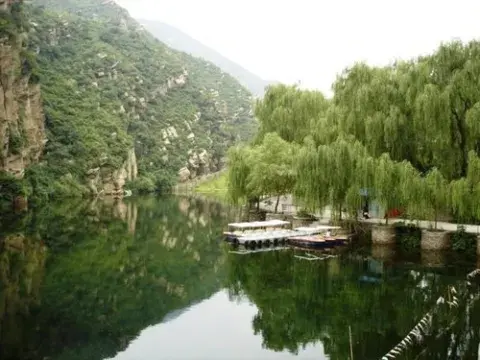
Hongluo Temple scenic spot covers an area of 8 square kilometers integrating the natural landscape with manmade features. It consists of two part: two scenic spots and three Buddhist areas.
Two scenic spots refer to Hongluo Hill at the back of Hongluo Temple and Qinglong...
Hongluo Temple scenic spot covers an area of 8 square kilometers integrating the natural landscape with manmade features. It consists of two part: two scenic spots and three Buddhist areas.
Two scenic spots refer to Hongluo Hill at the back of Hongluo Temple and Qinglong Hill to the east. Hongluo Hill, the natural barrier of the temple, has two peaks with an altitude of 813 meters. In spring you can enjoy bright-colored pediments and in autumn you can enjoy the red leaves all over the hill. In Qinglong Hill scenic spot there are maily ancient pines which boast an area of more than 1700 mu. Among which there are more than 10,000 ancient trees over 100 years old. It is one of the most important ancient trees group in Beijing. There are stone carvings of twelve annual animal signs and over 100 sets of stone tables and stone stools for tourists to have a rest in the ancient pinewoods. There the air is clear and fresh and the environment is quiet and tasteful. The air has a very high anion content. The gas emitted from the pines is good for people’s health. A saying goes around among the local people: If you stroll in the Arhat Valley once, all your disease will be removed. It is a good destination for tourists to keep healthy and relax themselves.
Three Buddhist areas refers to Hongluo Temple , Boddhisattva Guanyin Temple and 500- Arhat Statues Garden. Hongluo Temple has a history of more than 1600 years. The temple was built at the foot of the mountain, facing to the south. Most buildings were built during the Ming and Qing Dynasties. There is a main hall built in 3 tiers (The Hall of Heavenly Guardians, Grand Bodhisattva Hall, There Sages Hall) and four side halls in the east and west.(Faith Hall, Thousand-armed Goddess of Mercy Hall, Yaoshi Hall, Damo Hall) Buddhisattva Guanyin Hall is located on the halfway up the mountain. It takes half an hour to get there along the path for the climbers. There are the Gate Hall, Boddhisattva Guanyin Hall, Five-hundred-arhat garden, covering an area of 20 mu, is located in the ancient pinewoods of Archat Valley east of the temple. The stone statue of Maitreya is the center of the five-hundred-arhat garden. The archats are carved out of life-size bluestones. Each archat has different lifelike expressions.
Hongluo Temple has relatively good tourist facilities. The Bamboo Fragrant Restaurant and the restautrant in Hongluo Hill Resort can accommodate a banquet over 500 guests. Hongluo Hill Resort located in the pinewoods, with the architecture of siheyuan(compond with houses around courtyard) and Japanese style log cabin. There are over 200 beds of different grade, a gymnasium , a Karaoke lounge and conference rooms. In the morning, you can stroll in the pinewoods breathing in fresh air and fully enjoying the relaxation, comfort and romance far from the city.

Ancient Coins Museum
Various coins from the history of China such as the earliest shell coins, the cloth coins, the grimace money, coins from every dynasty, paper money from the Kuomingtang-ruled era are on display here.
Take Bus No. 5、27、44、55、315、345、380、815、919 and get off at Dengshengmen stop. Or take t...
Various coins from the history of China such as the earliest shell coins, the cloth coins, the grimace money, coins from every dynasty, paper money from the Kuomingtang-ruled era are on display here.
Take Bus No. 5、27、44、55、315、345、380、815、919 and get off at Dengshengmen stop. Or take the subway and get off at Jishuitan station