National Stadium (Bird's Nest)

The National Stadium, affectionately known as Bird's Nest, is situated in Olympic Green Village, Chaoyang District, Beijing. It was designed as the main stadium of 2008 Beijing Olympic Games. The Olympic events of track and field, football, gavelock, weight throw and discus were held there. Since...

The National Stadium, affectionately known as Bird's Nest, is situated in Olympic Green Village, Chaoyang District, Beijing. It was designed as the main stadium of 2008 Beijing Olympic Games. The Olympic events of track and field, football, gavelock, weight throw and discus were held there. Since October, 2008, after the Olympics ended, the National Stadium has been opened as a tourist attraction. Now, it's the center of international or domestic sports competition and recreation activities.
The design of this large stadium was accomplished together by Swiss architects Jacques Herzog and Pierre de Meuron and Chinese architect Li Xinggang and the others. The designers didn't do any redundant disposals to the look of the stadium. They just exposed the steel structures entirely and let them become the most natural appearance. The form of the stadium looks like a big nest which embraces and nurses human beings. Also it looks rather like a cradle bearing human beings'  hope of the future.
The construction of the National Stadium started on December 24, 2003. On July, 2004, the project was stopped temporarily due to the amendment of the design. On December 27 of the same year, the construction was resumed and finished in March, 2008. The gross cost of the whole project is 2,267 million Chinese yuan (about 33 million dollars).
The stadium covers an area of about 258 thousand square meters (99.614 square miles), which can accommodate 80,000 fixed seats and 11,000 temporary seats. Its appearance was formed by big steel frames. Its top surface is saddle-shaped with the major axis of 332.3 meters (1,090 feet) and the stub axis of 296.4 meters (972 feet). The tallest point of the stadium is 68.5 meters (225 feet) above the ground and the lowest point is 42.8 meters (140 feet). The top is covered by semi-transparent air bubble film. This kind of material is waterproof and can make enough sunshine penetrate into the stadium. Owing to that, the lawns in it can grow well.
In the National Stadium, the designs of everything are humanistic. The bowl-like stands zone surrounds the court. The stands can be changed in many ways, which can satisfy the needs of different numbers of spectators in different periods. During the Olympics, the temporary seats were set at the top of the stands zone. Rows of the stands distribute scientifically. No matter where the spectator is seated, the whole game can be seen without any visual obstruction. The stadium adopted the electro-acoustic public-address system. It makes the index of voice definition reaches 0.6. This number assures that all the audience can hear the broadcast very clearly. What's more, there are more than 200 wheelchair seats intended for the disabled. Many architectural experts think that Beijing National Stadium not only is a symbol building of the 2008 Olympics but also set a very good example to the world's architectural history.
The Bird's Nest boasts the largest ski resort in urban Beijing now. Tourists can not only visit the Olympic venue, but also go skiing.
Tian'anmen Square

Located at the center of Beijing City is Tiananmen Square, where you can visit Tiananmen Tower, Monument to the People's Heroes, Great Hall of the People, Mao Zedong Memorial Hall and see the national flag raising ceremony. Thousands of people come to the Square every day. It is the must place to...

Located at the center of Beijing City is Tiananmen Square, where you can visit Tiananmen Tower, Monument to the People's Heroes, Great Hall of the People, Mao Zedong Memorial Hall and see the national flag raising ceremony. Thousands of people come to the Square every day. It is the must place to visit in Beijing City.
Tiananmen Tower
At the north end of the Square is Tiananmen Tower. Initially built in 1417 during the Ming Dynasty (1368 A.D.- 1644 A.D.), the Square was the front door of the Forbidden City. The most important use of it in the past was to declare in a big ceremony to the common people who became the emperor and who became the empress. Until 1911 when the last feudal kingdom was over, no one could enter the Tower except for the royal family and aristocrats.
Monument to People's Heroes
The granite Monument to the People's Heroes is just at the center of the Tiananmen Square. Built in 1952, it is the largest monument in China's history. ' The People's Heroes are Immortal' written by Chairman Mao is engraved on the monument. Eight unusually large relief sculptures show to the people the development of Chinese modern history. Two rows of white marble railings enclose the monument, simple and beautiful.

Yuanmingyuan Park

Yuanmingyuan (Garden of perfect splendor) is renowned throughout the world for its fabled charms and association with Chinese modern history. Extolled as the "Garden of Gardens" and the "Versailles of the East" during its heyday. It was an imperial summer resort painstakingly built and repeatedly...

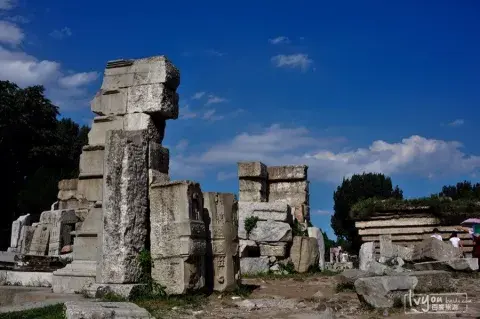
Yuanmingyuan (Garden of perfect splendor) is renowned throughout the world for its fabled charms and association with Chinese modern history. Extolled as the "Garden of Gardens" and the "Versailles of the East" during its heyday. It was an imperial summer resort painstakingly built and repeatedly expanded under the personal supervision of five emperors of the Qing Dynasty.

Located in the northern part of Haidian District in Beijing, Yuanmingyuan is composed of three comparatively independent but interconnected gardens: Yuanmingyuan, Changchunyuan (Garden of Eternal Spring), and Qichunyuan (Garden of Blossoming Spring). Covering an area of about 350 hectares, Yuanmingyuan was a vast landscaped garden at once grand in scale and enchanting in scenery. Its green hills and exquisite architecture were laid out with picturesque appeal, and decorated with thriving trees and beautiful flowers. As to close sights, the rolling hills and maze of streams and lakes divided the whole garden into more than 100 scenes, their captivating beauty enhanced by a host of pavilions, corridors, islands, and bridges. About 40 percent of the garden was covered by rivers and lakes, connected into an integral system by winding streams and dotted with more than 250 hills and rock formations. The water's constant murmur rendered life and soul to the hills and rocks. And together they transformed the entire complex into a landscaping and horticultural miracle which stood comparison with the beauty of the natural scenery south of the Yangtze River.