Guoliang Tunnel

Located in the Taihang Mountains of China, the small village of Guoliang is sitting on a mountaintop and was isolated from the rest of the world. The only way to reach it was to walk through a valley surrounded by steep cliffs, and then climb a series of cut out stone steps. Cut off from the rest...

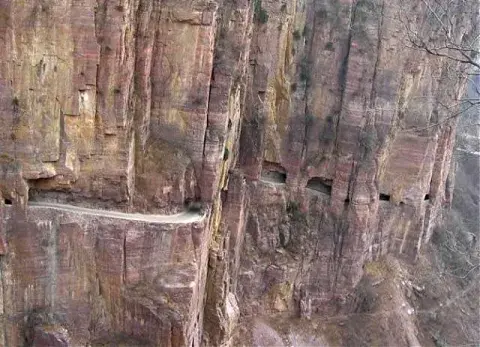
Located in the Taihang Mountains of China, the small village of Guoliang is sitting on a mountaintop and was isolated from the rest of the world. The only way to reach it was to walk through a valley surrounded by steep cliffs, and then climb a series of cut out stone steps. Cut off from the rest of the world, the village was doomed to become a ghost town, unless a road could be constructed trough the cliffs.

Guoliang tunnel

This all changed in 1972. When the Chinese government decided it wasn’t worth to invest several millions into a road that would only be used by 300 people, the villagers decided to dig the tunnel road themselves. It was their only hope to get connected to the rest of the world.

Construction of Guoliang tunnel

It took thirteen villagers five years to finish the 1,200-meter long tunnel road (0.8mile). The tunnel is about 5 meters high (15 ft) and 4 meters (12 ft) wide. It is wide enough for two vehicles to pass. Without any training, the construction of the tunnel was very dangerous. Farmers were working with explosives on the steep cliffs. Some of them died in fatal accidents, but the others kept on digging. Finally, on May 1, 1977, the tunnel was opened to traffic.

Guoliang tunnel

The tunnel itself has several windows looking out over the valley. These were carved to push the rubble out. The road surface and tunnel walls are very rough due to the primitive tools the workers were using. The rough, narrow and steep road is very dangerous in wet conditions. It can get very slippery, so use extreme caution if you explore this road whe it rains. You don't want to fall off those cliffs.

Guoliang tunnel

After all, the construction of the tunnel was a success. First of all, the village was now accessible by car, a huge leap forward. When China opened its borders for tourism around the year 2000, the tunnel became an attraction with thousands of visitors every year. The village even started to build hotels to accommodate all these guests.

Xiyagou and Kunshan tunnel

Not so far away from Guoliang, but located deeper into the Taihang mountains, there are two other villages who connected themselves to the world by means of a tunnel: Xiyagou and Kunshan.

In 1962, a county official visited the village of Xiyagou. The road he had to take to get there was so scary and dangerous that he donated 3,000 yuan to the villagers to construct another, safer road. Twenty years later, after a few unsuccessful attempts, they decided the road would spiral across the surface of a cliff with windows along the way to remove the crushed rocks, just like the villagers in the nearby Guoliang had done it. The tunnel section (about 3km, or 2 miles) was finally completed in 1991.

Xiyagou tunnel

Another tunnel road was also constructed in the nearby village of Kunshan. Very little is known about it, but just as the other tunnels it was constructed by farmers to create an easy access to their village. The pictures speak for themselves.


How to get there?

It’s rather difficult to find these tunnel roads. They are located in a very remote region deep into China. If you want to get there, you should start your trip in Xinxiang, a city in the Henan province (easy to find on google maps). Leave the city by driving north on Huanyu Avenue (the S229). After 13 miles you’ll enter the town of Huixian. Stay on the S229 for 15 miles more until you reach the junction with the S228. Turn left here and keep following the S229. After 8 miles you reach the village of Nanzhaizen. Turn left again and follow directions to Guoliang, 8 miles further.
Jingshan Hill Park

Jingshan Park is located in the center of Beijing's north-south axis on, South according to the Forbidden City, West rely on sea, north of Gulou distantly faces, was the highest point of the city center in Peking. Jingshan is yuan, Ming and Qing after the third generation of the palace court,...

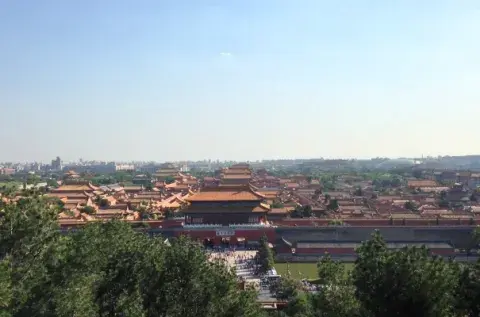
Jingshan Park is located in the center of Beijing's north-south axis on, South according to the Forbidden City, West rely on sea, north of Gulou distantly faces, was the highest point of the city center in Peking. Jingshan is yuan, Ming and Qing after the third generation of the palace court, had several name changes: Castle Peak, long live the hill, Zhen Shan, Jingshan, folk also has called for Meishan.1928 opened in, 1957 was set for the Beijing municipal key cultural relics protection units, 2001 is listed as national heritage conservation units, was designated as national 4A level scenic spots, 2005 was rated as Beijing "boutique Park".Towering old trees in Jingshan Park, mountain Duxiu, towering temples, peony varieties and different and rich cultural activities. Row mountain five kiosks, center Chunting million is located on the central axis of Beijing city the commanding heights, enjoy the day location, boarding, overlooking the panoramic view of the Forbidden City, Beijing axis list, a taste of neat symmetrical layout charm, read the magnificent palace building products. There was certain, the Qing emperor worship memorial is an important place, save the hall of imperial longevity, view de temple, loyal temple Huguo, Yee watchtower and other cultural relics exudes a strong flavor of progenitor on the root is to inherit and carry forward the Chinese filial piety culture of the holy land.

Baiquan mountain

The villa is located in Huairou District Labagoumen Manchu Township of Beijing City, here is the largest nature reserve in North Beijing forests, 111 national road runs through the territory to Fengning Bashang grassland tourism gold channel. 150 kilometers away from Beijing, convenient transport...

The villa is located in Huairou District Labagoumen Manchu Township of Beijing City, here is the largest nature reserve in North Beijing forests, 111 national road runs through the territory to Fengning Bashang grassland tourism gold channel. 150 kilometers away from Beijing, convenient transportation and communication developed. The simple folk, picturesque scenery, the temperature difference between day and night that is an ideal summer resort for leisure, "the back garden of Huairou" said Baiquan. Villa to Labagoumen forest and soup based on the natural environment, richly endowed by nature. Here far away from the noisy city, Yishanbangshui, wind Guang Yanli, filling the mountain natural scenery. Mountains, water, village bridges, water, people each other, a villa, perfect countryside. Villa covers an area of 110 acres, can accommodate more than 60 people dining accommodations, relying on the abundant soup River Water Villa formed many small lakes. The mountain village diet are produced in Villa Green food, Chaiji, wood duck, hare, cold water fish, grass carp, fish and shrimp in the river. Visitors can fishing, boating, horseback riding, hold the bonfire party, swimming in the river, enjoy leisure fashion. Villa, with four distinct seasons, spring flowers in full bloom, summer mountains DiCui, dahurian rhododendron leaf in autumn, winter snow wrapped, tourists in the dining to stay and enjoy the Beijing farm characteristics, feelings and affinity nature comfortable. Dear visitor, hope I Baiquan villa can give you good memories, to Baiquan leisure hills.
以上结果由

Gubei town

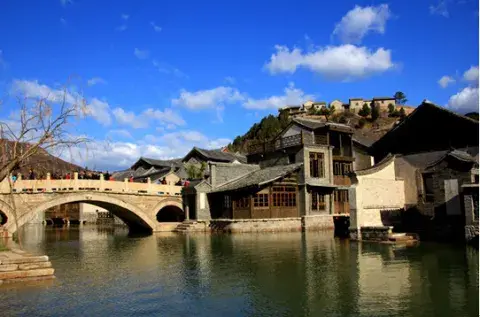
Miyun Gubei Town Village Simatai Gubeikou Gubei Town, as a newly developed tourism projects Gubei here, like Wuzhen, because it is new, the merchants here is not too much, some businesses in the rental, the ticket price is 150 yuan a day, the feeling is still relatively expensive, but there is st...

Miyun Gubei Town Village Simatai Gubeikou Gubei Town, as a newly developed tourism projects Gubei here, like Wuzhen, because it is new, the merchants here is not too much, some businesses in the rental, the ticket price is 150 yuan a day, the feeling is still relatively expensive, but there is still large, in the north to enjoy the Gubei style, the buildings here are basically imitating the ancient courtyard building, carved eaves, trees, courtyard, water, which I think is particularly suitable for photography enthusiasts, or wedding photo, what the film. See also can not feel the vicissitudes of history here. Baptism is the artificial landscape more, look at the scenery and architecture. Here is the wine cellar Museum, wax museum, escort, matchmaker temple, Toy Museum, shadow puppet Museum, the church does not need to be in another ticket, you can look. Shadow play has many sessions a day, look pretty good. For children ~ five to, where you can see the ship frozen in the river, the feeling is also very beautiful, also said the comic, lion dance, donkey, rowing team * * * ~ by the door, tickets place and God ~ very interesting. It is relatively large, at nine in the morning to play, to five in the afternoon, basically just look at it again, if you have fun, you can choose to live in the hotel, price is cheap and expensive, choose according to their own circumstances, if a ticket 80 yuan accommodation actually, no relief. Inside or snack street, can eat, the price can be, but the queue is a headache!

Hunan Provincial Museum

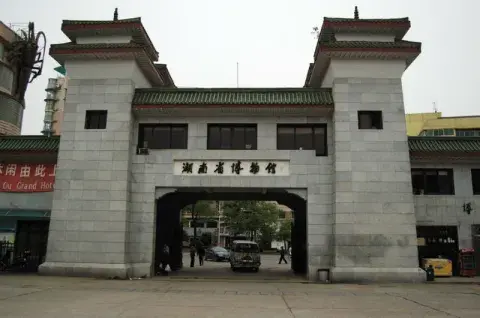
Hunan Provincial Museum is located on No. 50, Dongfeng Lu, Changsha City, next to the Revolutionary Martyr's Park. It covers an area of 50,000 square meters (about 12.2 acres) with a construction area of 20,000 square meters (about 4.9 acres). First built in 1951, the museum was open to the p...

Hunan Provincial Museum is located on No. 50, Dongfeng Lu, Changsha City, next to the Revolutionary Martyr's Park. It covers an area of 50,000 square meters (about 12.2 acres) with a construction area of 20,000 square meters (about 4.9 acres). First built in 1951, the museum was open to the public in July 1974. It has gathered together most curios unearthed in Hunan Province, unfolding the cultural development of Hunan Province throughout thousands of years.

This museum has a collection of more than 110,000 objects, over 763 of which are top grade cultural relics. Most of these objects were discovered by archaeological excavation. What's more, the museum has gathered together nearly all the fine works unearthed in different parts of Hunan Province. According to the various textures, the cultural relics in Hunan Provincial Museum can be classified into the following kinds: bronze, silk paintings and books, lacquers, textiles, ceramics, paintings and calligraphy. These cultural relics include stone implements and pottery from the Neolithic Age, bronze wares of the Shang Dynasty (16th - 11th century BC) and Zhou Dynasty (11th - 221 BC), and celadon wares from the Eastern Han Dynasty (25 - 220) to the Sui Dynasty (581 - 618) and the Tang Dynasty (618 - 907). Some masterpieces by famous scholars like Wang Xizhi, a famous calligrapher from the Tang Dynasty, and Wang Fuzhi, a great philosopher of the late Ming Dynasty (1368 - 1644) and the early Qing Dynasty (1644 - 1911) are also on display. Cultural relics unearthed in Mawangdui Han Tombs are the highlights in the museum.

The following cultural relics unearthed in Mawangdui Han Tombs are highly recommended because of the amazement they have brought to people. The first one is the tomb and corpse of Xin Zhui, circa 2,000 years ago, which is well preserved. Her skin is moist and her organs are still well protected, even after having been unearthed for more than 30 years. The second relic is a T-shaped colored silk painting. It is not only still intact but also has gorgeous color. The contents of this painting are various, giving you a full picture of lives in the Western Han Dynasty (206 BC - 24). The third one is a plain gauze garment. It is about 128 centimeters (about 4.2 feet) long but only weighs 48 grams (about 1.7 ounces). This garment is perhaps the most significant, because it proves the existence of very advanced textile technology in the Han Dynasty (206BC - 220) when China was called 'the country of silk'.

Admission Fee:  Free
The museum issues 5,000 free tickets to visitors from 08:45 to 16:00 on every opening day.
Opening Hours:  09:00 - 17:00 (Tuesday - Sunday);
Closed on Monday and Chinese New Year's Eve
08:45 - 16:00 (time to get tickets)
Bus Route:  Take bus 112, 113, 131, 136, 146, 150, 302, 303, 704, 901 and get off at Hunan Provincial Museum.