Langzhong Ancient City

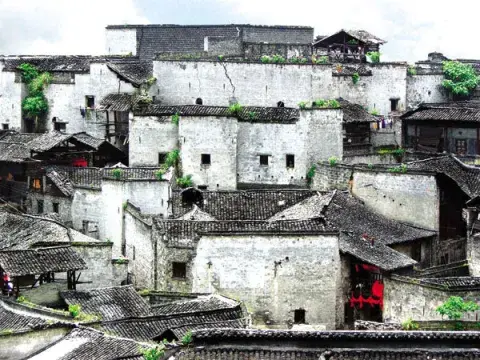
Langzhong Ancient City is situated on the bank of the Jialin River. to the east of the city lies Mt.Bashan and to the west is the ancient Jianmenguan Pass. Langzhong covers an area of nearly 2,000 quare kilometers, and has a population of about 900 thousand. 

Most of the buildin...

Langzhong Ancient City is situated on the bank of the Jialin River. to the east of the city lies Mt.Bashan and to the west is the ancient Jianmenguan Pass. Langzhong covers an area of nearly 2,000 quare kilometers, and has a population of about 900 thousand. 

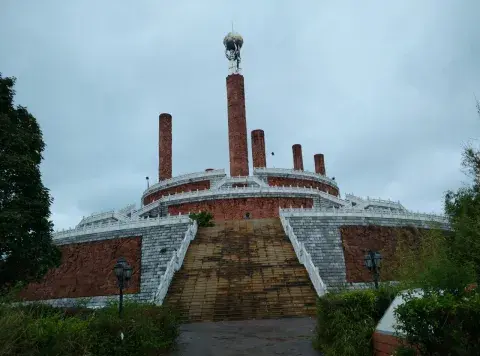
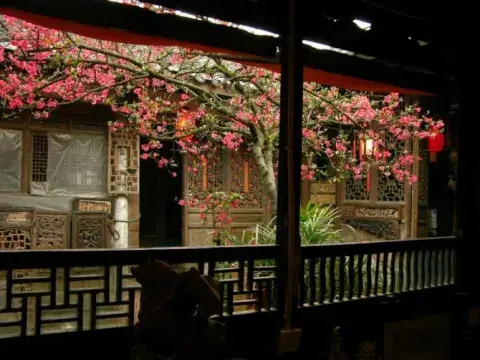
Most of the buildings in Langzhong Ancient City are contrusted in the style of the Ming and Qing dynasties. some of them retain the style of the construction in the last years of the Tang Dynasty. The city, with the grand Huaguang Tower as its center, stretches out like a fan. streets are no wider than 8 meters while alleys are only 2 or 3 meters wide. All the folk houses, simple and elegant, are bungalows with green tiles. The fame of ancient city is compatible to that of the Lijiang Ancient City in Yunnan Province. 

Langzhong is" the ancient city of geomantic omen "

constructed in strict accordance with the astronomical theory and geomantic omens of the Tang Dynasty. Langzhong Ancient City is proclaimed as one of the four well-known ancient cities in China. The other three are Lijiang Ancient City in Yunnan Province, Pingyao Ancient City in Shanxi Province and Shexian County in Anhui Province.

the Architectural Features of Langzhong Ancient City 

the preserved area of the ancient city is 1.7 square kilometers where lie 91 crisscrossing ancient streets.The city site of the Han Dynasty and the ancient city wall of the Song Dynasty are still visible. You can find the bricks of the Qin Dynasty and tiles of the Han Dynasty, steles of past dynasties and paper-cuts and carving decorations of  windows everywhere. The folk houses and courtyards are scattered along the ancient alleys and streets.

the Legend of Langzhong City

in 221 A.D. Zhangfei was in a hurry to take revenge for his brother GuanYu who was killed by the army of Wu Kingdom. He forced his soldiers to make weapons and and night and infuriated his two officers, Fanqiang and Zhangda. The two cut off Zhangfei's head and took it to offer it to Sun Quan( the king of Wu Kingdom) for an exchange of their promotion. they went eastward along the Yangtze River in a boat. on their way, they heard that the king of Wu kingdom, had made a ceasefire agreement with the king Liu Bei of Shu Kingdom. The two were very horrified and threw Zhang's head into the Yangtze River. The head floated to Yunyang and was picked up by a fisherman, who burried it at the foot of Mt.Fenghuang( Phoenix Mountain) in Yunyang. But his body was burried in Langzhong. That is the tragic story about " the head buried in Yunyang while the body buried in Langzhong" 

snacks in Langzhong 

Langzhong is polular for its long-standing food culture which consists of that of Hui,Han and Man peoples. There are many types of snacks cooked by the super cooking techniques . In the early Qing Dynasty, Islam was introduced in Langzhong and thus brought about the Hui food culture. The different food cultures creat numerous types of snacks with various flavors . famous ones like Cold Beef Noodles, Spindle Pancake, Hot-pot Beef Braised in Soy Sauce. Pot-stewed Smoked Pork, Northern Sichuan Bean Jelly and Warm Bean Jelly, etc. 

Folk Arts

Langzhong was the capital city of Bazi Country. The Ba People lived with the Han People for centuries .Bayu Dance is a group dance of martial art created by the ancient Ba People while they fought with beasts and other tribes. The time-honoured Northern Sichuan Lamp Drama, also called " Gu Yue Sheng" is very popular among the common people in north Sichuan. Its contents are mostly taken from the legends and the life of the working people. 


Jiu Xiang Cave Scenic Area

Jiuxiang Scenic Area

Jiuxiang Scenic Area is located in Yiliang County, which is under the jurisdiction of KM. It is a 4A national tourist attraction. Here is the inhabiting place of Yi people for generations.

Jiuxiang is about 40 km from Jiuxiang county while 90 ...

Jiuxiang Scenic Area

Jiuxiang Scenic Area is located in Yiliang County, which is under the jurisdiction of KM. It is a 4A national tourist attraction. Here is the inhabiting place of Yi people for generations.

Jiuxiang is about 40 km from Jiuxiang county while 90 km from Km city. It is called "hometown of caves" because it has the largest network of caves in YN. For this reason ,it is labled by speleologists as "Museum of Caves". The network of caves here is quite similar to that of the world natural heritage--Skocjan Cave in Dinaric, a karst plateau in Yugoslovia.


Yiliang Roast Duck


Speaking of Yiliang, the first thing come to most YN people is Yiliang Roast Duck. Not as famous as the Peking roast duck, Yiliang roast duck is equally palatable. It was developed by Zhang Wen, a resident of Yiliang COunty in the Qing dynasty. After learning the technique of making Beijing Roast Duck. The method of Yiliang duck roasting is as follows:
kill a duck and scald it to remove its feathers; open a cut under its left wing, from this cut, remove the gut and blow in air so that the duck itself bulges after that, stuff it with flavoring, daub it with honey and air it; then put it on iron hook and hang it inside a hearth, toasting it slowly with dry pine; turn over the duck at the right time, take it out and then daub it with lard, honey and duck fat; finally chop the duck and put it on a dish with onion , sweet sauce, pepper and salt. The whole toasting process takes about half an hour. The roast duck has a skin which  is crisp but not burnt, a texture which is tender and savory, and a taste which is delicious.


Tour Route:
the Green Shady Valley--the White Elephant Cave--the Goddess Cava--the Lying Dragon Cave--the Bat Cave


How does a limestone cave come into being?

To understand that, we need to know how the karst landform come into being. Limestone's major component is Calcium Carbon dioxicate, which is insoluble as we all know back in junior school. However, they are not invulnerable. When water dissolved in it flow through limestone area, they will erode the stone. As you know, the major component of limestone is calcium carbonate, which is insoluble. However, when it meets water and carbon dioxide, they turns into calcium bicarbonate which is soluble in water. When the water containing the dissolved calcium bicarbonate fell into a cave with lower pressure and temperature, the carbon dioxide separated out, leaving the insoluble calcium carbonate forming in the cave. That's why we can see the limestones taking on different shapes, as stone forests, stone peaks, stalagmites, stalactites, stalagnate, and underground rivers.

In some sense, we can even say that the limestone cave is the underground version of the stone forest.

The name of the county Jiuxiang is written as Nine townships in Chinese characters. How did it get such name?

* Some say it's because the place used to be divided into nine administrative regions, hence it was called Nine townships.
* Another saying is that Jiuxiang can also be written as aroma of wine. Because the inhabitant on this land the Yi people love wine more than anything. As a saying among them goes: a banquet is not a banquet without wine.
* The last kind of saying is there are 99 limestone caves.


Covering an area of 2,778 square kilometers, Jiuxiang Scenic Area consists of five major sections: Diehong (Laminated Rainbow) Bridge, Sanjiao(Three fee) Cave, Shangda(Upper Big) Cave, Dasha(Huge Sand) Dam and the Moon Lake. So far, only DIehong Bridge area has been developed and opened for visitors.

Diehong Bridge Scenic Spot is located along Maitian Wheatland River valley. It includes five major sites: the Green Shady Valley, the White Elephant Cave, the Goddess Cave, the Lying Dragon Cave and the Bat Cave.
Yunnan Military Academy

--What is Military Academy?

Military Academy refers to the kind of schools which specialize in teaching military-related courses.


--Why was the Military Academy established in Yunnan but not in other areas?

In the early 19 ...

--What is Military Academy?

Military Academy refers to the kind of schools which specialize in teaching military-related courses.


--Why was the Military Academy established in Yunnan but not in other areas?

In the early 19 th century,  Yunnan's two close neighbors, Burma and Vietnam were respectively colonized by French imperialism and British imperialism. As the back door of China, Yunnan was under tremendous threat. Besides the dangerous international environment, Chinese Revolutionary Alliance organized by Sun Yan-sen was engaged in intense Anti-Qing revolution. Under such circumstance, Yunnan governor was permitted to set up the Military Academy.


--What is special about this military academy?

This military academy is among the first batch of military schools in China. Also, it was the very first one which set up branch schools in other provinces, such as Sichuan and Guangzhou. Among the 9000 students graduated from here, there were students from Korea, Vietnam and other countries. Before the establishment of Huangpu Military School, Yunnan Military School was sure the most influential school at that time.

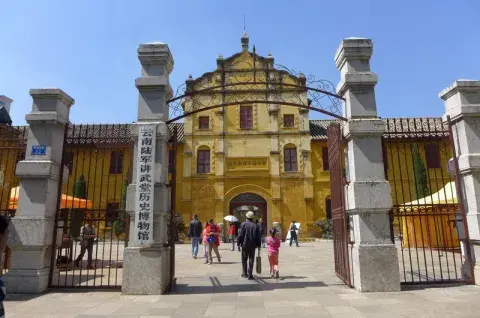
In 1988, it was listed as relic unit under the national protection. It is not only the biggest quadrangle dwelling architecture in China, but also the perfect blending of Chinese and Western styles, even with a bit Yunnan local style.

Another thing worth mentioning is the large number of talents nurtured here. Such as Zhu De, Ye Jianying who were among the top ten marshals on China, Long Yun, Luhan and Zhu Peide who were outstanding officials in Nationalist Party, as well as eminent military instructors like Li Genyuan, Tang Jiyao, Li Liejun and so forth. In the whole period of China Modern History, Yunnan Military Academy made tremendous contribution to a series of wars, such as 1911 revolution, national protection movement, the North Expedition, Anti-Japanese War and Liberation War.