Tianjin Huangyaguan Great Wall

One of the most striking things about China is the legendary great wall. However, there is a smaller wall called the Huangyaguan which is equally breathtaking and one of your must-visit places when you set foot in this amazing country. The Huangyaguan great wall is around thirty kilometers North ...

One of the most striking things about China is the legendary great wall. However, there is a smaller wall called the Huangyaguan which is equally breathtaking and one of your must-visit places when you set foot in this amazing country. The Huangyaguan great wall is around thirty kilometers North of Ji County, Tianjin. It is about a hundred twenty kilometers from the capital of Beijing.

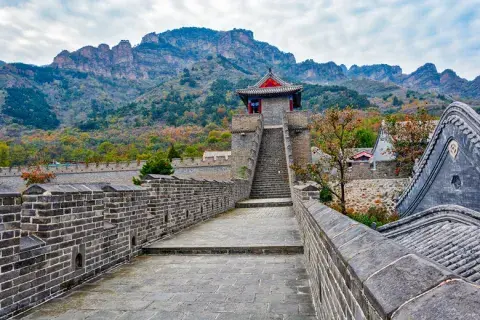
This wall was built back in 557 AD and it was repaired severally over the years. The first repair was done during the Ming dynasty. These repairs were conducted by Qi Jiguang who was appointed as one of the garrisons of the Ming dynasty. The repairs were part of a bid to reinforce the security of the area and the wall served as a place where military facilities could be aligned to. The wall has several watch towers along its entire length with the most notable ones being the Phoenix tower and the Baguagan Labyrinth which is the most unique tower. These are some of the things that make this tower the miniature version of the actual Great Wall of China.

The walls and towers of the Huangyaguan are built on a mountain ridge that is about 740 meters in altitude, something that makes it very vast and overwhelming. There is a cliff to the east of the wall and some crags to the left. It slithers across the mountains like a snake while offering the entrance to Jinxian to the North side. Due to the uneven terrain alternating between mountains and ridges, the wall contains some sloppy steps in some sections with some of them even looking like they are going straight up and down. If you have a phobia for heights, avoid looking down as you will start getting butterflies in your tummy.

Dalian Binhai road

Binhai Road is beside the south seashore of Dalian city, which is one of the best roads for tour. Binhai Road was built in 1970s for combat readiness, which was guarded by army. Deng Xiaoping suggested to open it to tourists when he visited Dalian at the beginning of 1980s, from then on, it becam...

Binhai Road is beside the south seashore of Dalian city, which is one of the best roads for tour. Binhai Road was built in 1970s for combat readiness, which was guarded by army. Deng Xiaoping suggested to open it to tourists when he visited Dalian at the beginning of 1980s, from then on, it became a tour road.

Binhai Road is 32 kilometers long, running through 12 main sceneries along the coastline. Whenever spring blossoms come, if you drive on this road, you could see rolling ranges with mixed coniferous broad leaved forest and piedmont with red azalea on one side, and a wide expanse of misty waters on the other side, with reefs and islands in great variety of shapes and forms in it, all of these make the scenery extremely beautiful. 

The southern section of Binhai Road start from Tiger Beach Ocean Park , end at Fu’s  houses estate, which is the most famous part of this road with maximum tourists , with several excellent scenery along the way, just like “Great North Bridge”, “Birds nest mountain rang”,  “Charming Moon peak”, and so on.

The Western section of Binhai Road is from Fu’s houses estate to Xinghai Square, with Fu’s estate park, silver sand-beach, white-cloud Mountain, great south pavilion, Xinghai Square along the way. This is the shortest part of BinhaiRoad. Besides, there are a lot of hotels, sanatoriums, holiday resorts and villas around the area from Fu’s houses estate to silver sand-beach. 

The northern section of Binhai Road is from Aura-Sea Square to the front gate of Mallet Island, which is the steepest part of this road, so that this part has a late start of exploitation. It also has lots of good sceneries along the way, like “Aura-Sea Square”, “Eighteen Bends odd slop”, “Rooftop sun rise” and so on, this part of BinhaiRoad is called “Northern Ocean Park”.

And the Eastern section of Binhai Road is from Mallet Island scenic area to Tiger Beach Ocean Park, along the way, you could see Mallet Island scenic area, stone cistern scenic area and Tiger Beach Ocean Park.
Red Beach in Panjin, China

Sand is probably the first thing that comes to mind when thinking about beach. However, this is not the case with the Panjin Red Beach in China, which is, actually, red, and not covered in sand at all. Such phenomena is caused by a type of sea weed Sueda. It starts growing during Ap...

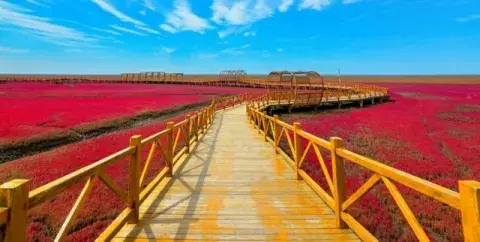
Sand is probably the first thing that comes to mind when thinking about beach. However, this is not the case with the Panjin Red Beach in China, which is, actually, red, and not covered in sand at all. Such phenomena is caused by a type of sea weed Sueda. It starts growing during April and May, then stays green during the summer, but starts turning vividly red in autumn.

The Red Beach is located in the biggest wetland and reed marsh in the world, and actually hosts the most completed ecosystem that can be found: the area has become home to more than 260 kinds of birds and 399 kinds of wild animals. You can find the endangered Crown Cranes and Black Beaked Gulls there, which is why the area is even called “home of the cranes”.

In order to keep the whole ecosystem safe, the area was granted state-level protection back in 1988. Even though most of the Red Beach is closed to the public, there still is a  small section that’s open for tourists. We can assure you that the photos below are not an example of infrared photography, it’s just one of those places that are hard to believe really exist!

Shanghai Disneyland Amusement Park

Shanghai Disneyland Park (Chinese: 上海迪士尼乐园) is a theme park located in Pudong, Shanghai, China, that is part of the Shanghai Disney Resort. The park is operated by Disney Parks, Experiences and Products and Shanghai Shendi Group, through a joint v...

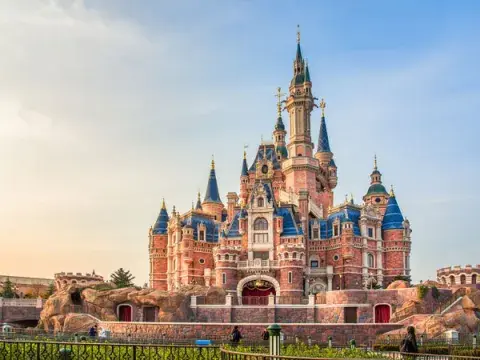
Shanghai Disneyland Park (Chinese: 上海迪士尼乐园) is a theme park located in Pudong, Shanghai, China, that is part of the Shanghai Disney Resort. The park is operated by Disney Parks, Experiences and Products and Shanghai Shendi Group, through a joint venture between The Walt Disney Company and Shendi.[1] Construction began on April 8, 2011.[3][4] The park opened on June 16, 2016.[2] The park operated in its first half-year with a visitor attendance of 5.60 million guests.[5]

The park covers an area of 3.9 square kilometres (1.5 sq mi), costing 24.5 billion RMB, and including an area of 1.16 square kilometres (0.45 sq mi). In addition, the Shanghai Disneyland Resort has a total of 7 square kilometres (2.7 sq mi), except for the first phase of the project which is 3.9 square kilometres (1.5 sq mi), there are two more areas for expansion in the future.[citation needed]

Walt Disney Company and Shanghai ShenDi Group jointly invest in the Shanghai Disneyland Resort project. As part of the agreement, two owners will be set up, including Shendi holding 57% and Disney holding the remaining 43%.

The park has seven themed areas: Mickey Avenue, Gardens of Imagination, Fantasyland, Treasure Cove, Adventure Isle, Tomorrowland, and Toy Story Land.

On January 22, 2019, Disney Parks announced an eighth themed land based on Disney’s Zootopia would be coming to the park. Construction is set to begin sometime in 2019.

Dr. Sun Yat-sen's Mausoleum

Covering an area of 80,000 square meters (about 20 acres), Dr. Sun Yat-sen's Mausoleum is located in Purple Mountain in the east suburb of Nanjing City, Jiangsu Province. As the mausoleum of Dr. Sun Yat-sen, the father of the Republic of China, it is considered the Holy land of Chinese ...

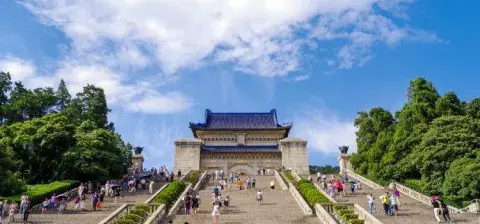
Covering an area of 80,000 square meters (about 20 acres), Dr. Sun Yat-sen's Mausoleum is located in Purple Mountain in the east suburb of Nanjing City, Jiangsu Province. As the mausoleum of Dr. Sun Yat-sen, the father of the Republic of China, it is considered the Holy land of Chinese people both home and abroad. With deep historical significance, magnificent architecture and beautiful scenery, it is a must see when visiting Nanjing.

Dr. Sun Yat-sen (1866-1925) was a great forerunner of the Chinese democratic revolution and led by Dr. Sun the Chinese people brought down the corrupt rule of the Qing Dynasty (1644-1911) and ended 2,000 years of the feudal monarchy system, which led the people into a new age.

The majestic construction inside the Dr. Sun Yat-sen's Mausoleum was started in 1926 and completed in 1929. The whole scenic area represents an alarm bell as seen from the air, symbolizing the noble spirit and heroic efforts of Dr. Sun Yat-sen's devotion to the Chinese people, fight of oppression and wining the independence of the country. Facing south, the structures, along with the mountain ascends gradually along with the central axis line running from south to the north and is regarded as the most outstanding mausoleum in the country's modern architectural history.

Wulong Karst National Geology Park

Wulong Karst National Geology Park, an important part of South China Karst, is situated at the lower reaches of the Wujiang River in southeast Chongqing. It was named as a world natural heritage by UNESCO in 2007. Wulong Karst features spectacular karst landscapes, including the three main p...

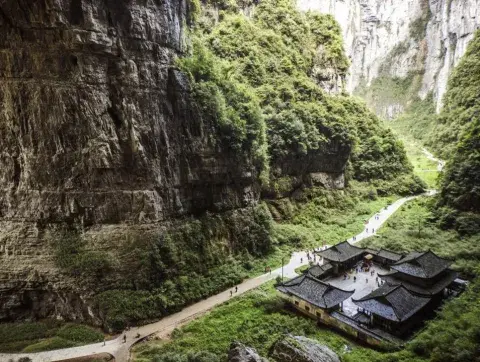
Wulong Karst National Geology Park, an important part of South China Karst, is situated at the lower reaches of the Wujiang River in southeast Chongqing. It was named as a world natural heritage by UNESCO in 2007. Wulong Karst features spectacular karst landscapes, including the three main parts of Furong Cave, Three Natural Bridges, Houping Giant Doline (Houping Tiankeng) and other scenic spots.

Wulong Karst is a valuable treasure that nature created. It is a cluster of several karst landscapes, consisting of gorges, natural bridges, caves, eroded dolines, shafts and underground streams. These karst landforms developed in the carbonate rocks, vividly recording the development and evolution of karst terrain in the Three Gorges area since Pleistocene Era. Furong Cave, Three Natural Bridges and Houping Giant Doline are the three representative karst landforms, developing under the condition of intermittent uplifting movement of the earth.

Each of the three karst systems standing alone forms a spectacular landscape. Furong Cave, literally Lotus Cave, abounds with various karren sediments forming many splendid natural wonders. The limestone sediments are also of great significance in scientific study. The three natural bridges constitute the largest natural bridge cluster in Asia, and the natural karst bridges are quite high and grand, a sight rarely seen anywhere in the world. Houping Giant Doline is the prime example and the largest tiankeng cluster formed by erosion in the world, and the longest underground cavern system in Asia.

Compared with Stone Forest Karst in Yunnan and Libo Karst in Guizhou, Wulong Karst National Geology Park is located in a relatively remote area away from the impact of human activities. Therefore, Wulong Karst retains the original features of karst landforms that have been despoiled elsewhere, hence its outstanding universal value.