Mawangdui Han tomb mummy

In 1971, a group of construction workers began digging on the slopes of a hill named Mawangdui, near the Chinese city of Changsha. Since the workers were about to construct a spacious air raid shelter for a nearby hospital, they were digging deep into the hill. Before 1971, the Mawangdui hill was...

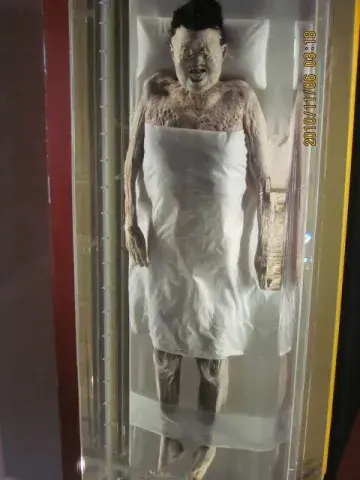
In 1971, a group of construction workers began digging on the slopes of a hill named Mawangdui, near the Chinese city of Changsha. Since the workers were about to construct a spacious air raid shelter for a nearby hospital, they were digging deep into the hill. Before 1971, the Mawangdui hill was never considered a place worth the attention of archaeologists.

However, this changed when the workers stumbled upon what appeared to be a tomb hidden beneath many layers of soil and stone. The construction of the air-raid shelter was canceled and, several months after the workers’ accidental discovery, a group of international archaeologists began excavating the site.

The tomb turned out to be so massive that the excavation process lasted for nearly a year, and the archaeologists needed help from as many as 1,500 volunteers, mostly local high-school students. Their painstaking work paid off because they discovered the majestic ancient tomb of Li Chang, the Marquis of Dai, who governed the province approximately 2,200 years ago, during the rule of the Han dynasty.

The tomb contained as many as 1,000 precious artifacts, including golden and silver figurines of musicians, mourners, and animals, intricately crafted household items, meticulously designed jewelry, and a whole collection of clothes made from fine ancient silk.

Alshan National Forest Park

Alshan National Forest Park is located at the southwest foot of Inner Mongolian side of Daxinganlin. It covers an area of 103000 square meters. Alshan National Forest Park is the ideal summer resort due to its cool weather, fresh air and dense forest. In addition, the mountain's various landscape...

Alshan National Forest Park is located at the southwest foot of Inner Mongolian side of Daxinganlin. It covers an area of 103000 square meters. Alshan National Forest Park is the ideal summer resort due to its cool weather, fresh air and dense forest. In addition, the mountain's various landscapes, well-maintained ecological environment has attracted numerous scientists during the past decade.

Alshan National Forest Park is a prime habitat for a number of plant and animal species.

Alshan Mountain abounds in geological relics and has rare deposit of mine resource. Since ancient times, the area has seen numberless volcano eruptions, which have given rise to odd-shaped rocks, sheer cliffs and narrow precipices.

With ideal nature environment alone isn't enough to be appealling to tourists. Alshan National Forest Park have a lot of tempting attractions to see, which include the highest peak  of the Daxinganlin mountain ranges, Te'ermei Peak,, stone forest and lakes on top of the mountains, resulted from frozen lava of the volcano eruptions, clear rivers and dense and primitive forestes.

Alshan National Forest Park is aboudant in hot springs. Hot springs in Alshan Mountain is drinkable and is with healing property. Dipping  in the hot springs in believed to be able to cure some certain chronic diseases.

Hulunbuir Grasslands

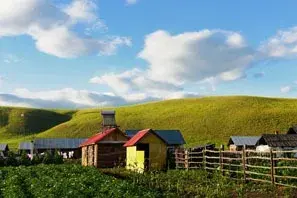
Located in the north-east of Inner Mongolia and named after Hulun Lake and Buir Lake, Hulunbuir Grassland is one of the three famous grasslands in the world with an elevation of between 650 and 700 meters, an area of about 100,000 square meters and natural grassland coverage of 80%.

The Pur...

Located in the north-east of Inner Mongolia and named after Hulun Lake and Buir Lake, Hulunbuir Grassland is one of the three famous grasslands in the world with an elevation of between 650 and 700 meters, an area of about 100,000 square meters and natural grassland coverage of 80%.

The Purest Grassland

A vast region with beautiful scenery, lush plants, over 3,000 crisscrossed rivers and 500 lakes dotted around, Hulun Buir Prairie is like a huge green picture scroll, which gives you boundless views. It is the most well preserved grassland at present in China and has more than 120 kinds of pasture such as stipa, alfalfa and wheat grass, hence being known as "The Grass Kingdom".

As the most plentiful and excellent pastures in China, it also holds the name "The Purest Prairie" since there is hardly any pollution there. Produce like meat, milk, leather, wool and other animal products are favored by people from both domestic and foreign countries. It’s the place where Genghis Khan was born and is also a famous tourist resort.

Under the nutriment of thousands of rivers, the prairie presents itself underneath the blue sky and white clouds, with green grass, warblers, and flocks and herds all around the prairie. You can ride on camels and horses, watch wrestling and horse racing, eat the ‘lamb feast’  which has a ‘grassland’ flavor, as well as enjoying a good bonfire in the evening; the unique lifestyle of nomads can be indulged.

There is a beautiful legend about how the name Hulun Buir came to be. Once upon a time, a brave Mongolian tribe had a couple whose girl, named Hulun, was good at singing and dancing and was endowed with both beauty and talent, while the boy, called Buir 贝尔, was extremely strong and was talented in riding and shooting. They fought against the demon for love and the safety of the prairie,and the girl turned into a lake and drowned the demon, while the boy jumped into the lake for the girl, thus came the two lakes of Hulun and Buir..

Mount Laoshan

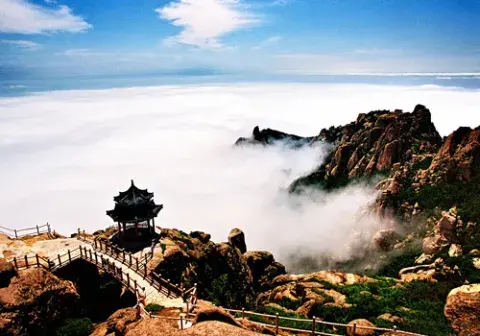
facing the Yellow Sea, Mt. Laoshan or Mount Lao is located to the east of Qingdao. This tall and majestic mountain is famous for its marvelous mountainous scenery and coastal landscape. It is regarded as the most recognized mountain of all mountains on the coast of China. It also holds ...

facing the Yellow Sea, Mt. Laoshan or Mount Lao is located to the east of Qingdao. This tall and majestic mountain is famous for its marvelous mountainous scenery and coastal landscape. It is regarded as the most recognized mountain of all mountains on the coast of China. It also holds significant importance in Taoism. Thus it is a must to see when traveling in Qingdao.

As the most famous mountain on the coast Mt. Laoshan caters well for tourists. Three lines lead the visitors to 220 scenic spots including historical and natural points of interest.

The Southern Line

On the first line there are not only marvelous landscapes but also sacred Taoist Palaces. Significant points of interest include the Taiqing Palace, Xufu Islet and Longtan Waterfall (Dragon Pond Waterfall). The Taoist culture and temples of Mt. Laoshan are very famous. At the peak of Taoism, it was said that there were nine palaces, eight Temples and seventy-two nunneries. The number of Taoist had reached above one thousand. While later many buildings were destroyed, amongst those still remaining the Taiqing Palace is the largest. The Taiqing Palace also has the longest history of these buildings spanning more than two thousand years. Covering an area of 30,000 square meters (about 7 acres), the Taiqing Palace has 155 rooms. It has been well preserved and holds the typical architectural style of the Song Dynasty (960-1279). This form of architecture is quite rare in religious architectures in China.
 

The Central Line

The second line mainly focuses on Beijiushui. The name Beijiushui derives its meaning from  Laoshan Mountain that has nine crooks, thus making the river turn nine times. The river starts from the north side of the Ju Peak (the highest peak of Mt. Laoshan) and flows into the valley. So many beautiful things are on this line that it is called 'the Jiushui Gallery'. At every corner, totally different sights can be found. The current here is rather swift while further on the river flows very slowly. The flowers, trees and odd rocks on both sides of the river emphasize the elegant beauty of the water. The most famous sight of Beijiushui is Chaoyin Waterfall. During the rainy season the waterfall is quite majestic. The water crashes against the rocks, producing a huge sound similar to waves crashing against the seashore.

The Eastern Line

The third line includes the Taiping Palace, the Lion Peak, Huayan Temple, Naluoyan Cavern and other sights. Naluoyan Buddha Cavern is one such scene. It is located in the Naluoyan Hill to the east of Mt. Laoshan. It is a natural granite cavern 7 meters (about 23 feet) wide and 15 meters (about 49 feet) high. More than 100 people can stand inside at one time. Its structure is quite unique. The smooth walls and flat ground are just as they were pared. On the wall of the cavern protrudes a thin stone, like a Buddha niche. At the top of the cavern is a round and smooth hole. It was said that the hole was made by the supernatural power of Naluoyan Buddha. Through this hole sunlight can enter thus lightening the whole cavern.