Shanghai Attractions
Shanghai Articles
Tips for Travling in Shanghai 2
Tips for Traveling in Shanghai 2
...
Tips for Traveling in Shanghai 2
1. Business Hours
Banks: 09:00 to 17:00, Monday to Saturday
Business Offices: 09:00 to 17:00, Monday to Friday
Post Offices: 08:00 to 18:00, Monday to Saturday
Department Stores and Shops: 10:00 to 22:00, daily, some close later
Museums: 09:00 to 18:00, Monday to Friday, some open on weekends
2. Cautions
Violent crime in China is particularly low, which is in part due to the severe penalties received for crimes of a serious nature. It is also largely a Buddhist country, with most people leading peaceful lives. It is extremely rare for a tourist to encounter any problems of a violent nature however petty crime can be somewhat more of a problem, with many pickpockets and bag-snatchers targeting tourist areas and public transport.
A bit of common sense will help to prevent you becoming a victim of crime. Always keep your valuables locked away in a hotel safe and try to avoid carrying more cash than is necessary. Never flash cash or expensive jewellery in public as this can be a magnet for potential thieves.
Road safety can be a concern in China as traffic laws are not as strictly followed and drivers can be erratic and dangerous. It is important to be especially vigilant when crossing the road or riding a bicycle as cars tend not to stop.
3. Currency
The Chinese currency is called the renminbi (RMB), and there are bills in denominations of 1, 2, 5, 10, 20, 50 and 100 yuan. Yuan are commonly referred to as kwai.
Make sure that you exchange any remaining yuan in China, because it cannot be exchanged outside of the country’s borders. Traveller’s cheques and foreign cash can be exchanged at banks and hotels throughout the city. Credit cards are accepted at various establishments such as hotels, restaurants and shops, although they may not be accepted at smaller independent businesses. ATMs are plentiful throughout Shanghai.
4. Customs
Before entering China, you will need to fill out a customs declaration form that will be given to you. If you are bringing in more than US$10,000 in cash, this will need to be declared. The import of live animals, fresh produce or pornographic material is strictly prohibited, as is anything which criticises the Chinese government. Chinese antiques over 150 years old cannot be exported as they are valuable to the country. Visitors may import 400 cigarettes, two litres of alcohol and a reasonable amount of perfume.
Electricity 220 V, 50Hz. Plug types can vary, but the two narrow-pin plugs are most common.
5. Etiquette
Many visitors arrive in China believing that they will have to adhere to extremely strict and complicated rules of etiquette. The truth is that while following many rules, you are not expected to get everything right all at once. Many of the customs are alien to Western traditions and therefore harder to remember. You'll soon understand that unlike in the West, certain questions are not thought of as rude such as asking someone you have only just met if they are married or how old they are.
It is wise to stay away from more in-depth conversations such as politics. The concept of ‘saving face’ is very important to Chinese people. You must avoid losing your temper in public and never criticise anyone in front of others.
You may find that you are invited out to eat. If you are, do not panic; Chinese etiquette surrounding the dining table is daunting, but you will not be expected to know everything. However, if it looks like you have made the effort to learn some, you will earn much respect.
A few simple customs include: bringing your bowl of rice close to your mouth and quickly scooping the rice into it with chopsticks. Never play with your chopsticks during a meal and always try to avoid pointing with them or standing them up in a rice bowl. If you are toasted, but do not wish to drink anything, simply bring the glass to your lips without actually drinking any.
6. Health
The occurrence of a number of epidemic diseases has been considerably decreased in recent years and as such, there are now very few health risks connected with visits to Shanghai. However, there are certain issues to be aware of. Some visitors will experience mild abdominal upsets, mainly caused by eating contaminated foods or drinking contaminated water. Always avoid uncooked food and unpasteurised milk and only drink bottled water, which you will find in shops across the city.
It is wise to make sure that all standard vaccinations are up-to-date such as tetanus, polio and hepatitis A. It may also be worth considering getting inoculated against hepatitis B and having a rabies vaccination.
If you fall ill, have an accident or require any healthcare while you are in Shanghai, you will find excellent medical facilities and English speaking doctors. Most hospitals will require a deposit or payment upfront and it is therefore vital that you have comprehensive medical insurance.
Huadong Hospital: +86 2162 483 180
Emergency services: 120
7. Language
Mandarin Chinese is the official language of China, but there are hundreds of dialects. English is not widely spoken, although you will find that many professionals have a grasp of English.
8. Passport/Visas
Everyone who visits China is required to have both a valid passport and visa. Visa applications should be made in advance, at least one month before the intended departure date. Passports must be valid for at least six months if you have a single or double entry visa, or nine months for a multiple entry visa. Your port of entry must be indicated in your passport.
9. Tourist Information
Shanghai Tourist Information Services can be found at Yu Garden, 159 Jiujiaochang Lu, Huangpu district, Shanghai. They can be contacted by calling: +86 215 355 5032.
Tips for Travling in Shanghai
Tips for Travling in Shanghai
...Tips for Travling in Shanghai
1. What to Pack
Light clothes like lined Jacket and woollen sweater are suitable for the weather in Spring (from March through to the end of May) and Autumn (from September to November). Extra-light clothing is for summer (from June to August). Heavy woollen overcoats are necessary to keeping out the cold outdoors in winter (from December to February). Since there is much rain during the periods between Spring and Summer and between Summer and Autumn, it is advisable to get rain gear ready.
2. Greeting someone in Shanghai
It is a good idea to take a large quantity of business cards with you, and if possible it would be wise to have the inscription translated into Chinese and printed on the reverse side of the card. When you are introduced to a local take out your card, bow slightly and present it with both hands. They will probably reciprocate in a similar manner most likely holding their card English version uppermost. It is at this point considered good manners to pass a polite comment on the appearance of the other's card, whilst tucking it carefully within the confines of your wallet. Don't get flustered if when meeting a group of people they start clapping when you arrive. This is simply a form of greeting and you may respond by clapping also.
3. Tipping advice
Tipping used to be very rare in China but now no doubt through western influence the idea is catching on. In restaurants a 3% tip is standard, bellboys and room service staff expect roughly $1or $2. You can tip in U.S dollars as hard currency is always appreciated.
4. When to Go
The best times to visit Shanghai are spring and autumn. In winter, temperatures can drop well below freezing, with a blanket of drizzle. Summers are hot and humid with temperatures as high as 40degree (104F). In short, you'll need silk long johns and down jackets for winter, an ice block for each armpit for summer and an umbrella wouldn't go astray in any season.
5. Be prepared for huge crowds at the airport, tourist sites, shopping areas, restaurants, and hotels during the Chinese New Year (usually in January or February) and the week-long holidays of International Labor Day (May 1) and National Day (Oct 1).
6. Events
The Shanghai Music Festival is in May and the Shanghai International Tea Culture Festival is usually at the end of April. The Shanghai Marathon Cup is in March and is one of the top sporting events in China. The Shanghai Beer Festival staggers into town around the end of July, while the Shanghai Tourism Festival kicks off in late September. It's worth bearing these dates in mind as hotel accommodation can become scarce - during the Chinese New Year, usually in February, Shanghai is packed.
Shanghai Useful Phone Numbers
Useful Information Shanghai Useful Phone Numbers
Useful numbers:
Shanghai Area Code: 021
...Useful Information Shanghai Useful Phone Numbers
Useful numbers:
Shanghai Area Code: 021
Fire Emergency Telephone No.: 119
Police Telephone No.: 110
Currency Exchange
Currency exchange service is available at most hotels, all banks. Credit card is widely acceptable as means of payment in hotels, department stores and boutiques. The credit cards commonly acceptable in China are Visa, MasterCard, and American Express Card.
Main Banks in Shanghai
Shanghai Branch of Citibank; Floor 20, China Shipping Building, No. 1, Pudong Main Street, 58791200
Shanghai Branch of Overseas Chinese Bank; Floor 23, No. 710, Oriental Road, 58200200
Yangpu Subbranch of Shanghai Branch of Huaxia Bank, No. 1207, Kongjiang Road, 65709961
The Head Quarter of Bank of Communications, No. 18 Xianxia Road, 62751234
Shanghai Pudong Developing Bank (The Headquarter), No. 50 Ningbo Road, 63291188
Shanghai Bank, No. 476 Xianxia Road, 62955327
Post Offices in Shanghai
Lujiazui Post Suboffice: No. 365, Shangcheng Road
Post Service Center in New Century Square: No. 501, Zhangzhang Road
Oriental Pearl Tower Post Office: No. 2, Fenghe Road (259meters away from the Oriental Pearl Tower)
Post Service Center in the Sight-seeing Hall of Jin Mao Tower: Floor 88 of The Sight-seeing Hall of Jin Mao Tower
Top Shanghai Tours

$238 Per Day
Private Hangzhou Day Trip from Shanghai by Bullet Train
Take in the highlights of beautiful Hangzhou on a private full-day tour from Shanghai. After hotel pickup and transfer by high-speed train to Hangzhou, your private guide takes you to see some city attractions, such as Faxi temple. Moreover, enjoy a tasty lunch at a local restaurant before heading to Longjing village. There, learn about the process of farming and producing dragonwell tea, the region’s most famous product. Finally, enjoy a scenic boat cruise on UNESCO World Heritage-listed West Lake before returning to Shanghai.
...Read more
Take in the highlights of beautiful Hangzhou on a private full-day tour from Shanghai. After hotel pickup and transfer by high-speed train to Hangzhou, your private guide takes you to see some city attractions, such as Faxi temple. Moreover, enjoy a tasty lunch at a local restaurant before heading to Longjing village. There, learn about the process of farming and producing dragonwell tea, the region’s most famous product. Finally, enjoy a scenic boat cruise on UNESCO World Heritage-listed West Lake before returning to Shanghai.
This is a private, full-day trip from Shanghai to Hangzhou. After you are picked up in your hotel lobby in the early morning, you will take a bullet train to Hangzhou. This is the fastest way to Hangzhou and you can experience train speeds of up to 300 kilometers per hour. Your tour begins at one of Hangzhou's signature sites, the West Lake. Enjoy a lake cruise to see the top ten West Lake scenic views. You will then be taken to experience the wonderful cuisine of Hangzhou at a local restaurant. After lunch, you will visit Faxi temple, a well-known Temple dating back to the Jin Dynasty. See its famous wooden Buddha. Here, you will see fewer tourists and more locals. Finally, enjoy a cup of green tea when you visit the famous Longjing village to see wild fields of Longjing tea bushes where the locals produce the world famous green tea- Longjing Tea. In the village, all locals are tea farmers and you will see the entire procedure of making the famous tea and will get the chance to taste the best quality emperor tea. Afterwards, you will take the bullet train back to Shanghai and you will be returned to your hotel.
$70 Per Day
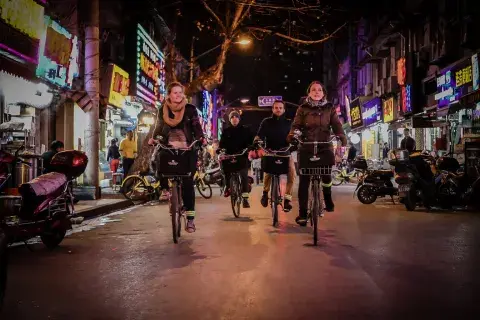
Bike Tour - "Shanghai by Night"
What would be a better way to experience the “City That Never Sleeps” than hopping on one of our vintage Forever bicycles and explore a whole New World after dark?...Read more
What would be a better way to experience the “City That Never Sleeps” than hopping on one of our vintage Forever bicycles and explore a whole New World after dark? Follow our foreign expert Tour Leader on a multi-themed route from the narrow streets of the Old Town all the way to the dazzling lights of the Bund. Meanwhile, cycle around the famous landmark Yu Garden, learn about Ghost Wedding rituals, visit a Traditional Chinese Medicine outlet and get to learn more about the "Paris of the East". Finally, tickle your taste buds with some delicious street food in order to immerse yourself deeper into local life. In just one evening, we'll explore the many faces of Shanghai that make this city so unique. Easy and accessible ride for all!
USEFUL INFORMATION
- English-speaking (for other languages, please contact us)
- About 9 km ride, easy ride for all.
- From 18:15pm to 21:30pm
- Up to 6 participants
- Departure and arrival at our Culture Shock Office in Xintiandi district.
- Minimum height is 1.50m. Tandem bikes are available for kids below 12
- Prices are all inclusive (Snack food, a bottle of water, a foreign experienced guide, a helmet and single-gear vintage bike rental with all lights)
- Join-in Group every Tuesday/Friday/Saturday (USD 70 per person)
- Private Tour possible every day (USD 210 in total for 2 participants)