Chengdu Attractions
Chengdu Articles
Which one should I go, of the 5 Panda Sanctuaries in Sichuan Province?
There are 5 Panda Sanctuaries in Sichuan Province as below,
1. Chengdu Research Base of Giant Panda Breeding Base(Chengdu Panda Base), 16km away from the city center, established in 1987,is the best place to see pandas of all ages,well designed facilities to watch over 50pandas there.
...There are 5 Panda Sanctuaries in Sichuan Province as below,
1. Chengdu Research Base of Giant Panda Breeding Base(Chengdu Panda Base), 16km away from the city center, established in 1987,is the best place to see pandas of all ages,well designed facilities to watch over 50pandas there.
2. China Giant Panda Conservation and Research Center Wolong Base, 133km away from Chengdu,the capital city of Sichuan, it is the first panda sanctuary in China,unfornately it was badly damaged by 8 magnitude earthquake in 2008.
most of the pandas there have been moved to #3 and #4, the road to Wolong is quite dangerous,lot of landslide,so not recommended to go there.
3. China Giant Panda Conservation and Research Center Bifengxia Base,140km away from Chengdu. After the 2008 earthquake,most of the pandas from Wolong had been move to Bifengxia,and stayed there until 2014, when the #4 was built. Most of the Pandas in Bifengxia has been moved to #4.
4. China Giant Panda Conservation and Research Center Dujiangyan Base, 70km away from Chengdu, was built on 2013, so far it's home for about 40 Pandas. Taishan, born in National Zoo (Washington D.C) is currently living here.
And it's the only place in the world where visitors can hold a baby panda,after all the other Panda Sanctuaries stopped this
program from November 2014. The nature setting here is quite pretty, 2km away from another popular tourist attraction QIngcheng mountain. This panda facility focuses on Panda disease preventing and controlling as well as wild pandas rescue.
5. Chengdu Rsearch Base of Giant Panda Breeding Dujiangyan Base, 70km away from Chengdu, open to tourists from 2014, it's home for 16 pandas. This facility focuses on Panda training and releasing into the wild.
Some secnic spots in Chengdu city !
A brief introduction about Jingli : A look at the street
...A brief introduction about Jingli : A look at the street
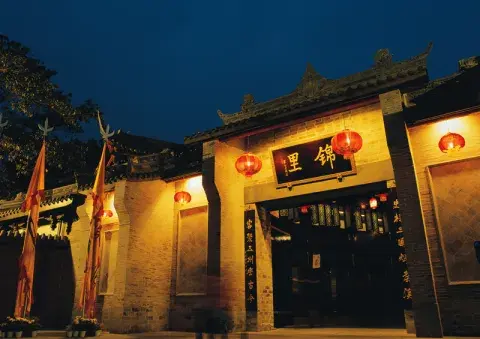
The 350-metre-long Jinli Street enjoys a reputation as a historic town. At one end of the street is an imposing archway with "Jinli Street" carved on it.
Extending from a gatehouse decorated with two red lanterns, the slab stone-paved street stretches with ancient-style buildings lined on both sides. The grey bricks and crimson columns of these two and three-storey teahouses and antique shops are of classic beauty and primitive simplicity. Porcelain and folk handicrafts displayed in the shops are so dazzling; you can't tear yourself away from them.
Wenshu temple :
Initially built in the Tang Dynasty (618-907), Wenshu Monastery was once called Xinxiang Temple. In 1681, during the reign of Emperor Kangxi of the Qing Dynasty (1644-1911), Cidu, an accomplished Buddhist monk, came to the monastery. He built a simple hut between two trees and for several years lived an ascetic life there. Legend has it when Cidu was being cremated; the statue of Wensu (Bodhisattva Manjusri in Sanskrit) appeared in the flames, staying for a long time. So people regarded Cidu as the reincarnation of the Bodhisattva Manjusri. Thereafter, Xinxiang Temple became Wenshu Monastery.
Cultural relics are the highlights of Wenshu Monastery. Since the Tang and Song dynasties, over 500 pieces of painting and calligraphy by celebrities have been stored here. In the Sutra-Preservation Pavilion, many famous handwriting exhibits, paintings, and artwork are restored. These precious works of art were created by renowned Chinese painters and calligraphers, including Zhang Daqian, Zheng Banqiao, and Feng Zikai. Of all the precious relics, a piece of the broken skull of Xuan Zhang, a renowned monk of the Tang Dynasty, is the rarest. Another treasure is a delicate jade Buddha statue brought from Burma to China in 1922 by Xing Lin, a Buddhist monk who walked the whole distance. In addition, the monastery houses some 300 Buddha statues of various materials including iron, bronze, stone, wood, and jade, some gloriously painted.
In addition to its cultural relics, Wenshu Monastery is famous for its exquisite garden and solemn halls. Tourists and locals can enjoy tea in the Tea House while listening to music by folk artists.
Panda base:
Base of Giant Panda Museum was established in 1993, Giant Panda Museum, which is the only rare and endangered wild animals for the establishment of thematic museums. Has built a giant panda museum, a butterfly museum and the Museum of Vertebrate three independent but related exhibition hall, with a total area of nearly 4000 square meters. Inside the museum, on display all kinds of valuable information in Figure 800 pieces of photos, showing the main types of samples collected from Sichuan, more than 2140 kinds of physical, more than 12450 pieces; another collection of 10000 specimens, collection of thousands of types of literature books formed a human understanding of the giant panda research and protection of the theme of rescue and breeding breeding, exhibition, promotion and protection of natural biodiversity comprehensive museum.
KuanZha Alley :
Width alley is one of Chengdu has a long history of business cards, where you can touch history here left traces, but also to appreciate the Chengdu Let's original flavor of the mayonnaise leisure lifestyle, into the alley width, into the The most Chengdu, the world's oldest and most fashionable old Chengdu. Chengdu can be retained under the alley width, it is very rare, historical and cultural section, alley width from wide alley, and alleys of the three-shaft parallel with the old-fashioned street and the courtyard between the group charged component. Planning control area of 479 hectares, of which the core 108 acres of protected areas. The region is the three major historical and cultural city one of the protected areas, in the 1980s included "the protection of historical and cultural city of Chengdu planning." It is an old Chengdu "Millennium small city," 100 years of urban pattern and the pattern of the last really building remains, but also the north alley cultural and architectural style in the South, "Guben." Xuantong Period wide alley in the Qing Dynasty, the name is Xingren alley. It is said that here is embedded in the red flag of the Qing Jun, a wide alley in the Mongolian understand the Manchu people, the alley is the Mongolian, who, on the alley of origin, a statement refers to the Mongols in the grasslands on the Zhaqi Yurts between the channel. And to the Republic of years, against imperialism and feudalism in China a revolutionary atmosphere, called the Qing Dynasty, "Xingren alley" renamed as "wide alley." Now the wide alley is a replay of the elderly living in Chengdu, you in this alley in the Tour, to experience life into the old museum in Chengdu, Chengdu, the customs and feelings almost lost some of the old folk living in Chengdu scene. The courtyard of the goods on you can Gaiwan Cha, eat authentic Sichuan. We aroused a wide alley to the warm memories of the old Chengdu.
Chunxi road
Chunxi Road features: eat snacks, Street, take a look at beautiful women, you come to want to leave.
Chunxi Road is located in Chengdu city center, is a long history, bustling downtown business district, people from outside to Chengdu to if you do not wander Chunxi Road, is like not go to Beijing Wangfujing, as Nanjing Road in Shanghai is less than sorry. Chunxi Road is not only a fashion center in Chengdu, beautiful look to play, it is also gathered for the delicious snacks, Zhong dumplings, glutinous rice balls Lai, Beef and Beef Tendon, Korean dumplings, Long Chao Shou, there are streets of spicy barbecue and Chuanchuan Xiang , price index and index contrast is absolutely delicious in a real treat you the same time, does not worry about the rapid shrinking wallet. Chunxi Road has always been a place of traders, is the most representative of Chengdu, the most bustling commercial pedestrian street, almost all the popular elements together, eat, wear, use, play, nothing is there. More lively evening, Ambilight, popular transpiration, Chengdu crush often haunt here.
homaland for pandas !(Introductions about pandas )
Giant Panda
Geographic distribution
...Giant Panda
Geographic distribution
Giant pandas live in a few mountain ranges in southwestern China, 85% in Sichuan, others in Shaanxi and Gansu provinces.
Habitat
Giant pandas live in broadleaf and coniferous forests with a dense understory of bamboo, at elevations between 5,000 and 10,000 feet. Torrential rains or dense mist throughout the year characterizes these forests, often shrouded in heavy clouds.
Physical description
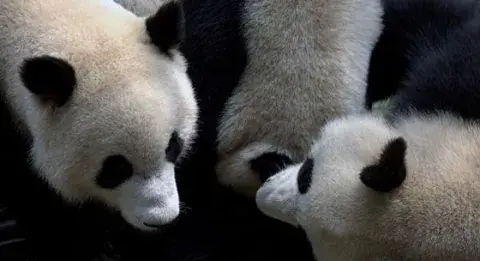
The giant panda, a black-and-white bear, has a body typical of bears. It has black fur on ears, eye patches, muzzle, legs, and shoulders. The rest of the animal's coat is white. Although scientists do not know why these unusual bears are black and white, some speculate that the bold coloring provides effective camouflage into their shade-dappled snowy and rocky surroundings. The panda's thick, wooly coat keeps it warm in the cool forests of its habitat. Giant pandas have large molar teeth and strong jaw muscles for crushing tough bamboo. Many people find these chunky, lumbering animals to be cute, but giant pandas can be as dangerous as any other bear.
Size
Giant pandas stand between two and three feet tall at the shoulder (on all four legs), and reach four to six feet long. Males are larger than females, weighing up to 250 pounds in the wild. Females rarely reach 220 pounds.
Status
The giant panda is listed as endangered in the World Conservation Union's (IUCN's) Red List of Threatened Animals. There are about 1,600 left in the wild. More than 160 pandas live in zoos and breeding centers around the world, mostly in China.
Life span
Scientists aren't sure how long giant pandas live in the wild, but they are sure it's shorter than lifespans in zoos. Chinese scientists have reported zoo pandas as old as 30.
Diet
A wild giant panda’s diet is almost exclusively (99 percent) bamboo. The balance consists of other grasses and occasional small rodents or musk deer fawns.
Social structure
Adult giant pandas are generally solitary, but they do communicate periodically through scent marks, calls, and occasional meetings. Offspring stay with their mothers from one and a half to three years.
The giant panda has lived in bamboo forests for several million years. It is a highly specialized animal, with unique adaptations.
Feeding adaptations
Millions of Zoo visitors enjoy watching giant pandas eat. A panda usually eats while sitting upright, in a pose that resembles how humans sit on the floor. This posture leaves the front paws free to grasp bamboo stems with the help of a "pseudo thumb," formed by an elongated and enlarged wrist bone covered with a fleshy pad of skin. The panda also uses its powerful jaws and strong teeth to crush the tough, fibrous bamboo into bits.
A giant panda’s digestive system is more similar to that of a carnivore than an herbivore, and so much of what is eaten is passed as waste. To make up for the inefficient digestion, a panda needs to consume a comparatively large amount of food—from 20 to 40 pounds of bamboo each day—to get all its nutrients. To obtain this much food means that a panda must spend 10 to 16 hours a day foraging and eating. The rest of its time is spent mostly sleeping and resting.
Water
Wild giant pandas get much of the water they need from bamboo, a grass whose contents are about half water. (New bamboo shoots are about 90 percent water.) But giant pandas need more water than what bamboo alone can provide. So almost every day wild pandas also drink fresh water from rivers and streams that are fed by melting snowfall in high mountain peaks. The temperate forests of southwestern China where giant pandas live receive about 30 to 40 inches of rain and snow a year.
Reproduction
Giant pandas reach breeding maturity between four and eight years of age. They may be reproductive until about age 20. Female pandas ovulate only once a year, in the spring. A short period of two to three days around ovulation is the only time she is able to conceive. Calls and scents draw males and females to each other.
Female giant pandas give birth between 95 and 160 days after mating. Although females may give birth to two young, usually only one survives. Giant panda cubs may stay with their mothers for up to three years before striking out on their own. This means a wild female, at best, can produce young only every other year; in her lifetime, she may successfully raise only five to eight cubs.
Development
At birth, the cub is helpless, and it takes considerable effort on the mother’s part to raise it. A newborn cub weighs three to five ounces and is about the size of a stick of butter. Pink, hairless, and blind, the cub is 1/900th the size of its mother. Except for a marsupial (such as the kangaroo or opossum), a giant panda baby is the smallest mammal newborn relative to its mother's size.
Cubs do not open their eyes until they are six to eight weeks of age and are not mobile until three months. A cub may nurse for eight to nine months. A cub is nutritionally weaned at one year, but not socially weaned for up to two years.
Lifestyle
A wild panda spends much of its day resting, feeding, and seeking food. Unlike other bears from temperate climates, giant pandas do not hibernate. Until recently, scientists thought giant pandas spent most of their lives alone, with males and females meeting only during the breeding season. Recent studies paint a different picture, in which small groups of pandas share a large territory and sometimes meet outside the breeding season.
Top Chengdu Tours
$200 Per Day
CHENGDU, A PANDA CITY, A GOURMET CITY, A TEA CITY, LOOKING FOWARD TO YOUR ARRIVAL
Chengdu, with an area of 12,400 square kilometers and a polulation of about 14,170,000 is not just the biggest provincial capital in west China, but also the only city in the history of China whose name has reminded the same for 3,000 years since its establishment. In Chinese, "Cheng" means "success or successful" and "Du" means "big city or capital". This "Successful City" boasts a long history. It is believed that everything about Chengdu has their origin from "Sanxingdui Ruins", from where you can deeply discover the history story of Chengdu.
...Read moreChengdu, with an area of 12,400 square kilometers and a polulation of about 14,170,000 is not just the biggest provincial capital in west China, but also the only city in the history of China whose name has reminded the same for 3,000 years since its establishment. In Chinese, "Cheng" means "success or successful" and "Du" means "big city or capital". This "Successful City" boasts a long history. It is believed that everything about Chengdu has their origin from "Sanxingdui Ruins", from where you can deeply discover the history story of Chengdu.
Giant pandas definitely are the best calling card and trademark of Chengdu. Every year, million of people are attracted by giant pandas to spend their holidays here, go sightseeing here, make investment here and even settle here permanently. The reason is that for people around the world, the charm of giant pandas cannot be replaced by anything else.
Various kinds of wonderful food shall be another reason attracting you to visit Chengdu. Of the four most famous schools of culinery art in China (Beijing cuisine, Sichuan cuisine, Jiangsu cuisine, Guangdong cuisine), Sichuan cuisine boasts tongue-numbing, hot, delicate and fresh taste and a variety of flavors, as "each dish has its unique taste and no two dishes have the same flavor." Such spcial flavors as fish-flavored, gongbao (with peanuts), and water-boiled are incomparable at home and abroad.
"The teahouses in Sichuan top the world, and those in Chengdu Top Sichuan." This widespread saying not only points out the status of Chengdu's teahouses but also the inseverable ties between Chengdu culture and tea. Like bars in Paris and cafes in Vienna, teahouse add a touch of refinement and leisureliness to Chengdu, an ancient yet modern metropolis. The practice of driking tea prevailed in Sichuan as earlt as prior to the Qin and Han Dynasties.
Wish you can have a nice trip in Chengdu. You will love it.
$40 Per Day
The Snow-Capped Xiling Mountain
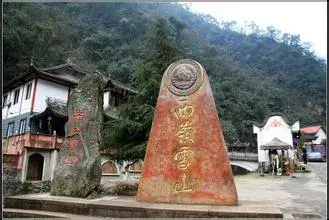
The Snow-Capped Xiling Mountain Scenic Area is located in Dayi County,105kilometers from chengdu ,and covers a total area of 483 square kilometers. Primarily known for its virgin forest,the Snow-Capped Xiling Mountain Scenic Area consists of green mountains,snow-capped plateaus,steep peaks,amazibg stones,spectacular waterfalls and exotic wildlife and animals....Read more
The Snow-Capped Xiling Mountain Scenic Area is located in Dayi County,105kilometers from chengdu ,and covers a total area of 483 square kilometers. Primarily known for its virgin forest,the Snow-Capped Xiling Mountain Scenic Area consists of green mountains,snow-capped plateaus,steep peaks,amazibg stones,spectacular waterfalls and exotic wildlife and animals. With diffefent seasonal views at various vertical levels,this high mountain is especially attractive, with many kinds of flowers in spring,beautiful waterfalls in summer,colorful leaves in autumn and dazzling white snow and ice in winter. Driving westwards about 95 kilometers from chengdu you will arrive at the Snow-Capped Xiling Mountain in Dayi County in an hour. The great variation of altitude and temprature gives the scenic area the advantage ofviewing all of the seasons all the year around. The famous saying "boundless sights are seen only at the summit" gives us the essence of sightseeing.

$300 Per Day
10 Days from Lijiang to Shangrila Daocheng Yading and Chengdu
Day1from lijiang to shangrila on the way see the first bend of Yangtze River and tiger leaping gorge then continue to Shangrila Day2 Shangri La – Xiang Cheng
Day3Xiang Cheng – Yading
Day4look around Yading
Day5 Yading – Daocheng – Litang
Day6 Litang – Yajiang – Xinduqiao
Day7 Xinduqiao – Tagong – Bamei – Danba
Day8look around Danba
Day9 Danba - Ya’an
Day10 Ya’an – Bifengxia – Chengdu