
Beijing Attractions

Memorial: "There would be no New China without the Chinese Communist Party"

There goes a famous song which praises the Chinese Communist Party for its greatest contributions to New China. The song is still sung today by many people because of its inspiring melody and historical significance. The name of this song is "There Would Be No New China without the Chinese Commun...

There goes a famous song which praises the Chinese Communist Party for its greatest contributions to New China. The song is still sung today by many people because of its inspiring melody and historical significance. The name of this song is "There Would Be No New China without the Chinese Communist Party".

This memorial is located in the Xiayunling Forest Park, Fangshan District, where the song was created by musician Cao Huoxing in 1943. The historical site, Xiayunling, used to be part of the Pingxi Anti-Japanese base.

Features: The memorial covers about 6,000 square meters, of which the exhibition hall covers over 1,800 square meters and the "great stage" about 4,000 square meters. Within the memorial visitors can see over 800 pictures and dozens of reliefs, wax sculptures and stone sculptures. In 2003, the Memorial for "There Would Be No New China without the Chinese Communist Party" was appointed as the "base for patriotic education." If you are a patriotic Chinese National or if you are interested in the Chinese Communist Party and the revolutions that have occurred throughout China, then this is the place for you to gain an experience that you will never forget. Name of Attraction: Memorial: "There Would Be No New China without the Chinese Communist Party"

Take Bus No. 917 zhi to Fangshan and then take Bus No. 25 to the museum.

Silver Fox Cave

Silver Fox Scenic Area is the largest limestone cave within northern China. It is said that Silver Fox Cave is more than 10 kilometers long, though, up to now only five kilometers has been opened to the public. The inner space of the cave is very large with a capacity of about 200,000 cubic meter...

Silver Fox Scenic Area is the largest limestone cave within northern China. It is said that Silver Fox Cave is more than 10 kilometers long, though, up to now only five kilometers has been opened to the public. The inner space of the cave is very large with a capacity of about 200,000 cubic meters. The main cave, side caves, horizontal cave, vertical caves, water caves, dry caves and many kinds and different sizes of caves make up the whole scenic area. According to the flow of caves, it is divided into ten major scenic divisions with over 100 attractions.

Features: The only underground water system which is open to the public is also located 106 meters underground in Silver Fox Cave. With the total length of over one kilometer, this is the first underground river which was discovered in northern China. Tourists can experience the amazing creation of this underground water system on boats. Throughout the journey, visitors may find that the river is wide but the next moment, it would be very narrow; sometimes visitors can hardly see the top of the cave but sometimes visitors need to bend down 90 degrees in the boat in order not to bump into the rocks above. Known as one of the Karst wonders of the world, in which it is common to see stalactites, stalagmites, stone pillars, stone flags and stone shields, there are also large amounts of stone chrysanthemum, stone pearls and crystal clear calcite etc. in the silver cave. After all, the most significant wonders would be the needle like and filamentous "Silver Fox" which is rarely found in the world. It is also revered as one of the top karst wonders worldwide and one of China's National Treasures.

Xiaolongmen National Forest Park


Xiaolongmen National Forest Park is located at the foot of Lingshan in Mentougou District, which is about 114 kilometers away from Beijing. It is not only a good scenic spot for vacations but also a research and teaching venue. The park covers an area of 15.95 square kilometers and t...


Xiaolongmen National Forest Park is located at the foot of Lingshan in Mentougou District, which is about 114 kilometers away from Beijing. It is not only a good scenic spot for vacations but also a research and teaching venue. The park covers an area of 15.95 square kilometers and the softwood forest and hardwood forest covers more than 6.67 square meters. Visitors can also see various trees with different colored leaves and numerous nameless wild flowers.


Features:


There are 844 advanced vascular plants of 107 families, which include the Sorbus discolor and Sorbus pohuashanensis, two special species in Beijing and the western mountainous area, as well as the Needle fir and Larix principis-rupprechtii Mayr, a species indigenous to Northern China.

The park is also a paradise for wild animals. Its inhabitants include more than 700 kinds of animals such as Aquila chrysaetos, and Crossoptilon mantchuricum, the national first-class protected animals, Nemorhaedus, the national second-class protected animal, and Prionailurus bengalensis, a Beijing protected animal. The mountains, rocks and forests in the park show a great variety of shapes and forms, and the Phasianus colchicus Hill, Boar Forest, Rhododendron Valley, and Potherb Land can be found one after another making for a beautiful vision, which constitutes the park’s great charm.

Take Bus No. 929 at Pingguoyuan to the park.

Lianhuachi Park

Lianhuachi Park is located in Fengtai District, not far from the Beijing West Railway Station. With an area of 44.6 hectares (110 acres), the park is a modern garden and is well-known for its splendid lotus scenery. The park was built on the site of a place of historical interest—the Lotus Pond. ...

Lianhuachi Park is located in Fengtai District, not far from the Beijing West Railway Station. With an area of 44.6 hectares (110 acres), the park is a modern garden and is well-known for its splendid lotus scenery. The park was built on the site of a place of historical interest—the Lotus Pond. The pond is regarded as the birthplace of the city of Beijing, and bears a history of over 3,000 years. The capital of the Jin Dynasty (1115-1234) was built to the southwest of the Lotus Pond in 1153 and the pond provided most of the water for the capital at that time. Therefore, the park is of great significance to the study of the location and landscape of the ancient capital of the Jin Dynasty.

Features: It is an exquisite, elegant and classical park, and various pavilions, rockeries, ponds, bridges, stones, fragrant flowers, luxuriant lawns and trees are can be seen there. On both sides of the biggest pond, there are verdant Chinese pines, cedars, ginkgos, locust trees, white waxes, and magnolia trees. About 80,000 lotuses with 250 species are planted in the clear pond. The most stunning is the lotus scenery. In summer, all kinds of lotus flowers are in full bloom as if they are competing for the title of most beautiful. As an ancient poem wrote: “The Lotus leaves stretch to the sky a boundless green; the lotus flower in sunlight with unusual red to glow.” A breeze ripples with the surface of the hectares of the Lotus Pond, resulting in a wonderful picture. A delicate white marble statue stands at the bank of the pond, telling a beautiful love tale between a Lotus-flower Fairy and Lotus-root Man. Next to the pond, there is an outdoor theater with a stage in a 'T' shape and music fountain pools on both sides. The pools are full of water lilies blooming with different floral colors of summer. Besides the lotus scenery, there are many activities to join and great scenery to enjoy within the park. For example, the Exercise Square, Outdoor Dancing Area, Fishing Area, Children's Playground, Peacocks and Drovers' Garden, a lotus Propagation Place, Wind and Lotus Pavilion. Every year, the park will hold a traditional style temple fair, making the park an ideal place to enjoy Chinese folk arts and food.

Take Bus No. 1, 4, 300, 309, 730, 830, 845, 937, te2, yuntong201 to Liuliqiao Beili station.

Wanfangting Park

Beijing Wanfangting Park (Wanfang Pavilion Park Beijing) is located at the South Third Ring Road of Fengtai District. The whole area of the park covers about 10.6 hectares and according to historical records, the site for Yuanli Yuan was the previous location of an original villa. In early 1990, ...

Beijing Wanfangting Park (Wanfang Pavilion Park Beijing) is located at the South Third Ring Road of Fengtai District. The whole area of the park covers about 10.6 hectares and according to historical records, the site for Yuanli Yuan was the previous location of an original villa. In early 1990, the government of Fengtai District approved the plans of transforming this piece of green land into a park. Most of the scenery and facilities here are artificially made in order to suit the theme of the park.

Features: As a multipurpose park, the residents around this area have been set as the targeted visitors ever since the construction of the park. This is a great place for residents to exercise in the morning, take strolls after dinner, and it also plays an important role as an activity center open to all. As a result of the civil development of the area, there are more and more people residing around this area. Up until now, the park has received over 300,000 visitors since its opening. More facilities are offered to its visitors and its surrounding area is well designed for the convenience of visitors .

Take Bus No. 324, 434, 654, 665, 678, Te 8 Nei Kuai, Yuntong 108 to Wanfangqiao East and walk for 200 meters.

Beijing Dabaotai Xi Han Dynasty Tomb Museum

Beijing Dabaotai Xi Han Dynasty Tomb Museum is located in Fengtai District near Beijing World Park and has an area of 18,000 square meters. It is a unique imperial site museum. It was built more than two thousand years ago on the site of the underground palace of Liu Jian (73 B.C. to 45 B.C.), wh...

Beijing Dabaotai Xi Han Dynasty Tomb Museum is located in Fengtai District near Beijing World Park and has an area of 18,000 square meters. It is a unique imperial site museum. It was built more than two thousand years ago on the site of the underground palace of Liu Jian (73 B.C. to 45 B.C.), who was Guanyanqing Feudal Prince during the Western Han Dynasty. Its main exhibition contents include the underground original site, unearthed cultural relics and the Exhibition of China Mausoleums for the Emperors of different dynasties. It also includes a number of projects in a unique style, such as an archaeological study simulation, as well as amusement activities related to Han Dynasty Culture and etc.

Features: The underground palace is very large in scale, and its construction is special. It was built with the "System of the Sons of the Heaven", in mind, namely the highest level funeral specific system used by the emperors of the Western Han Dynasty. It is known as the "Xin Palace, Bian House and Huangchangticou". The whole palace was built using several hundred cubic meters of cypresses and chinaberries. Its length from its south to north is 23.2 meters, while the width from east to west is 18 meters and it is 4.7 meters beneath the earth’s surface. Three carriages and eleven horses are buried together in the tomb channel. They were both real carriages and horses for practical use. According to historical records, they are "carriages with red spotted wheels and green covers" designated for the prince and dukes. The site features more than one thousand unearthed cultural relics, which include: copper ware, iron ware, jade ware, agate utensils, golden leaf, pottery and textile products. The palace site and the carriage and horse relics are precious artifacts which have been used to study China’s Han Culture and the history of Beijing, and the site museum is the sole largest scale Han Tomb site in complete condition preserved in its original state in China.

Take Bus No. 635 to World Park station and continue towards the southeast for 800 meters; take Bus No. 744 to World Park station and continue for 800 meters; take Bus No. 937 to the south gate of World Park and continue for 800 meters.

Beijing Film Tourism City

Beijing Film Tourism City is a tourist attraction incorporating tourism and sightseeing, film and TV-related services, and culture and entertainment. The city, whose name was inscribed personally by President Jiang Zemin in 1993, was awarded by the Bureau of Tourism of Haidian District the title ...

Beijing Film Tourism City is a tourist attraction incorporating tourism and sightseeing, film and TV-related services, and culture and entertainment. The city, whose name was inscribed personally by President Jiang Zemin in 1993, was awarded by the Bureau of Tourism of Haidian District the title a "Designated Scientific and Technological Tourism Destination in Zhongguancun" and the "Haidian District Scientific Knowledge Popularization Education Base for Youngsters."

Beijing Film Tourism City is composed of three parts: the Rong, Ning Mansions, the Laser Gun Fight City and a street featuring the style of the Ming and Qing Dynasty. It demonstrates the infinite charms of cinematography and film art to you from various perspectives and different angles.

Features: In the magical blue screen room, tourists can sit on a "magic carpet" placed in front of a blue wall and see themselves flying over a cityscape on the television screen. In the second building, part of a traditional Chinese courtyard from the setshooting site of the famous TV series Dream of Red Mansions (Hong Lou Meng), visitors can act out a scene and star in their own movie. The set includes a table and chairs, and around four people can take part in acting out the scene. The guide tells each actor what to say and then it's time for "action!" In the sound effects studio, a clip of a film is shown on a big screen, while a Foley artist next to the stage adds the sound effects to each scene, splashing water here and making tapping sounds there. Although the presentation is quite rudimentary, you might still experience some hair-raising moments in the pitch black auditorium.

Take Bus No. 22, 16, 367, 387, 302, 331, 300 to Beitaipingzhuang station and walk towards the west for 300 meters on the north side of the road.

Dajue Temple

Dajue Temple is located at the foot of Yantai Hill in the western suburbs of Beijing. With a long history of nearly 950 years, it has many precious historical features. Standing at the foot of mountains, the scenery here is perfectly charming with ancient trees, ceaseless water, and a tranquil an...

Dajue Temple is located at the foot of Yantai Hill in the western suburbs of Beijing. With a long history of nearly 950 years, it has many precious historical features. Standing at the foot of mountains, the scenery here is perfectly charming with ancient trees, ceaseless water, and a tranquil and serene environment. The temple itself is appealing to those who are interested in Buddhism. A set of Buddhist buildings are featured, including a gate, a bell tower, a drum tower, the Hall of Heavenly King, the Grand Hall and other subsidiary halls.

Features: The principal structures in the temple are the Maitreya (Future Buddha) Hall, the main hall, the rear hall, the northern and southern courtyards and, at the very rear of the complex, a peaceful courtyard. The roof brackets and columns of the halls date from the early Ming Dynasty (1368-1644). A mountain spring flows by the Qiyun (Restful Clouds) Pavilion’s rear courtyard. Near the spring there is a stupa which stands at the highest point in the temple complex. Inside the temple is a Liao Dynasty (916-1125) stela on which it is recorded that, more than 1,000 years ago, the temple was named ‘Clear Stream Court’ after the nearby springs. Although the carving is blurred and the stela itself broken into two pieces, most of the inscription remains legible.

There are a number of interesting sights in the immediate vicinity. They include Vulture Peak; the tomb of a Qing prince; Yang Family Garden and Lotus Temple and the Temple of Universal Grace. All are accessible by mountain roads. Minghui Tea House is located in the temple and offers a tea service with Taoist features. Dajue Temple is best known for its Yulan trees, planted almost 300 years ago. The finest being the magnolias. It is said that a monk brought two of the specimens found in the southern courtyard from Sichuan during the Qianlong era, and one of them survives today. Another magnolia in the northern courtyard was transplanted about 100 years ago, and grows alongside a ginkgo tree. The ancient tree usually blossoms around the April 5 every year, during the traditional Chinese Everbright Festival.

Take Bus No. 346 at Beigongmen to Zhoujiaxiang and walk for 15 minutes or take Bus No. 633 at Qinghe Xiaoying to Dajue Temple.

The Imperial Temple of Emperors of Successive Dynasties

The Imperial Temple of Emperors of Successive Dynasties was built 470 years ago in 1530, or the 9th year of Emperor Jiajing’s reign in the Ming Dynasty. It was the only imperial temple in the Ming and Qing dynasties for worshiping the Three Sovereigns and the Five Emperors, distinguished emperors...

The Imperial Temple of Emperors of Successive Dynasties was built 470 years ago in 1530, or the 9th year of Emperor Jiajing’s reign in the Ming Dynasty. It was the only imperial temple in the Ming and Qing dynasties for worshiping the Three Sovereigns and the Five Emperors, distinguished emperors, ministers, and generals of China in successive dynasties. As time passed by, more and more honored persons were enshrined there. During Emperor Qianlong’s reign in the Qing Dynasty, Jingde Chongsheng Hall housed tablets of 188 emperors, and the east and west wing halls housed those of 79 ministers and generals. Guandi Temple was built to worship Guan Yu, a hero of the Three Kingdoms period. By then the temple had housed the greatest number of tablets in the country. The fact that great leaders of all dynasties were enshrined in this temple implies the important trait of continuity within Chinese civilization. After the Republic of China was founded, the temple was converted for non-sacrificial uses. It was renamed No. 3 Girls High School of Beijing. In 1972, it was merged into No. 159 High School of Beijing. In 2000, government bodies at various levels began to finance a three-year renovation. It was officially opened to the public in April 2004.

Features: The temple covers an area of 21,500 square meters, of which 6,000 square meters are covered by ancient buildings. The whole complex faces the south. The main buildings include the screen wall, the gate of the temple, Jingde Gate, and Jingde Chongsheng Hall, the warehouse of ritual vessels situated along its central axis. These are flanked by the east and west wing halls, the stele pavilions, the sacrificial burners, and the bell tower. In the southeast are the bell tower, the Divine kitchen, the Divine Depot, the Slaughter Pavilion, and the Well Pavilion; in the southwest are the Music Official Rooms, the Guard Official Rooms, the Fasting Rooms, and the Guandi Temple, a temple within a temple.

With a majestic layout, the complex is a classic example of Chinese traditional architecture. Jingde Chongsheng Hall, the main hall, has been refurnished the way it was in Emperor Qianlong’s reign. Prominently displayed in its center are the spiritual tablets of the Three Sovereigns: Fuxi, Emperor Yan, Emperor Huangdi, and the Five Emperors: Shaohao, Zhuanxu, Diku, Tangyao, and Yushun. They are flanked by those of the emperors of successive dynasties. Visitors may feel the solemnity and sense of worship in the hall. In the east wing hall is an exhibition on the historical evolution of the temple; in the west wing hall, an exhibition of the major worshiped figures. These two may help visitors learn more about the temple and the founding, development and consummation of the sacrificial system. Held in the Divine Depot is the exhibition on Family Names and the Three Sovereigns and the Five Emperors, showing how the 100 major Chinese family names originated from the Three Sovereigns and the Five Emperors on how they evolved, and stories of emperors of successive dynasties. This may help visitors learn more about the Three Sovereigns and the Five Emperors who were the common ancestors of Chinese people. Held in the Guandi Temple is the Guan Yu Cultural Exhibition on the life of Guan Yu, Guan Yu’s Tomb in Dangyang, the Cemetery of Guan Yu in Luoyang, and Guandi Temple in Xiezhou. The exhibition tells the story of how his body lies in Dangyang, his head rests in Luoyang, his soul is back in his hometown, and his statue is worshipped in Temples. It tells of “A Life of Heroic Tragedy, A Sage of Eternal Sanctity”.

Take Bus No. 7, 47, 101, 102, 103, 202, 211, 409, 603, 604, 612, 614, 619, 623, 685 to Baitasi Station.
Beijing Articles

Top Beijing Tours

$200 Per Day

Private Beijing Antique Shopping Tour with Lunch

Start your private tour with pickup from your central Beijing hotel, and meet your private guide. 
 
Hop inside your private, climate-controlled vehicle and travel to your first stop: Liulichang Antique Street. Situated in old Beijing, this history-steeped street is lined with stone shop-houses selling antique books, handicrafts, paintings, rubbings, glazed pottery, and other treasures. 
 
Hear about Liulichang’s history, and get advice from your guide as to the best shopping opportunities. Sift through the traditional shops and stands, and explore the side lanes (hutongs), where the shops still bear original Ming and Qing architectural features like ornately carved doors and upswept roofs. 
 
Next, drive to Panjiayuan Market, a so-called ‘weekend market’ that’s open daily. Weave through the throng of stands, perusing the huge array of antiques, curios, ceramics, Tibetan rugs, calligraphy, and other finds. 
 
After shopping here, refuel with lunch at a Chinese restaurant, and continue to Baoguosi Cultural Market, set around an old temple. Scour the courtyards of vendors hawking stamps, books, coins and jade, and get tips on scouting out and clinching the best deals from your guide. 
 
If time allows, squeeze in a visit to Hongqiao Market, a mall known for its pearl traders, and electronics, art, clothes, and accessories shops. Trawl for bargains, and haggle over pearls and other precious gems as perfect keepsakes of your time in Beijing. 
 
After seven hours, your tour concludes with a hotel drop-off.
$50 Per Day

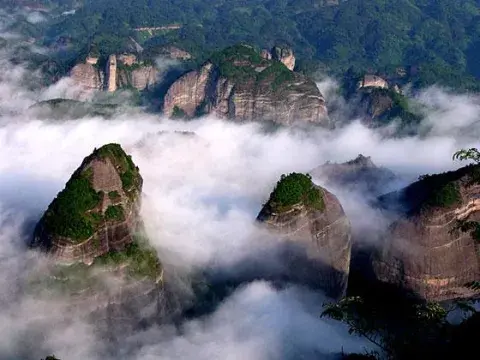
One day tirp to Bajiao Zhai, a noticeable Danxia Landform.

This is a tailor-made trip for nature-lovers and fans of photography.  Danxia rock formation in the inland basin is a red rock debris, and later uplift due to the movement of the earth-crust, erosion of rocks by the water and weathering, which was dominant in the hillside to collapse back, kept down the rocks to form the red mountain block. This area was listed in the Natural Heritage of the world in 2009 by UNESCO. Bajiao Zhai Village is a combination of  strategic place, steepy mountian, elegant scenery and secluded remote. It is reputed as the "Soul of Danxia Landform". Here you can enjoy the sunrise or sunset and the sea-cloud. 1. I'll pick you up at 8:00 am in your hotel, and transfer to Bajiao Zhai Village by our private van. On the way, you can enjoy some terraced fields, bamboo groves and the wooden residences of the natives.(3.5 hours by ride) 2. First, we'll visit the village and have lunch in the village, and then we'll hike the mountains, the scenery including the group of snails looking up the sky, the ancient trail, Eye-stone, Joss stick of dragon's head and the Treasured sword Peak.(4 hours by hike) 3. After appreciating the sunset, after dinner in Ziyuan county, we'll take the bus back to your hotel around 10:00 pm.