
Beijing Attractions

Yunmeng Mountain National Forest Park

The Yunmeng Mountain National Forest Park is located in the northwestern part of Miyun District, and the park gate is at the 81.5-kilometer point of the Jingfeng (Beijing-Fengning) highway. Yunmeng Mountain is one of the most well-known, picturesque mountains in suburban Beijing, and the topograp...

The Yunmeng Mountain National Forest Park is located in the northwestern part of Miyun District, and the park gate is at the 81.5-kilometer point of the Jingfeng (Beijing-Fengning) highway. Yunmeng Mountain is one of the most well-known, picturesque mountains in suburban Beijing, and the topography of the forest park is extremely unique. In the park, the mountains are high and towering, the valleys and ravines are steep and deep, the peaks and stones are weirdly shaped, there are many waterfalls and gushing springs, the clouds and mist are beautiful and mysterious, and forests, flowers and grasses are vibrant and blanketing the area. All these form a picturesque natural scenery features, lend the mountain its nickname the “small Huang Mountain of Beijing.”

Yunmeng Mountain National Forest Park occupies a total area of 2,208 hectares and the elevation of its main peak is 1,414 meters. The forest park has rich scenic resources, thick forests and plenty of animal and plant varieties, including 711 species of green plants. From April to October, the bushes and flowers are in full blossom, making for a vibrant and beautiful picture. According to weather statistics, the temperatures in Yunmeng Mountain are generally 6-7 degrees Celsius lower than that on the plains, and the content of negative ion oxygen in the air is 6-12 times greater than that of the cities The air humidity and breeze are also both favorable. The national forest park is the first choice for escaping from the summer heat and for carrying out forest ecological tourism.

In the Yunmeng Mountain National Forest Park, there is a legend that Sun Bin and Pang Juan kowtowed to Guiguzi to become his martial arts disciples, and this legend is evidenced by the ruins of the Temple of Sun Bin at the main peak of Yunmeng Mountain. These add greatly to the atmosphere of mystery that permeates Yunmeng Mountain. The strange peaks, grotesque rocks, ponds and waterfalls, seas of clouds, forests and ancient ruins all form otherworldly, vivid landscapes. Yunmeng Mountain integrates the functions of sightseeing and tourism, letting one escape from the summer heat and vacation, all while attaining fitness and mentally recuperating. The site also allows for scientific exploration, expeditions, all at the same time. Likewise, it is a perfect place for children from elementary schools, middle school, and higher levels of education, alike, to conduct field studies on wild animals and plants, and to gather specimens.

Featured Attractions: It is a sequestered place with rummy hills, characterized as being majestic, steep, fantastic, secluded and open. The experts conferred “Mt. Huangshan’s miniature” after their on-the-spot investigation. The most striking characteristic which make the site superior to Mt. Huangshan is its misty clouds and exuberant forests. The wonder of “The Three Seas” (the sea of forests, clouds and flowers) is rare in Beijing. Yunmeng Mountain has 6 scenic features: strange peaks, grotesque rocks, clouds, forest, waterfall, ancient sites, forming a constantly changing vista. There are flower viewing activities in April and May, Cloud Tours in July and August, and Fruits Harvests in September and October.
Yunfeng Mountain

Yunfeng Mountain Scenic Area is located on the northern bank of the Miyun Reservoir in Bulaotun Township in Beijing’s Miyun District. It is within the embrace of two great landmarks – the Simatai portion of the Great Wall to the east and Yunmengshan National Forest Park to the west. Yunfeng Mount...

Yunfeng Mountain Scenic Area is located on the northern bank of the Miyun Reservoir in Bulaotun Township in Beijing’s Miyun District. It is within the embrace of two great landmarks – the Simatai portion of the Great Wall to the east and Yunmengshan National Forest Park to the west. Yunfeng Mountain has a pleasant climate all year-round, and the average temperature is 7-9 degrees Celsius below that of the city. In the summer, the climate is cool and mild, making the mountain a popular vacation destination.

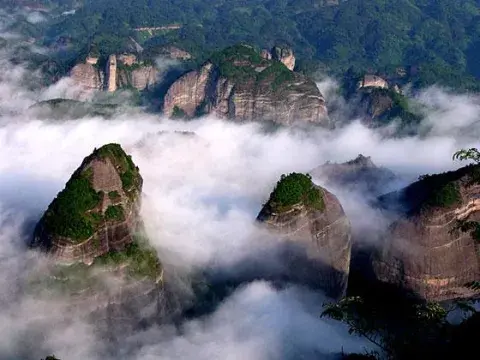
The mountain's unusual elevation features a large variety of oddly shaped stones. Lush grass and trees cover Yunfeng hill during virtually all year round. Its peak is steep and wondrous, jutting directly upwards into the sky. At the top of the mountain, Miyun Reservoir is in clear view shining like a bright pearl. Other compelling sights in the scenic area include Chaosheng Temple, the Moya Stone Inscriptions, and the Cave of Guanyin (also Kwan-yin, the East Asian bodhisattva). The ancient temple was built during the Tang Dynasty (618-907). It is situated in the midst of a forest and makes for a harmonious scene – a rarity in the bustling Beijing. Behind the temple lies the oldest and largest Moya Stone Inscriptions in Beijing, the text of which refer to the characters carved on the natural rocks. The imposing inscriptions are well preserved, reflecting the great value of the art of calligraphy and the appreciation of cultural relics. Guanyin Cave is a natural granite cave, 12 meters deep, six meters wide, and seven meters high. In the middle of the cave sits the Guanyin statue, accompanied by two smaller statues of fairies. Guanyin is an infinitely merciful Bodhisattva in Chinese culture and is believed to help people escape the sufferings of this world.

Featured Attractions: Chaosheng Nunnery (Exceeding Wonder Nunnery) is a must-see spot for visitors, as it embodies the spirit of Yunfeng Mountain. As one of the most well-known ancient nunneries in Beijing, Chaosheng Nunnery was first built in the Tang Dynasty more than 1,000 years ago. Later, it was rebuilt during the Jin, Ming and Qing Dynasties. However, the majority of the construction was demolished by the Japanese during their invasion into China in 1943.

Qingliang Valley

Qingliang Valley, also referred to by its literal name "Cool Valley", is a scenic area in Miyun District on the outskirts of Beijing. It is located in the Yunmeng Mountains and features a picturesque natural landscape. It also includes the Waterfall Cave, with the ever-flowing Baishui River passi...

Qingliang Valley, also referred to by its literal name "Cool Valley", is a scenic area in Miyun District on the outskirts of Beijing. It is located in the Yunmeng Mountains and features a picturesque natural landscape. It also includes the Waterfall Cave, with the ever-flowing Baishui River passing in front of it. Its unique location and environment creates a favorable climate, as temperatures in the nearby Qingliang Valley are usually 5-6 degrees Celsius lower than in the city.

The waterfalls and ponds are the essence of the valley. In wet or dry seasons, the falls are always abundant in water and the ponds are crystal clear throughout the year. A four-km course is dotted with five waterfalls and 13 ponds, varied in size and shape. The famous Waterfall Cave is 230 meters deep, with the waterfall cascades beside it concealing the entrance of the cave like a colossal water curtain. The cave itself is at an average temperature of 18 degrees Celsius.

Visitors can select tourist activities to enjoy at the "travel supermarket" and pay at the "cash register" at the exit gate when leaving; as its motto goes, "enjoy first and pay later." Visitors can also choose activities such as bamboo rafting, boating and water fighting. In addition, about 2,000 kg of fish have been released into the water for fishing and general appreciation. Anyone who catches a fish can keep it free of charge. Qingliang Valley is also fully equipped with dining and lodging facilities and is specially known for its local rural cuisine.

Featured Attractions: The scenic area is characterized by various waterfalls and pools. Whether on rainy days, or during dry seasons, the magnificent waterfalls offer you unusual discoveries. About 5 kilometers from the entrance of the valley lies the imposing Pearl Waterfall. Water rushes down from a high cliff and resembles a splendid curtain of pearls. A glimpse into the distinctive cave behind the Pearl Waterfall will impress you deeply.

Shouyun Iron Ore Park

Shouyun Iron Ore Park belongs to the Shouyun Iron Ore Co., LTD, 67 kilometers outside the capital city. It was established in 2005 and covers an area of 3.62 km2. So far, it is an unusual, national mining tourist theme park and is also one of the most important industrial tourism attractions east...

Shouyun Iron Ore Park belongs to the Shouyun Iron Ore Co., LTD, 67 kilometers outside the capital city. It was established in 2005 and covers an area of 3.62 km2. So far, it is an unusual, national mining tourist theme park and is also one of the most important industrial tourism attractions east of Miyun District.

Shouyun Iron Ore Park is the first park in China to synergize iron ore mining and theme tourism. The park has successfully built four major theme sightseeing areas: The Iron Ore Museum, the open pit mines, granite geological relics, the tailings dam and another iron themed sightseeing area along with a live CS field. One can also discover the iron clad men training at a camp and several other themed recreational experiences within this district. The park also offers a mini golf course, a pottery museum, an archery pavilion, KTV and other themed-based forms of entertainment. Shouyun Iron Ore Park is an "AAA scenic spot" with fresh air, a pleasant environment and variety plants; it is an ideal place for exploring scientific knowledge, sightseeing, entertainment and for planning business affairs within the greater conference rooms.

Featured Attractions: The park has successfully built four major theme sightseeing districts: The Iron Ore Museum, the open pit mines, the granite geological relics, the tailings dam and the other themed iron sightseeing district as well as a live CS field. The park also offers a mini golf course, a pottery museum, an archery pavilion, KTV and other themed-based forms of entertainment.

Eighteen Ponds

Eighteen Ponds lies within the borders of Anjiazhuang of Wangping Town in Mentougou District, and features a deep valley, unique stones, special streams and uncommon flowers as one of the rare natural scenic spots of Northern China.

Features:

The group of pools is backed...

Eighteen Ponds lies within the borders of Anjiazhuang of Wangping Town in Mentougou District, and features a deep valley, unique stones, special streams and uncommon flowers as one of the rare natural scenic spots of Northern China.

Features:

The group of pools is backed by the Qingshuijian which is one of the top 4 peaks of Beijing. There are roaring streams stretching along peaks, water falls down from each cliff, ravines form pools in the valley, contributing to the famous natural landscape of "three-waterfalls, six-scenes and Eighteen Ponds" which is distinct across the seasons. While, another kind of scenery is revealed at the mouth of the valley: two door-like mountains overlooking the valley, zigzagging peaks, peculiar cliffs and stones, flying spring waters hitting against cliffs. There is also a great amount of birds, animals and flowers.

Shibatan (Eighteen Ponds) is scattered along the Yongding River, to the south of 109 National Highway. This natural landscape is only about 50 km away from the center of Beijing and is easy to reach with convenient transportation and clear road signs.

Two traditional activities at the ponds are very popular and attract many tourists each year. One is “Mulberry Picking Festival” and the other is the “Red leaves Scenery Festival”. The “Mulberry Picking Festival” takes place every June and July and tourists can taste mulberries whilst watching the birds and fish. The “Red leaves Scenery Festival” begins on September 15 and lasts till the end of November. Tourists can enjoy the wonderful and splendid view of the red autumn leaves.

Chinese Culture Garden

The Chinese Culture Garden opened in September 2001, 500 meters from the Langfa Exit of the Fifth Ring Road and about 18 kilometers from downtown Beijing, and is a theme park focusing on developing Chinese culture and spreading patriotic education. The Chinese Cultural Garden occupies an area of ...

The Chinese Culture Garden opened in September 2001, 500 meters from the Langfa Exit of the Fifth Ring Road and about 18 kilometers from downtown Beijing, and is a theme park focusing on developing Chinese culture and spreading patriotic education. The Chinese Cultural Garden occupies an area of 333,000 square meters. Its south gate is in the shape of a tripod and its west gate is in the shape of a “Pingshouqiaozububi Coin”. Its east gate is a dynamic sculpture, combining Qufu Colored pottery basins and pottery Gui, which represent the cultural image of the garden. The scenery can be summed up with the words “one spirit and three gardens”. One spirit refers to the Artistic Wall representing the Chinese spirit and the three gardens the Tranquil Garden, Dynamic Garden and Yixian Garden. History, important events, famous figures, cultural achievements, discoveries and inventions are engraved on the “Artistic Wall displaying China’s spirit” 2.4 meters in height and 2.3 kilometers in length. Standing in front of the wall, one will feel awe whilst facing and talking about history, and the spirit of the Chinese ancients.

The “Tranquil Garden” occupies an area of 62,000 square meters. There is a lake of 15,000 square meters in the garden. There is a unique “Dragon Character Wall” together with the tranquil garden. The word “dragon” as written by 999 calligraphers is engraved on the expansive walls. The garden also includes the Lucky Deer Turning Round, Wenyuan Palace, Bamboo Garden, Cultural Corridor, Music Fountain, and the open air theatre in the “Dynamic Garden”. Yixian Garden is composed of Crescent Lake and 12 ancient quadrangles. The Chinese Culture Garden inherits the characteristics of ancient royal gardens whilst incorporating the style of modern gardens. The regular themed activities of the garden include “sunshine travel in search of the Chinese spirit” in spring, “dating in fields” in summer, and “historical travels in China” in autumn. Tourists can ride electric bicycles to enter the garden, view the history and scenery, and appreciate Chinese culture.

Beijing Articles

Top Beijing Tours

$200 Per Day

Private Beijing Antique Shopping Tour with Lunch

Start your private tour with pickup from your central Beijing hotel, and meet your private guide. 
 
Hop inside your private, climate-controlled vehicle and travel to your first stop: Liulichang Antique Street. Situated in old Beijing, this history-steeped street is lined with stone shop-houses selling antique books, handicrafts, paintings, rubbings, glazed pottery, and other treasures. 
 
Hear about Liulichang’s history, and get advice from your guide as to the best shopping opportunities. Sift through the traditional shops and stands, and explore the side lanes (hutongs), where the shops still bear original Ming and Qing architectural features like ornately carved doors and upswept roofs. 
 
Next, drive to Panjiayuan Market, a so-called ‘weekend market’ that’s open daily. Weave through the throng of stands, perusing the huge array of antiques, curios, ceramics, Tibetan rugs, calligraphy, and other finds. 
 
After shopping here, refuel with lunch at a Chinese restaurant, and continue to Baoguosi Cultural Market, set around an old temple. Scour the courtyards of vendors hawking stamps, books, coins and jade, and get tips on scouting out and clinching the best deals from your guide. 
 
If time allows, squeeze in a visit to Hongqiao Market, a mall known for its pearl traders, and electronics, art, clothes, and accessories shops. Trawl for bargains, and haggle over pearls and other precious gems as perfect keepsakes of your time in Beijing. 
 
After seven hours, your tour concludes with a hotel drop-off.
$50 Per Day

One day tirp to Bajiao Zhai, a noticeable Danxia Landform.

This is a tailor-made trip for nature-lovers and fans of photography.  Danxia rock formation in the inland basin is a red rock debris, and later uplift due to the movement of the earth-crust, erosion of rocks by the water and weathering, which was dominant in the hillside to collapse back, kept down the rocks to form the red mountain block. This area was listed in the Natural Heritage of the world in 2009 by UNESCO. Bajiao Zhai Village is a combination of  strategic place, steepy mountian, elegant scenery and secluded remote. It is reputed as the "Soul of Danxia Landform". Here you can enjoy the sunrise or sunset and the sea-cloud. 1. I'll pick you up at 8:00 am in your hotel, and transfer to Bajiao Zhai Village by our private van. On the way, you can enjoy some terraced fields, bamboo groves and the wooden residences of the natives.(3.5 hours by ride) 2. First, we'll visit the village and have lunch in the village, and then we'll hike the mountains, the scenery including the group of snails looking up the sky, the ancient trail, Eye-stone, Joss stick of dragon's head and the Treasured sword Peak.(4 hours by hike) 3. After appreciating the sunset, after dinner in Ziyuan county, we'll take the bus back to your hotel around 10:00 pm.