Tehran Attractions
Tehran Articles
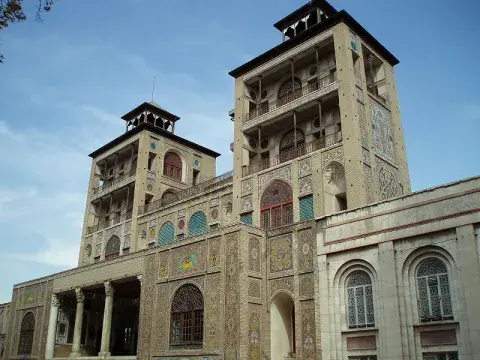
Golestan palace
The Golestan Palace (Persian: کاخ گلستان - Kāx e Golestān), literally the Roseland Palace, is the former royal Qajar complex in Iran's capital city, Tehran.
...The Golestan Palace (Persian: کاخ گلستان - Kāx e Golestān), literally the Roseland Palace, is the former royal Qajar complex in Iran's capital city, Tehran.
The oldest of the historic monuments in Tehran, and of world heritage status,[1] the Golestan Palace belongs to a group of royal buildings that were once enclosed within the mud-thatched walls of Tehran’s Historic Arg (citadel).
History
Tehran’s Historic Arg was built during the reign of Tahmasp I (r. 1524-1576) of the Safavid dynasty (1502–1736), and was later renovated by Karim Khan of Zand (r. 1750-1779). Agha Mohammad Khan of Qajar (1742–1797) chose Tehran as his capital. The Arg became the site of the Qajar (1794–1925). The Court and the Golestan Palace became the official residence of the royal Qajar family. The palace was rebuilt to its current form in 1865 by Haji Ab ol Hasan Mimar Navai.
During the Pahlavi era (1925–1979), Golestan Palace was used for formal royal receptions, and the Pahlavi dynasty built their own palace at Niavaran (Niavaran Palace Complex). The most important ceremonies, held in the palace during the Pahlavi era, were the coronation of Reza Shah (r. 1925-1941) on the Marble Throne and the coronation of Mohammad Reza Pahlavi (r. 1941-deposed 1979) in the Museum Hall.
In between 1925 and 1945, a large portion of the buildings of the palace were destroyed on the orders of Reza Shah. He believed that the centuries-old Qajar palace should not hinder the growth of a modern city. In the place of the old buildings, commercial buildings with the modern style of 1950s and 1960s were erected.
Palaces
The Marble Throne (Takht e Marmar)
Karim Khani Nook (Khalvat e Karim Khani)
Pond House (Howz Khaneh)
Brilliant Hall (Talar e Brelian)
Museum of Gifts
Containers Hall (Talar e Zoroof)
Ivory Hall (Talar e Adj)
Mirror Hall (Talar e Aineh)
Salam Hall (Talar e Salam)
The Building of Windcatchers (Emarat e Badgir)
Diamond Hall (Talar e Almas)
Abyaz Palace
IRAN
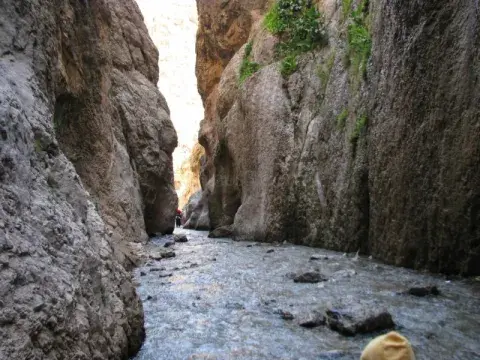
Tangeh Savashi (Persian: تنگ ساواشی) or Tangeh Vashi (Persian: تنگ واشی) is a gorge and mountain pass in the Alborz range of Iran (Persia). It is a popular tourist attraction in Tehran Province.
...Tangeh Savashi (Persian: تنگ ساواشی) or Tangeh Vashi (Persian: تنگ واشی) is a gorge and mountain pass in the Alborz range of Iran (Persia). It is a popular tourist attraction in Tehran Province.
Located 15 kilometers west of Firouzkouh, 9 kilometers north of the Firouzkouh-Damavand road in Tehran Province, it is a narrow mountain pass in the Alborz range. The narrow gorge was created by a perennial stream which comes down from a series of waterfalls upstream.
Slightly lower, in a hilly area, the stream provided a patch of lush grazing land within the mountains. Until the 20th century the area was a royal hunting reserve, populated by various wildlife. The Qajar Persia king Fath Ali Shah (1772 – 1834) maintained a hunting lodge there.
To commemorate his hunts, Fath Ali Shah ordered the carving of a rock relief in the mid way point of the pass. There are ruins of a Qajar guard tower at the top of one of entrances to the gorge.
Today, the relief is a popular tourist attraction and the location is also highly popular among trekking and hiking fans.
Tangeh Savashi has private land owner from 1275 khorshidi and was belongs to Agha Mohammad Nayeb Hamedi Sangasari, Haji Esfandiyar Hamedi sangesari ,Ali agha Hamedi Esfandiyari,and his son Siamack Hamedi and family sine 1375 khorshidi.
Reza Abbasi Museum
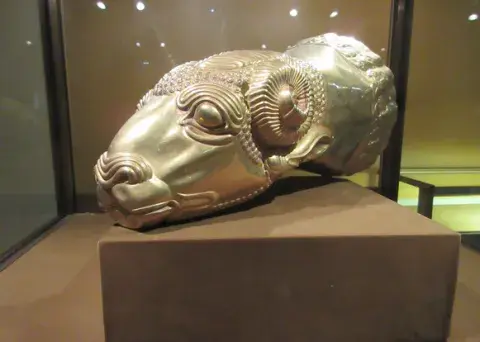
Reza Abbasi is a very worth-seeing museum which consists of 3 floors that specialized for certain periods of time, ancient, medieval and contemporary.
...Reza Abbasi is a very worth-seeing museum which consists of 3 floors that specialized for certain periods of time, ancient, medieval and contemporary.
The Reza Abbasi Museum (the RAM) opened in September 1977, but in November 1978, just one year after its official opening it was closed. Exactly a year later in 1979, having had changes in its internal decorations and with further expansion of its exhibition space it was reopened. In 1984, because of some internal difficulties, once more it was closed and again reopened in 1985. And finally on February 4, 2000, it was opened for the fifth time, after its renovation.Reza Abbasi Museum is administrated by Iranian Cultural Heritage Organization.The head of the museum is Mrs Batool Ahmadi.
Collections
The collections on display and in storage of this museum belong to a period from the 2nd millenium BC to the early 20th century which corresponds to the end of Qajar period. The displays are arranged chronologically, so visitors can have a chance to observe the development of art, culture and technology during this time interval. This setup has made the RAM unique between other museums in the country, in respect to the Iranian Art History. The objects exhibited in this museum include artifacts made of baked clay, metal and stone from the pre-historic times to pottery and metal objects, textile and lacquer painting belonging to the Islamic period. Other artworks on display in the RAM are paintings on canvas and paper, manuscripts and jewelry from pre-Islamic period, besides art and technology and calligraphy works of the Islamic period.
Conservation Department
The Conservation Department with its two laboratories and workshops for conservation of painting, metal objects and manuscript books is considered as one the most advanced conservation workshops of the country. Therefore, it not only covers its own needs, but accepts conservation works from all other museums with in the country.
Library
The library of the museum with over 10,000 Persian, English, French and German books is open to the museum curators, the staff of Cultural Heritage Organization, universities students and researchers. The subjects of the books are mostly composed of Iranian history art, archaeology and classical paintings.
The books are classified by LC classification and the system is open shelf.
The library has over 50 different Persian and 60 foreign magazines, and 90 different newspapers that are all accessible to the visitors.
The library does not have any book loan service.
Opening times of the library: Everyday except Thursdays and Fridays and national holidays, from 8:30 to 15:30
Publication Department
The Publication Department has published valuable references on Iranian artistic legacy. The following titles that are available can be ordered from www.chf-iran.com.
1- The Art of the Achaeminians, Parthids and Sassanians.
2- Lorestan Brass and Metal Objects from Islamic Period.
3- A Collection of Iranian Arts, from the 2nd Millennium to 6th Century BC.
4- A Collection of Iranian Miniature and Calligraphy, from the 8th to late 12th Century AH.
5- An Introduction to the Art of Iranian Tilework.
6- Architecture of Esfahan Jamè Mosque.
7- Clay Tablets of Neishabour.
8- Tea-house Painting.
Top Tehran Tours
$1 Per Day
Special Tehran Tour
SPECIAL TEHRAN TOUR
Is an amazing tour to discover Tehran treasures and local life together.
on this tour we don’t visit just tourist attractions, visit old parts of Tehran, walk in local areas and know how is local life.
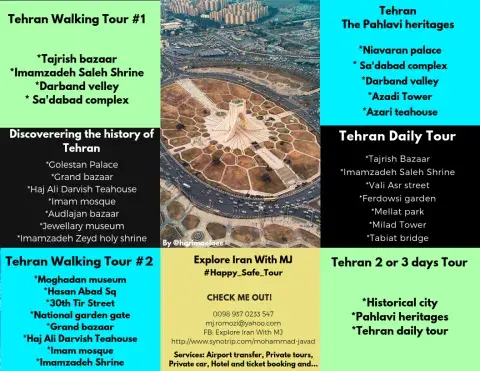
we will visit, Golestan palace, Grand bazaar, Imam mosque, Haj Ali tea house, Imam zadeh zeyd holy shrine, Audlajan bazaar, Milad tower, Saad abad palace, Tajrish bazaar, Tabiat bridge, Darband valley, Azadegan Teahouse and...
It is not just a tour! we will Talk, share our culture and experience, have fun and discover Tehran together.
$0 Per Day
Walk through History of Tehran
If you are an independent traveller or want to experience tourism in a different way, free walking tour can be a good choice for you.
On this tour we will see:
- Golestan Palace
- walk through a part of Grand Bazaar
- Tomb of Lotfali Khan Zand,
- visit Imam Khomeini Mosque
Starting point: @10:00 am, in front of Gate of Golestan Palace.
Duration: 2.5-3 hours
Ending Point: Imam Khomeini Mosque
...Read moreIf you are an independent traveller or want to experience tourism in a different way, free walking tour can be a good choice for you.
On this tour we will see:
- Golestan Palace
- walk through a part of Grand Bazaar
- Tomb of Lotfali Khan Zand,
- visit Imam Khomeini Mosque
Starting point: @10:00 am, in front of Gate of Golestan Palace.
Duration: 2.5-3 hours
Ending Point: Imam Khomeini Mosque
Price: Pay what is worth it
If you like to join this tour and experience old Tehran with me, you can book now.
$300 Per Day
Tehran Tour During Norooz
We are going to take a tour in Tehran and make it the most memorable one. We can visit a wide range of places including Grand Bazaar,Tajrish, Jewellery and other museums, and Niavaran and Golestan Palaces and all other historical ancient places of Tehran. It'd be fun as I'm a good tempered young lady who is in favor of making friends with foreigners and sharing the Iranian culture and customs with them. We can also try different kinds of traditional foods such as Dizi and I hope you'll enjoy it.