Tehran Attractions

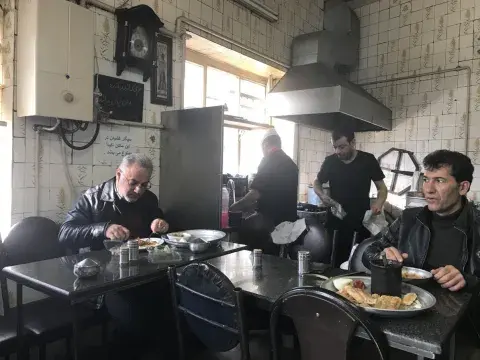
National Museum of Iran
The National Museum of Iran (Persian: Muze ye Melli ye Irān – موزهٔ ملی ایران) is located in Tehran, Iran.
It is an institution formed of two complexes, including the Museum of Ancient Iran (Muze ye Irān e Bāstān) which ...
The National Museum of Iran (Persian: Muze ye Melli ye Irān – موزهٔ ملی ایران) is located in Tehran, Iran.
It is an institution formed of two complexes, including the Museum of Ancient Iran (Muze ye Irān e Bāstān) which was inaugurated in 1937, and the Museum of the (post-) Islamic Era (Muze ye Dowrān e (pasā) Eslāmi) which was inaugurated in 1972.
It hosts historical monuments dating back through preserved ancient and medieval Iranian antiquities, including pottery vessels, metal objects, textile remains, and some rare books and coins.
There are a number of research departments in the museum, including Paleolithic and Osteological departments, and a center for Pottery Studies.
Tehran Articles
What is Nowruz?
The Persian New Year is called Nowruz or Eid Norooz. In Iran, the beginning of the year is celebrated when winter changes into spring. Actually, international day of Nowruz is not only celebrated in Iran. It is celebrated in many countries all around the world....
The Persian New Year is called Nowruz or Eid Norooz. In Iran, the beginning of the year is celebrated when winter changes into spring. Actually, international day of Nowruz is not only celebrated in Iran. It is celebrated in many countries all around the world. It is one of the most ancient traditions in the history.
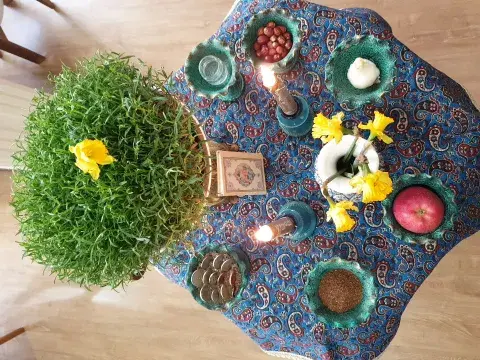
Nowruz haft seen (seven “s”) is a table with seven significant items set on top of it. Setting this table is one of the main customs of Nowruz.
Here is list of each item with its haft seen meaning:
- For rebirth and renewal: Sabzeh (Some kind of sprout; wheat, barley, mung bean or lentil grown in a dish)
- For beauty, love: Senjed (Dried fruit, a sweet fruit from a lotus tree)
- For health: Sib(Apples)
- For medicine and taking care of oneself: Seer(Garlic)
- For wealth and fertility: Samanu (A sweet pudding)
- For the patience and wisdom that comes with aging: Serkeh (Vinegar)
- For the sunrise of a new day: Sumac (A Persian spice made from crushed sour red berries)
The first five days are the official Nowruz holiday and the 13th of Farvardin (first month on the Persian calendar) is the last day of Nowruz. Iranians celebrate the last day of Nowruz with a family picnic. They pack up a big picnic for a meal in the great outdoors. Today, this day is also called the nature day. Iranian believe that there is a curse that has been put on the 13th day of Nowrooz. It has been said that, the curse can be broken with spending this day out in the nature with family and friends.
Nowruz
Nowruz is the Iranian New Year, also known as the Persian New Year, which is celebrated worldwide by various ethno-linguistic groups.
...Nowruz is the Iranian New Year, also known as the Persian New Year, which is celebrated worldwide by various ethno-linguistic groups.
Nowruz is a rite dating back to at least the 6th century BCE, marking the new year and ushering in spring. Variously known as Novruz, Nowrouz, Nooruz, Navruz, Nauroz or Nevruz, this historic rite is observed on 21 March in many countries along the Silk Roads, including Afghanistan, Azerbaijan, India, Iran, Iraq, Kyrgyzstan, Kazakhstan, Pakistan, Tajikistan, Turkey, Turkmenistan and Uzbekistan.
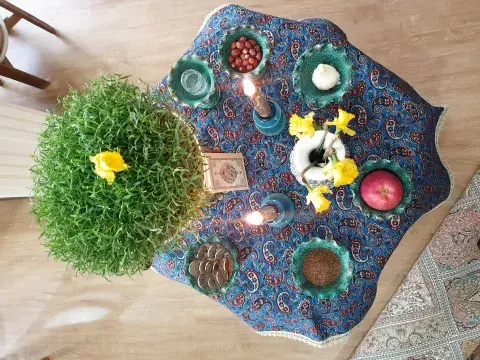
One widespread tradition is the preparation of a Nowruz table, on which a number of symbolic objects are placed. While these tables differ slightly from region to region, the most common features are: water, candles, dishes of green sprouts (or Sabzeh), a traditional dish made out of crushed wheat sprouts, mirrors, eggs, and various fruits. These objects symbolise purity, brightness, abundance, happiness and fertility for the new year. In Iran, the table is referred to as the “Sofreh-ye Haft Sin”, and displays seven objects, each starting with the letter ‘S’. A similar table is set in areas of India.
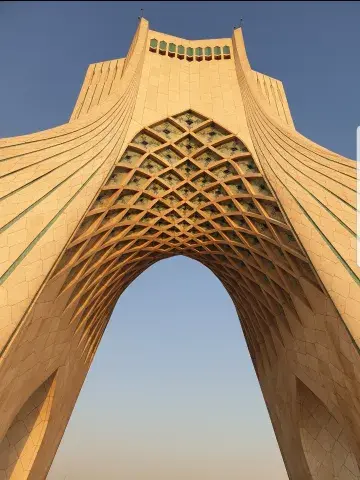
Azadi tower
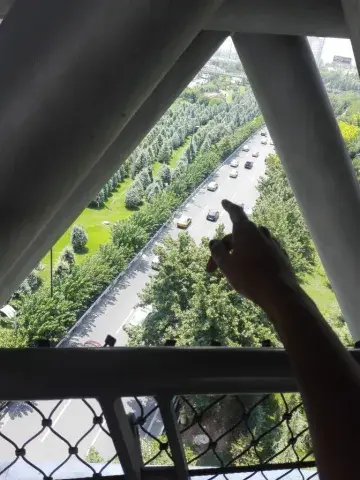
Azadi tower is a monument located on Azadi Square in Tehran, Iran. It is one of the landmarks of Tehran, marking the west entrance to the city, and is part of the Azadi Cultural Complex, which also includes a museum underground.
...Azadi tower is a monument located on Azadi Square in Tehran, Iran. It is one of the landmarks of Tehran, marking the west entrance to the city, and is part of the Azadi Cultural Complex, which also includes a museum underground.
The tower is about 45 metres (148 ft) tall and is completely clad in cut marble.It was commissioned by Mohammad Reza Pahlavi, the last Shah of Iran, to mark the 2,500th year of the foundation of the Imperial State of Iran.
After winning a competition, architect Hossein Amanat was tasked to design the tower. His ideas were based upon classical and post-classical Iranian architecture,[3] popular influences on art in the 1960s following the White Revolution. Iran's increasing wealth sparked modernization programs and sent the art industry into a renaissance-like period.
Top Tehran Tours
$1 Per Day
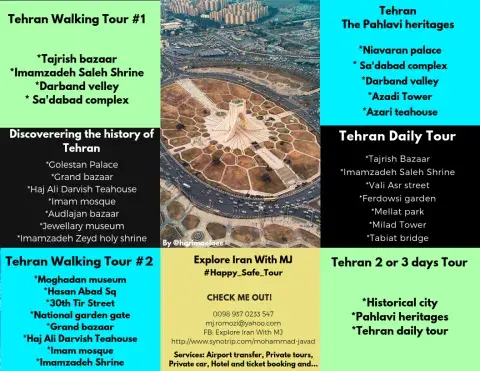
Special Tehran Tour
SPECIAL TEHRAN TOUR
Is an amazing tour to discover Tehran treasures and local life together.
on this tour we don’t visit just tourist attractions, visit old parts of Tehran, walk in local areas and know how is local life.
we will visit, Golestan palace, Grand bazaar, Imam mosque, Haj Ali tea house, Imam zadeh zeyd holy shrine, Audlajan bazaar, Milad tower, Saad abad palace, Tajrish bazaar, Tabiat bridge, Darband valley, Azadegan Teahouse and...
It is not just a tour! we will Talk, share our culture and experience, have fun and discover Tehran together.
$0 Per Day
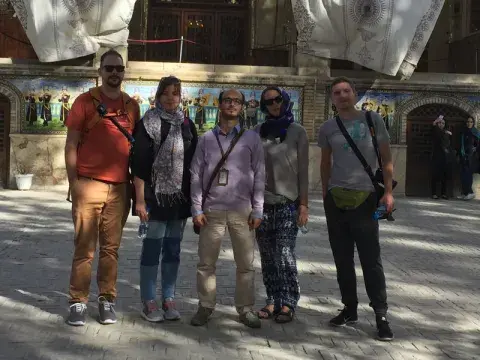
Walk through History of Tehran
If you are an independent traveller or want to experience tourism in a different way, free walking tour can be a good choice for you.
On this tour we will see:
- Golestan Palace
- walk through a part of Grand Bazaar
- Tomb of Lotfali Khan Zand,
- visit Imam Khomeini Mosque
Starting point: @10:00 am, in front of Gate of Golestan Palace.
Duration: 2.5-3 hours
Ending Point: Imam Khomeini Mosque
...Read moreIf you are an independent traveller or want to experience tourism in a different way, free walking tour can be a good choice for you.
On this tour we will see:
- Golestan Palace
- walk through a part of Grand Bazaar
- Tomb of Lotfali Khan Zand,
- visit Imam Khomeini Mosque
Starting point: @10:00 am, in front of Gate of Golestan Palace.
Duration: 2.5-3 hours
Ending Point: Imam Khomeini Mosque
Price: Pay what is worth it
If you like to join this tour and experience old Tehran with me, you can book now.
$300 Per Day
Tehran Tour During Norooz
We are going to take a tour in Tehran and make it the most memorable one. We can visit a wide range of places including Grand Bazaar,Tajrish, Jewellery and other museums, and Niavaran and Golestan Palaces and all other historical ancient places of Tehran. It'd be fun as I'm a good tempered young lady who is in favor of making friends with foreigners and sharing the Iranian culture and customs with them. We can also try different kinds of traditional foods such as Dizi and I hope you'll enjoy it.