Hoi An Ancient Town

Hoi An, an exceptionally well-preserved example of a traditional Asian trading port, is an outstanding material manifestation of the fusion of cultures over time in an international maritime commercial centre.
The town is a special example of a traditional trading port in South-East Asia ...

Hoi An, an exceptionally well-preserved example of a traditional Asian trading port, is an outstanding material manifestation of the fusion of cultures over time in an international maritime commercial centre.
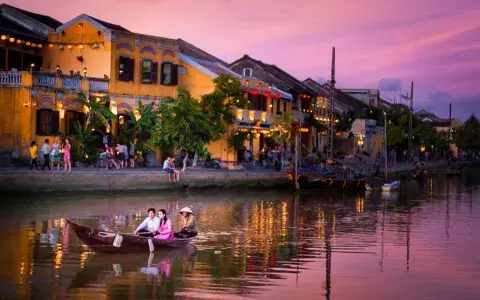
The town is a special example of a traditional trading port in South-East Asia which has been completely and assiduously preserved: it is the only town in Viet Nam that has survived intact in this way. Most of the buildings are in the traditional architectural style of the 19th and 20th centuries. They are aligned along narrow lanes of traditional type. They include many religious buildings, such as pagodas, temples, meeting houses, etc., which relate to the development of a port community. The traditional lifestyle, religion, customs and cooking have been preserved and many festivals still take place annually.


Archaeological finds and excavations have shown that there was a port and trading centre of the local Sa Huynh people along the Thu Bon River as early as the 2nd century BC. This continued to expand, especially during its most flourishing period from the late 16th to the early 18th centuries. It was through Hoi An that Christianity penetrated Vietnam in the 17th century.


By the end of the century, the rise of other ports on the coast of Vietnam, in particular Da Nang, and silting of its harbour, led to the final eclipse of Hoi An. As a result of this economic stagnation, it has preserved its early appearance in a remarkably intact state, the only town in the country to have done so. The ancient town is situated on the north bank of Thu Bon River. There is a street running east-west along the river's edge and three further streets parallel to the river. They are intersected at right angles by streets and alleys. Within this area there are houses (often combined with shops), religious monuments such as pagodas, temples, communal houses and family cult houses, a ferry quay and an open market.


The architecture of Hoi An, which is almost entirely of wood, is of considerable interest. It combines traditional Vietnamese designs and techniques with those from other countries, above all China and Japan, whose citizens settled there to trade and built houses and community centres to their own designs.
The typical house conforms to a corridor plan, the following elements occurring in sequence: house, yard and house. The buildings are:
family cult houses, dedicated to the worship of ancestors;
the community houses, used for worship of ancient sages, founders of settlements, or the legendary founders of crafts;
the pagodas are almost all from the 19th century, although inscriptions show them to have been founded in the 17th and 18th centuries. They conform to a square layout and decoration is largely confined to the elaborate roofs. In the case of the larger examples, they constituted nuclei of associated buildings with religious and secular functions. Some of the larger pagodas also served as meeting halls. These are located along the main street (Tran Phu).


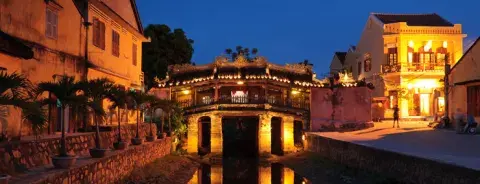
There is a fine wooden bridge, reminiscent of Japanese examples, with a pagoda on it. It has existed from at least the early 18th century, as an inscription indicates, but it has been reconstructed many times. There is also a number of ancient tombs in Vietnamese, Japanese and Chinese style within the buffer zone.

Cam Kim island in Hoi An

Cam Kim Island is a great escape in a small space.  It’s an opportunity to immerse yourself in the real backwoods of Vietnam, while being only 15 minutes from downtown Hoi An.  Cam Kim Island feels like a million miles from any city, and a hundred years back in time, but you can c...

Cam Kim Island is a great escape in a small space.  It’s an opportunity to immerse yourself in the real backwoods of Vietnam, while being only 15 minutes from downtown Hoi An.  Cam Kim Island feels like a million miles from any city, and a hundred years back in time, but you can cross back into the happenings of Hoi An in one quick and easy boat ride.  Here’s what to expect from this little river island.

Wood and Shells

Ever wonder where all those gorgeous hand-made wood carvings come from?  It only takes a short scenic boat ride over the rive to find out.  Wood carving here remains a highly honoured art, passed down through generations of dedicated families.  It’s here where local shells are transformed into glittery accents.  Despite its small size, Cam Kim is home to multiple wood carving and shell inlay shops where you are welcome to watch masters at work.  Like what you see?  It’s all for sale – and at a fraction of the price you’ll find anywhere else (including downtown Hoi An). The friendly boat captains who bring you over from Hoi An are happy to show you around – and will point out which shop belongs to their family.

Bikes and Rice

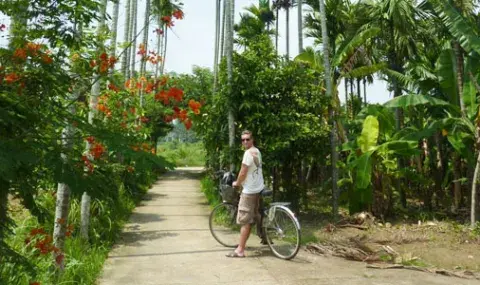
The wood and shells are lovely, but the real beauty of Cam Kim is the island, itself.  This is the perfect spot to rent a bicycle for a few hours and wheel around, past small groups of homes, undisturbed water buffalo and shockingly green rice paddies.  Choose the path less taken and find yourself suddenly surrounded by jungle.  Explore old ramshackle buildings forgotten by all but the ancestors.  With no cars around, and very few scooters, ride without fear or distraction, bikes on Cam Kim are only $2 to rent  for the day.