
Yungang Grottoes
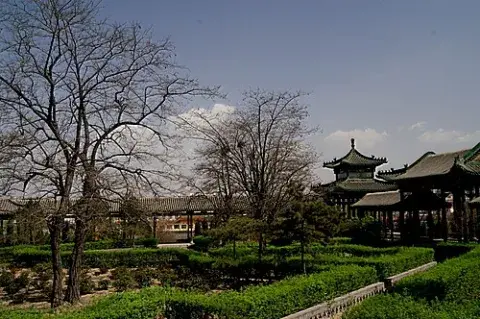
The Yungang Grottoes ( 云冈石窟) are ancient Chinese Buddhist temple grottoes near the city of Datong in the province of Shanxi. They are excellent examples of rock-cut architecture and one of the three most famous ancient Buddhist sculptural sites of China....
The Yungang Grottoes ( 云冈石窟) are ancient Chinese Buddhist temple grottoes near the city of Datong in the province of Shanxi. They are excellent examples of rock-cut architecture and one of the three most famous ancient Buddhist sculptural sites of China. The others are Longmen and Mogao.The site is located about 16 km west of the city of Datong, in the valley of the Shi Li river at the base of the Wuzhou Shan mountains. They are an outstanding example of the Chinese stone carvings from the 5th and 6th centuries. All together, the site is composed of 252 grottoes with more than 51,000 Buddha statues and statuettes. In 2001, the Yungang Grottoes were made a UNESCO World Heritage Site. The Yungang Grottoes are considered by UNESCO to be a “masterpiece of early Chinese Buddhist cave art and represent the successful fusion of Buddhist religious symbolic art from south and central Asia with Chinese cultural traditions, starting in the 5th century CE under Imperial auspices.” It is classified as a AAAAA scenic area by the China National Tourism Administration.
If you need our guide/assistant/sourcing/interpreter, welcome to contact us.:)
We can custom your trip and guide you.
Please click my photo and add my contact. Let's talk details.
Thanks for reading.
Jessica In China (86-13570345653)
Hanging Monastery
The Hanging Temple, also Hanging Monastery or Xuankong Temple (悬空寺) is a temple built into a cliff (75 m or 246 ft above the ground) near Mount Heng in Hunyuan County, Datong City, Shanxi province, China. The closest city is Datong, 64.23 kilometers to the northwest....
The Hanging Temple, also Hanging Monastery or Xuankong Temple (悬空寺) is a temple built into a cliff (75 m or 246 ft above the ground) near Mount Heng in Hunyuan County, Datong City, Shanxi province, China. The closest city is Datong, 64.23 kilometers to the northwest. Along with the Yungang Grottoes, the Hanging Temple is one of the main tourist attractions and historical sites in the Datong area. Built more than 1,500 years ago, this temple is notable not only for its location on a sheer precipice but also because it is the only existing temple with the combination of three Chinese traditional religions: Buddhism, Taoism, and Confucianism. The structure is kept in place with oak crossbeams fitted into holes chiseled into the cliffs. The main supportive structure is hidden inside the bedrock. The monastery is located in the small canyon basin, and the body of the building hangs from the middle of the cliff under the prominent summit, protecting the temple from rain erosion and sunlight. Coupled with the repair of the dynasties, the color tattoo in the temple is relatively well preserved. On December 2010, it was listed in the “Time” magazine as the world’s top ten most odd dangerous buildings.
If you need our guide/assistant/sourcing/interpreter, welcome to contact us.:)
We can custom your trip and guide you.
Please click my photo and add my contact. Let's talk details.
Thanks for reading.
Jessica In China (86-13570345653)
Pingyao’s old town
Pingyao’s old town (平遥) is typically considered the best ancient walled city in China, and is on many lists of the best walled cities in the world. The city walls of Pingyao were constructed in the 3rd year of the Hongwu Emperor (1370). The walls have six barbican gates....
Pingyao’s old town (平遥) is typically considered the best ancient walled city in China, and is on many lists of the best walled cities in the world. The city walls of Pingyao were constructed in the 3rd year of the Hongwu Emperor (1370). The walls have six barbican gates. The north and south sides have one gate each. The east and west sides have two gates each. This pattern is similar to that of a turtle (the head, tail and four legs), earning Pingyao the moniker “Turtle City.” The walls measure about 12 metres high, with a perimeter of 6,000 metres. A 4-metre wide, 4-metre deep moat can be found just outside the walls. Aside from the four structured towers at the four corners, there are also 72 watchtowers and more than 3,000 battlements. In 2004, part of the southern walls collapsed but were reconstructed. However, the rest of the city walls are still largely intact and are considered among the best-preserved ancient city walls on this scale. This makes the city walls the centrepiece of the UNESCO Heritage Site. Pingyao was the financial centre of China in the late Qing Dynasty. During those times, there were as many as 20 financial institutions within the city, comprising more than half of total in the whole country.
If you need our guide/assistant/sourcing/interpreter, welcome to contact us.:)
We can custom your trip and guide you.
Please click my photo and add my contact. Let's talk details.
Thanks for reading.
Jessica In China (86-13570345653)
Xiamen village -- Ancient Villages in Shanxi
The Chinese legend, “Emperor Yu tames the flood” says that in order to channel flood waters from the Fenhe River to the Yellow River, Emperor Yu, leader of the Xia tribe, built a mountain pass between the Taiyue and Luliang Mountains. This pass is now the location of Xiamen village.
...The Chinese legend, “Emperor Yu tames the flood” says that in order to channel flood waters from the Fenhe River to the Yellow River, Emperor Yu, leader of the Xia tribe, built a mountain pass between the Taiyue and Luliang Mountains. This pass is now the location of Xiamen village.
Xiamen village is in the city of Jinzhong, Shanxi province, nine kilometers away from the southwest of Lingshi county.
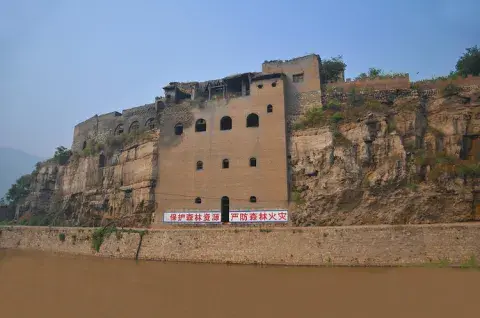
Encircled on three sides by the Fenhe river , the village was built on a giant rock, with steep cliffs in front and high mountains behind. A line of castle-like residences was erected near the Fenhe River. Known as Xiamen Castle, it was constructed between the Wanli Reign of the Ming Dynasty (1368-1644) to the Guangxu reign of the Qing Dynasty (1644-1911).
Although it has gone through over 400 years, most structures in the village are well preserved and maintain their original patterns. Now there are over 60 ancient buildings and historical sites in the village, including tombs, courtyards, temples, ancestral halls, stores, and memorial archways, all forming an ancient architectural complex with a castle style.
Baichi Tower is one of the ancient structures in Xiamen village. Baichi means hundreds of chi, a Chinese unit of length equal to 33.33 centimeters. Baichi Tower is hailed as the most famous tower in Shanxi, built in the Reign of Emperor Qianlong during the Qing Dynasty (1644-1911) by Liang Shu, one of the descendants of Xiamen village’s Liang Family. The Liang Family was one of the four most notable families in Lingshi county in ancient times.
Most of the streets and lanes in Xiamen village are paved with dressed stones. These streets connect the village’s courtyards. Some streets and lanes are connected by secret passages, not only for convenience, but also for, hiding and drainage.
Tips:
Route:
Tourists can take a train to Lingshi Railway Station, then take No 2 Bus to its terminal-Xiamen town (Xiamenzhen). Self-driving tourists can go along No 108 National Highway towards Lingshi county, and the village is ten km away from its southern downtown, on the west bank of the Fenhe River.
Accommodation:
Tourists can stay in the hotels in the downtown of Lingshi County and try local specialties, such as steamed sponge cake and porridge made of corn powder.
Yannen Pass Great Wall
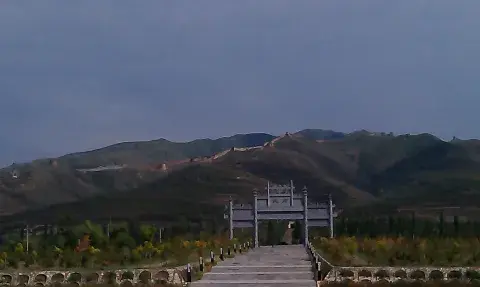
Yanmenguan , also known as Xixingguan is the name of a Great Wall pass. Located in Dai County, Xinzhou of Shanxi province in China. The current Yanmenguan reconstruction was built during Ming dynasty and currently known as one of the announced monuments of China.
...Yanmenguan , also known as Xixingguan is the name of a Great Wall pass. Located in Dai County, Xinzhou of Shanxi province in China. The current Yanmenguan reconstruction was built during Ming dynasty and currently known as one of the announced monuments of China.
Yanmenguan is situated on Yanmen Mountain. The east side and the west side of the mountain face each other, and hence the whole mountain looks like a huge door. Yanmen Mountain was named for its door-alike shape, in which "Yanmen" means wild goose door in Chinese.
The first pass was built by the King Wuling of Zhao during the Warring States period, for defense against the Inner Asian nomads. During Yuan Dynasty it eventually fell into disrepair. The pass was then reconstructed in 1374.
Datong Museum
Datong Museum covers an area of 51556 square meters, construction area of 32821 square meters, the ground floor, the ground floor of three, nearly 10 thousand square meters of the exhibition hall, four special exhibition hall and a temporary exhibition hall....
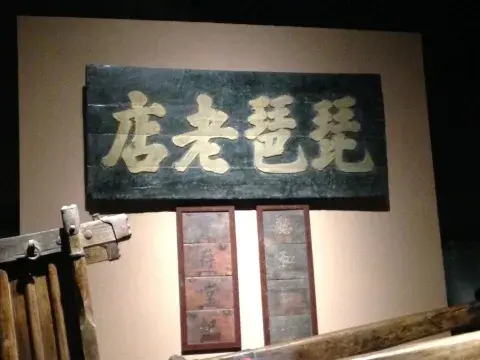
Datong Museum covers an area of 51556 square meters, construction area of 32821 square meters, the ground floor, the ground floor of three, nearly 10 thousand square meters of the exhibition hall, four special exhibition hall and a temporary exhibition hall. The exhibition hall is divided into a series of "generation" vicissitudes of life "" "" of Northern Wei Pingcheng in Liao and Jin Dynasties, "" city of the Ming and Qing Dynasties, including the special exhibition hall of the "Datong" dinosaur "porcelain" pen "Jane's road" Dan "voiceless" sanskrit. The underground layer also specially designed for visitors of the interactive area, equipped with a first-class facilities for the 5D theater and cultural characteristics of the entertainment program.
Opening Hours
9:00~17:00
(16:30 stop go inside, Monday Closed , the first day of the first lunar month Closed.)
Ticket Price
Free (You need show your passport or ID card at ticket office)
Traffic information
Bus line:
(1) NO38 bus, NO64 Bus, Datong University east station to the East
(2) No.65 Bus Datong Museum station take off
(Museum70 Buus, Tai Wo Road South Station Yunshan Street
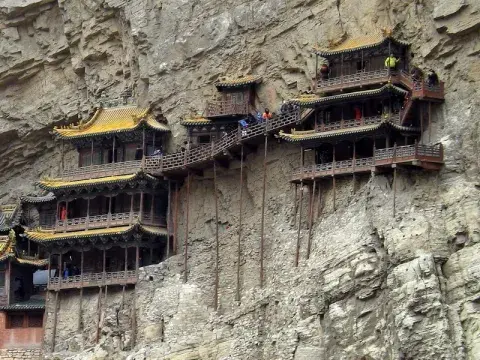
Hanging Temple in Datong
Hanging Temple, hanging in the Datong Hengshan Mt. Hengshan Golden Dragon Gorge West of Cuiping peak half cliff cliff, built in Northern Wei Wo 15 years (AD 491 years)....
Hanging Temple, hanging in the Datong Hengshan Mt. Hengshan Golden Dragon Gorge West of Cuiping peak half cliff cliff, built in Northern Wei Wo 15 years (AD 491 years). Founded early, the top three of the hall 90 meters from the ground, because over the years the riverbed is only 58 meters. 1957 listed as key cultural relics protection units in Shanxi Province, in 1982, included in the national key cultural relics protection units. The whole temple, set on the cliffs, overlooking the valley, according to rock back niche, the west is the gate of the temple to the south. The whole temple wooden frame structure, in accordance with the principle of mechanics, semi plug beam as the base, Qiao asked by dark rock, one on top of the beam column, the gallery tight around the field. Only 152.5 square meters of area, built 40 small rooms .
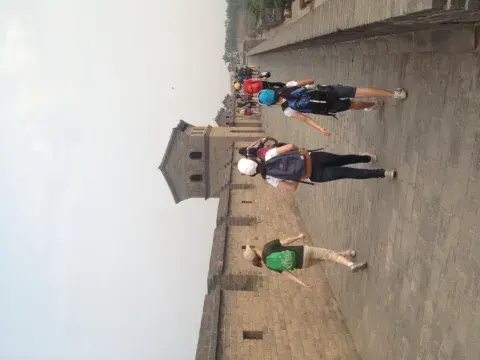
pingyao city wall tips
Dear Guest:
If you got the plan to walk on the wall upon you arrive in Pingyao
Here some tips for you :
1.You can climb up to the wall from North gate and south gate ,also can get off from those two gates.
...Dear Guest:
If you got the plan to walk on the wall upon you arrive in Pingyao
Here some tips for you :
1.You can climb up to the wall from North gate and south gate ,also can get off from those two gates.
2.The lower west gate(Northwest gate, Named Fenyi Menin Chinese) is just the exit.
3.If you prefer the long walking on the wall, you can not walking on the eastern part which is under the construction.
This information is updated on the day of 7th of June 2015

The Info of Dam in Datong Yungang Grottoes
In the ancient times there used to be a reiver in fornt of Mount Wuzhou and it was called Wuzhou River. the Royao family of Northern Wei Dynasty mountain . Then a dam was constructed in front of the carves. One could imagine how magnificent it was at the time while visiting here.
...In the ancient times there used to be a reiver in fornt of Mount Wuzhou and it was called Wuzhou River. the Royao family of Northern Wei Dynasty mountain . Then a dam was constructed in front of the carves. One could imagine how magnificent it was at the time while visiting here.
The dam was filled with crushed stones and wastes soon after a general named Zhan Han worshipped Buddha at caves. He thought that stone Buddha could be damaged with river so close to the temple . So troops were sent to replace hte river four hundred meter to the south of the caves, which is renamed the Yungang part of the Ten Mile River.