Shanxi Drama (Jin Drama)
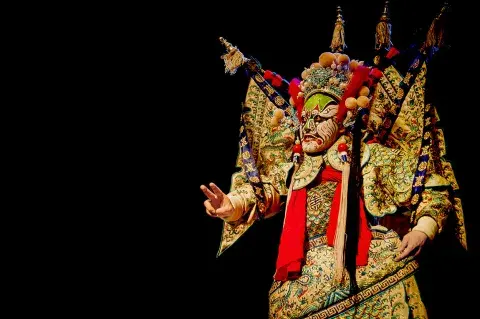
The Shanxi drama has a long history and is considered one of the original Chinese dramas, with its own unique cultural charateristics, for which it is accorded a certain honor....
The Shanxi drama has a long history and is considered one of the original Chinese dramas, with its own unique cultural charateristics, for which it is accorded a certain honor. The earliest Shanxi drama dates back to the Han Dynasty (206BC-220) and was referred to as “baixi” (hundred dramas) for its dances and acrobatics. By the Song Dynasty (AD420-479), it had reached quite a high level.
Shanxi has more than 390 drama types, 54 of them its own particular type, and these days, thanks to the gradually developing culture and innovation, has the new vigor, with many famous artists In May of this year, 44 Shanxi performers won the Plum Blossom Prize, China’s top dramatic performance award, putting the province in the No.1 slot nationwide.
Shanxi has a form of Bangzi operas, a kind of local opera accompanied by wooden clappers, including Puzhou, Zhonglu, Beilu, and Shangdang , which are outstanding representatives of Bangzi opera and of the historical and cultural values of the Chinese dramatic arts mixed with folk customs.
Zhonglu Bangzi, also known as Jin opera or Shanxi Bangzi, is popular in the middle part of the province, especially in the cities of Taiyuan and Jinzhong, and is known for its rhythm and clear spoken parts.
Beilu, which developed in the mid-16th century, is popular in northern Shanxi and the Inner Mongolia autonomous region, where it is known for its loud, strong rhythm, power, and excitement.
Shangdang, also called Great Opera or Shangdang classical, dates back to the end of the Ming Dynasty (1368-1644) and, in May 2006, was ranked among the top group of national cultural heritage. Shangdang Bangzi has a high, clear sound and a powerful, rich rhythm, with 400 traditional dramas, mainly relating to heroes, loyal officials, resisting foreign invaders, and punishing treacherous people, portraying a positive, patriotic theme for audiences.
Puzhou, also called Pu opera, is oldest of the four bangzi and came into being during the Jiajing reign period of the Ming. In 2006, it was ranked among the top group of national cultural heritage. It developed different genres over a long time period, with the Nanlu being quite elegant, while the Xilu is quite strong. Pu opera is good at expressing solemn heroic themes and characters’ feelings. Shanxi also has many local operas as well, such as Daoqing, Yangko, and Wanwan, all of which help to fill out Shanxi drama.
Impression Pingyao
<<Impression Pingyao>>" describes a heritage, life and growth in nature: the story of the late Qing Dynasty, the Pingyao County club Zhao Yishuo arrived as the property exchange, from Russia and...
<<Impression Pingyao>>" describes a heritage, life and growth in nature: the story of the late Qing Dynasty, the Pingyao County club Zhao Yishuo arrived as the property exchange, from Russia and back to a semicolon blood Wang Zhanggui. With 232 biaoshi go public security. Seven years later, Zhao Dongjia himself with 232 biaoshi all died on the way, while the royal blood continuity.
The performance by the "wife", "biaoshi bath", "soul home" and "show" segment, highlights the Pingyao people's moral tradition, and because of the traditional and the elucidation of the tragic feelings. A feature is valuable, Pingyao is in the moral spirit of folk, historical facts presented based on highly purified, such as "farewell", "choose a wife". At the same time, about the visual form is not only rich in literature, more profound, the symbolic meaning of the means to express. Such as: the positive performance of biaoshi's death, and the city wall of the ghost to show biaoshi's spirit and soul, which is very creative, very literary conception. These fragments not only impact the feelings of the audience, let the audience to remember those characters, but also reflects the creator's philosophy.
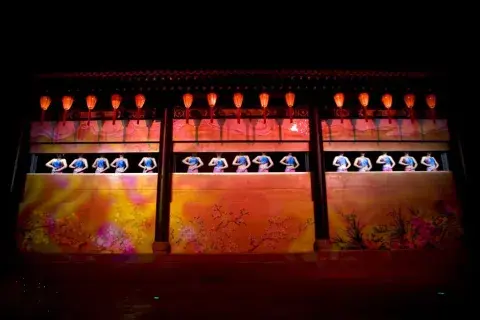
With the previous "impression" series of live performance are very different, "Pingyao" and see the original breakthrough using the real landscape scenery, but moved to the interior, and the ancient city's elements and performance together organically. The labyrinth theatre has complicated spatial segmentation, completely different from the traditional theater: walk through several different forms of theme space in 90 minutes, the audience can pick up the ancestors of fragments of life: the end of the Qing Pingyao City escort, Zhao courtyard, street, South Gate Plaza, from the numerous pieces of PEEP story clue...... Look at the real performance was like a "through" the audience, sometimes like spectators, sometimes like a witness.
The live performance is a new attempt, in this regard, Wang Chaoge believes that the "impression" series is a live performance, from the "impression" to the "impression of Lijiang" to "West Lake impression", are based on the landscape as the core, from the creation of live performance for 10 years now, an artist should never be afraid to take a step further. "Outdoor in the north is not suitable for everyone, the frozen winter landscape of Pingyao County is not big enough, is completely, its character of humanity, so I want to art reproduction words, not to close it, but slightly out of a point, praise it in the periphery, so to build a large theater here."