Jiu Xiang Cave Scenic Area

Jiuxiang Scenic Area

Jiuxiang Scenic Area is located in Yiliang County, which is under the jurisdiction of KM. It is a 4A national tourist attraction. Here is the inhabiting place of Yi people for generations.

Jiuxiang is about 40 km from Jiuxiang county while 90 ...

Jiuxiang Scenic Area

Jiuxiang Scenic Area is located in Yiliang County, which is under the jurisdiction of KM. It is a 4A national tourist attraction. Here is the inhabiting place of Yi people for generations.

Jiuxiang is about 40 km from Jiuxiang county while 90 km from Km city. It is called "hometown of caves" because it has the largest network of caves in YN. For this reason ,it is labled by speleologists as "Museum of Caves". The network of caves here is quite similar to that of the world natural heritage--Skocjan Cave in Dinaric, a karst plateau in Yugoslovia.


Yiliang Roast Duck


Speaking of Yiliang, the first thing come to most YN people is Yiliang Roast Duck. Not as famous as the Peking roast duck, Yiliang roast duck is equally palatable. It was developed by Zhang Wen, a resident of Yiliang COunty in the Qing dynasty. After learning the technique of making Beijing Roast Duck. The method of Yiliang duck roasting is as follows:
kill a duck and scald it to remove its feathers; open a cut under its left wing, from this cut, remove the gut and blow in air so that the duck itself bulges after that, stuff it with flavoring, daub it with honey and air it; then put it on iron hook and hang it inside a hearth, toasting it slowly with dry pine; turn over the duck at the right time, take it out and then daub it with lard, honey and duck fat; finally chop the duck and put it on a dish with onion , sweet sauce, pepper and salt. The whole toasting process takes about half an hour. The roast duck has a skin which  is crisp but not burnt, a texture which is tender and savory, and a taste which is delicious.


Tour Route:
the Green Shady Valley--the White Elephant Cave--the Goddess Cava--the Lying Dragon Cave--the Bat Cave


How does a limestone cave come into being?

To understand that, we need to know how the karst landform come into being. Limestone's major component is Calcium Carbon dioxicate, which is insoluble as we all know back in junior school. However, they are not invulnerable. When water dissolved in it flow through limestone area, they will erode the stone. As you know, the major component of limestone is calcium carbonate, which is insoluble. However, when it meets water and carbon dioxide, they turns into calcium bicarbonate which is soluble in water. When the water containing the dissolved calcium bicarbonate fell into a cave with lower pressure and temperature, the carbon dioxide separated out, leaving the insoluble calcium carbonate forming in the cave. That's why we can see the limestones taking on different shapes, as stone forests, stone peaks, stalagmites, stalactites, stalagnate, and underground rivers.

In some sense, we can even say that the limestone cave is the underground version of the stone forest.

The name of the county Jiuxiang is written as Nine townships in Chinese characters. How did it get such name?

* Some say it's because the place used to be divided into nine administrative regions, hence it was called Nine townships.
* Another saying is that Jiuxiang can also be written as aroma of wine. Because the inhabitant on this land the Yi people love wine more than anything. As a saying among them goes: a banquet is not a banquet without wine.
* The last kind of saying is there are 99 limestone caves.


Covering an area of 2,778 square kilometers, Jiuxiang Scenic Area consists of five major sections: Diehong (Laminated Rainbow) Bridge, Sanjiao(Three fee) Cave, Shangda(Upper Big) Cave, Dasha(Huge Sand) Dam and the Moon Lake. So far, only DIehong Bridge area has been developed and opened for visitors.

Diehong Bridge Scenic Spot is located along Maitian Wheatland River valley. It includes five major sites: the Green Shady Valley, the White Elephant Cave, the Goddess Cave, the Lying Dragon Cave and the Bat Cave.

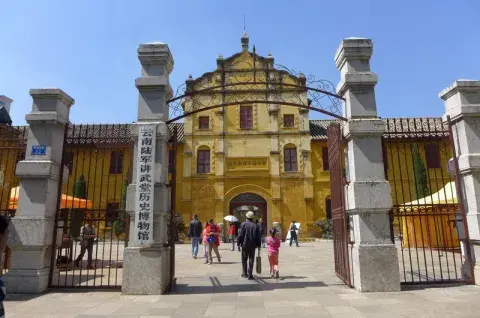
Yunnan Military Academy

--What is Military Academy?

Military Academy refers to the kind of schools which specialize in teaching military-related courses.


--Why was the Military Academy established in Yunnan but not in other areas?

In the early 19 ...

--What is Military Academy?

Military Academy refers to the kind of schools which specialize in teaching military-related courses.


--Why was the Military Academy established in Yunnan but not in other areas?

In the early 19 th century,  Yunnan's two close neighbors, Burma and Vietnam were respectively colonized by French imperialism and British imperialism. As the back door of China, Yunnan was under tremendous threat. Besides the dangerous international environment, Chinese Revolutionary Alliance organized by Sun Yan-sen was engaged in intense Anti-Qing revolution. Under such circumstance, Yunnan governor was permitted to set up the Military Academy.


--What is special about this military academy?

This military academy is among the first batch of military schools in China. Also, it was the very first one which set up branch schools in other provinces, such as Sichuan and Guangzhou. Among the 9000 students graduated from here, there were students from Korea, Vietnam and other countries. Before the establishment of Huangpu Military School, Yunnan Military School was sure the most influential school at that time.

In 1988, it was listed as relic unit under the national protection. It is not only the biggest quadrangle dwelling architecture in China, but also the perfect blending of Chinese and Western styles, even with a bit Yunnan local style.

Another thing worth mentioning is the large number of talents nurtured here. Such as Zhu De, Ye Jianying who were among the top ten marshals on China, Long Yun, Luhan and Zhu Peide who were outstanding officials in Nationalist Party, as well as eminent military instructors like Li Genyuan, Tang Jiyao, Li Liejun and so forth. In the whole period of China Modern History, Yunnan Military Academy made tremendous contribution to a series of wars, such as 1911 revolution, national protection movement, the North Expedition, Anti-Japanese War and Liberation War.


Wenhua Valley

Wenhua Valley


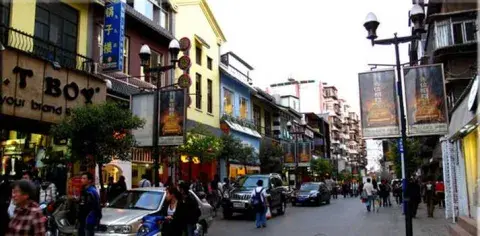
This lane, with a length less than 300 meters, shaped like a zigzag rule, was now decorated by all these fancy shops and restaurants. It seems hard for us to associate it with the word culture. But, to fully understand a place, you need to div...

Wenhua Valley


This lane, with a length less than 300 meters, shaped like a zigzag rule, was now decorated by all these fancy shops and restaurants. It seems hard for us to associate it with the word culture. But, to fully understand a place, you need to dive deeper into its history instead of staying on the surface of it. As first, this lane was overgrown with weeds and grass.  It was almost forgotten by people. However, the coming of Southwest Associated University brought life here, the intelligent minds. Here was built into the living quarters for professors of nearby universities. They have to walk everyday from the lane to their schools. The increasing students from home and abroad had to cross the lane in order to reach Green Lake Park and Xiao Xi Men center. Gradually, this lane became a busy lane with those intellectual minds. What's more, many preeminent scholars, Nobel price winner, physicist, mathematicians as well as writers all left their footsteps here.


One-two-one Street

 The one-way street behind the valley is called one-two-one street. It was named as a honor to commemorate the students movement happening on December 1st, 1945. To elaborate on this event, we need to know more about the situation at that time. As the anti-Japanese war erupted, the education system in north China was under great instability and threat. In order to protect some major universities, the government moved Peking University, Qsinghua University in Beijing and Nankai University in Tianjing to Kunming. Together, they formed the Southwest Associated University, the location of which was at the now Yunnan Normal University right there. At that time, the conflict between the government of Nationalist Part and Communist Part was so intense that the Nationalist Party was conspiring a civil war. As strong opponents to civil war, the patriotic students and teachers from the South-west Associated University, Yunnan University and some other universities had a gathering on the  campus lawn. As the Nationalist Part learned about it, they conducted a violent attack on the school, resulting in four people's death and 10 people's severe injury. This appalling news shocked the whole country. In order to commemorate the heroic and patriotic deeds of students and teachers, the road running in front of their universities were named "One-two-one street" based on the date December 1st. Nowadays, this street is teeming with prestigious universities and schools as well as electronic malls.


Guandu Ancient Town

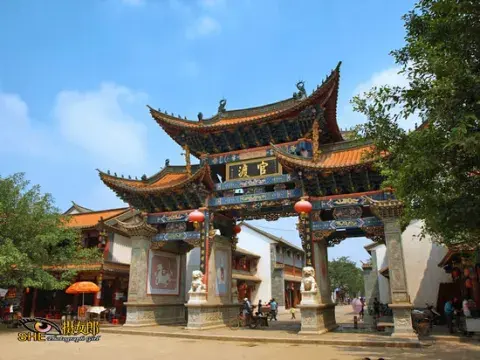
Guandu Ancient Town官渡古镇


Located in the guandu region  in kunming, the ancient town is around 10 km away from kunming center.It used to be the center of kunming. However, with the constant changes of the natural conditions as well as the construction of Wujiaba airport, ...

Guandu Ancient Town官渡古镇


Located in the guandu region  in kunming, the ancient town is around 10 km away from kunming center.It used to be the center of kunming. However, with the constant changes of the natural conditions as well as the construction of Wujiaba airport, more and more people moved out of here,leaving the town standing there alone.

______________________________________________________________________________

1. Why was it named Guandu  (Official Ferry)


During Nanzhao kingdom period, King Ge Luofeng appointed his son Feng Jiayi to build up Tuodong city, which was the predecessor of present Kunming. Though you can hardly discern any sign of water here, this region used to be an important ferry place for those who wanted to board the land. When the construction of the tuodong city started, officials and relevant personnels frequented here so often that it was names official ferry. This is how the name came into being.

___________________________________________________________________________

2. What makes it so famous?

It's hard to imagine that within the area of less than 1 km square stands five mountains, six temples, seven pavilions and eight shrines which have witnessed the ups and downs of five dynasties of Tang, Song, Yuan, Ming ,Qing. It's quite rare that there are 10 sites that are under national, provincial, municipal and regional protection.
Besides, there are more than 100 traditional houses called yikeyin (seal-like compound) dwelling survived here, forming an quaint ancient town here.

--The view of fish lantern on the ancient ferry (古渡渔灯)
Since the water in Dianchi lake descended  greatly, therefore, this view is  no longer in existence. We can only discern its beauty from poems and essays.

-- Running mountain ridges of luofeng. (峰叠翠)

The Luofeng mountain is located in the east side of Shangyi village. It might be a bit hard to believe but it was piled up by spiral shells. Inside those spiral shells we can even find copper debris left by our predecessors. On the top stands Fading Temple, which is surrounded by hundreds of cypress trees.

-- Sheperding sheep in the apricot trees (杏圃牧羊)
In the old times, there used to be a large expanse of apricot trees mixed with bamboos, which was the favorite place for men of letters as well as officials to drink and compose poetry. When it came to spring, sherperd boys would gather on this area and sheperd together, playing games while sheperding sheep.

-- King Kong’s night whispering (金刚夜语)
This is a local legend which goes that there used to be two statues of vajra standing on both sides of the Miaozan Temple. The number of monks then was relatively large. They often volunteer to chant for the dead in the village, some even chanted til midnight. There was one night when a young monk returned from chanting and saw two vajras sitting on the bridge and whispered to each other. He told the others about the thing and people named this bridge vajra bridge.

______________________________________________________________________

3. How was the ancient town looked like in the old times?

Before the water in Dianchi lake declined, Guandu was more busy than we can imagine. It’s fair to say that the Guandu at that time was equal to Shenzhen at present. Myriads of businessmen, craftsmen,scholars and monks were attracted here, some left touching poems, some even chose to stay. The town at that time was much larger than what we see today. If someone was intending to do spring festival shopping, or purchase luxuries or some curiosities, here was definitely their first choice. In order to attract more people, the government even constructed a platform here so that people could enjoy performances while shopping or doing business. With the receding water in Dianchi lake, here was no longer the vital transport site. Fewer and fewer people came here and some even moved out of here, leaving it a lonely town here.


___________________________________________________________________________________

4. The temple of five pagodas (金刚宝座塔)


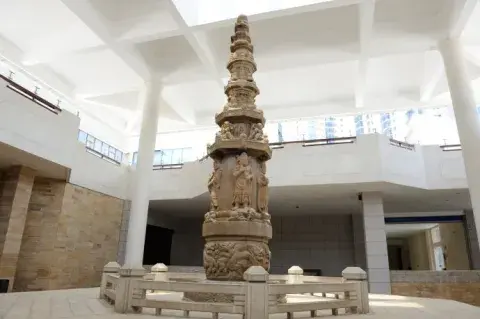
The temple of five pagoda temple is the symbol of Guandu’s ancient civilization. What’s more, it is also the earliest and most well-preserved among the existent five-pagoda temple in China. According to historical record, it was first build in Yuan dynasty and later renovated in Ming dynasty. An earthquake in Qing dynasty destroyed it but was rebuilt later. If we count from the very beginning of its construction, then this pagoda has witnessed 600 years of history.

Now please take a closer look at the pagoda. As you can see, there is no cement in it, instead, we can discern the debris of spiral shells and even rice-shaped stuff. What are these? Actually, the ancient people constructed this pagoda by the mixture of spiral shells and black puddle, with sticky rice and red soil as bedding. It’s said almost every households’ sticky rice was used to in order to compete this pagoda, which weighing 1350 tons!

Now let’s look at the lower part of the pagoda. As you can see, the pedestal is square shaped with four gates on each side. Since the four gates meet in the center and are cross linked, therefore, it is also called 穿心塔, meaning crossing the heart.

Now let’s move our attention to the upper part of the pagoda. If you count, you will find there are five pagodas standing on the tall pedestal, with a major one in the middle and four smaller ones surround it. The major one is as tall as 16.5 meters while the smaller ones are only 5 meters tall. Now let’s look at the major one. Sitting on the square pedestal is dolioform pillar column on which inscribed Buddhism lectures and joss. On the top is a canopy with four small bronze statues sitting on each side. They are four buddhas in Vajrayana sitting on their mounts. The one in the middle is Parinirvana  sitting on a lion; the one in the east is Akshobhya

Akshobhya sitting on an elephant, the one in the south is Ratnasambhava sitting on a horse and the one in the west is Amitabha sitting on a peacock. The one in the north is Jiemo King, sitting on Garuda. Legend goes that under the pagoda suppressed nine dragons which did all kinds of evil and were of great strength.

5. The old platform

This is the platform we mentioned before. The couple conveys the meaning that the platform has survived years of wind and rain and witnesses the past and present.  

6. Miaozhan Temple ″妙湛寺"

The temple was first built in Yuan dynasty, dividing into three parts, the front hall, the middle hall and a rear hall. The original one was destroyed and the one we can see now is rebuilt one. The front hall is the five pagoda temple area, while where we are standing now is the middle hall. In front of the middle hall are two pagodas, east one and west one. The west one is not the the original one because it was destroyed in an earthquake. Local legend goes that every 60 years at the time of the Autumn Equinox, the setting sun shines at the east tower while the ascending moon at the east tower,  the shadow of both towers' tips connect with each other, which is similar to the scene of that of Jinma and Binji archways.

Between the two towers sits a bronze articraft which is a imitation of 司母毋大方鼎.  It' s said that tower is a spiritual item between the sky and the earth, therefore, when taking pictures of towers,we should make sure that we have include the sky and the earth in the pictures.


_____________________________________________________________________


Snacks you should not miss in Guandu Ancient Town

--Roasted Sticky Rice Pancake (Kao Er Kuai)

--Cold dish of Rice Noodle (Liang Mi Xian)

-- Spiral Shells

--Cold "Shrimps" made of rice (Liang Xia)

--Small pot of Rice Noodle (XIao Guo Mi Xian)

--And anything you find unfamiliar
 

Jinma & Biji Archways (Golden Horse & Jade Rooster Archways)

Jinma & Bijin Archways (Golden Horse and Jade Rooster Archways)

--Why is Jinma & Bijin Archways a must-see place in Kunming?

Just like the Bund in Shanghai, the Tian'an men Square in Beijing, the Terra-Cotta Warriors in Xi&#3...

Jinma & Bijin Archways (Golden Horse and Jade Rooster Archways)

--Why is Jinma & Bijin Archways a must-see place in Kunming?

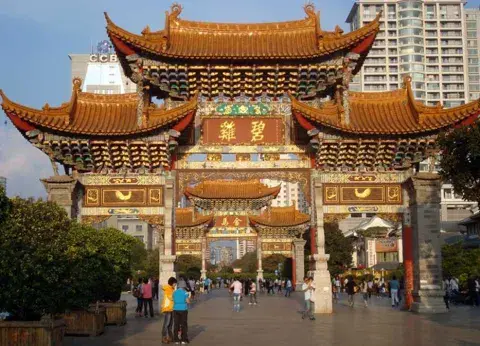
Just like the Bund in Shanghai, the Tian'an men Square in Beijing, the Terra-Cotta Warriors in Xi'an, every city marked with a most representative site. Kunming is no different. Jinma & Biji Archways is the symbol of Kunming.

Those who have been there find it hard to understand:"why such normal archways which can hardly be called as scenic spots outweigh so many sites and become the symbol of Kunming?". To get a better understanding of it, I will give some account of the cultural and historical information of it.

__________________________________________________________________________________

--What is Jinma & Biji?

Jinma is literally translated as Golden Horse. This is a kind of primitive totem worship among ancient Yunnan people.  It was believed that such horse with golden colored skin can cover a thousand li in a single day. If such horse was in real existence, then it's definitely a fantastic news for Yunnan people. Why? Because 94% of the land here is occupied by mountains and plateaus, which make transportation an incredibly difficult thing. Unlike today, they had no access to vehicles, trains, let alone airplanes, what they can rely on was manual and animal force. Therefore, the Golden Horse became a totem that all the ethnic peoples here worship. (On the eastern side of Kunming city lies a mountain named Golden Horse Mountain. )

Biji, on the other hand, is translated as Jade Rooster. However, the real image of it is actually peacock. In the old times, peacock was called phoenix by Chinese people. Beside lustrous and beautiful feathers, their singing was more than pleasant to ears. Local people held that the sight of them or the sound of their singing could bring people endless blessing. (On the western side of Kunmng is the Biji Mountain. )

Another explanation goes that Kunming was abound in copper and jade, therefore, Golden Horse was the embodiment of copper while Jade Rooster the jade.


_______________________________________________________________________________________

--The Unique Scene: Overlapping of the Two Archways' shadow (金碧交辉)


What  makes the two archways unique is a kind of rare phenomenon called overlapping of the Two Archways' shadow. As you may know, ancient Chinese people record time by using Heavenly Stems and Earthly Branches. Since they believe human beings living on earth was subject to the influence of all the stars around us as well as the earth itself. For instance, Earth revolves around the Sun while the Moon revolves around the Earth, the former one affect the temperature on the earth while the latter influence the tide's push and pull. Ancient Chinese people were a group of careful observers, they found that every 60 years, when the Middle-Autumn day falls right on the Autumn Equinox and the sky as clear, the light of the setting sun projects the shadow of Biji Archway to the east, while the light of the arising moon projects the shadow of Jinma archway to west, the two shadows will gradually approach each other til they overlap. This is an extremely rare phenomenon and few elders claim to have seen. Since ordinary people only have one round of 60 years, therefore, those who are lucky enough to witness such scene are believed to be the blessed ones.


__________________________________________________________________________________________

--Three Archways forming the shape of 品


Beside Jinma & Biji archways, there is another archway standing on the street of Zhengyi Street known as Zhong'ai Archway, literally means loyal to the emperor while  sympathizing with his people. This archway was erected to honor the governor of Yunnan back in Yuan dynasty,  his name was Saidianchi Sansiding. Saidianchi was appointed by Kublai Khan to rule over Yunnan. During his reign here, he found that Kunming people were perplexed by frequent flood due to the high seabed of Dianchi Lake, therefore, he took measures to build water-control projects and lowered the seabed of Dianchi. Thanks to such movement, more fertile land was exposed. In addition, he introduced Confucius culture into Yunnan and promoted education cause. Because of his contribution to Yunnan, the Zhong'an Archway was erected.