Jinma & Biji Archways (Golden Horse & Jade Rooster Archways)
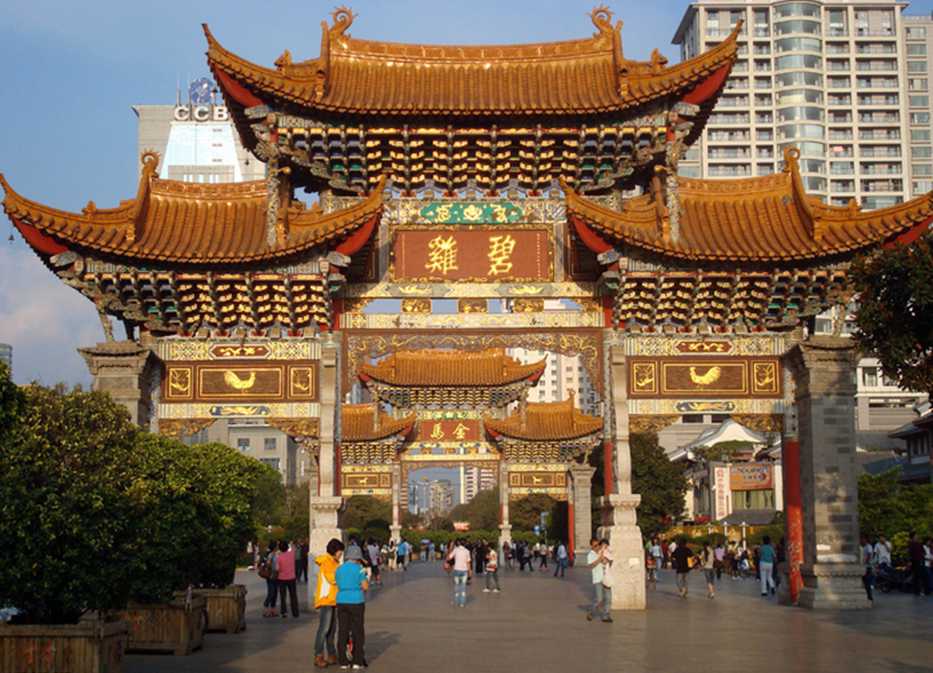
Jinma & Bijin Archways (Golden Horse and Jade Rooster Archways)
--Why is Jinma & Bijin Archways a must-see place in Kunming?
Just like the Bund in Shanghai, the Tian'an men Square in Beijing, the Terra-Cotta Warriors in Xi'an, every city marked with a most representative site. Kunming is no different. Jinma & Biji Archways is the symbol of Kunming.
Those who have been there find it hard to understand:"why such normal archways which can hardly be called as scenic spots outweigh so many sites and become the symbol of Kunming?". To get a better understanding of it, I will give some account of the cultural and historical information of it.
__________________________________________________________________________________
--What is Jinma & Biji?
Jinma is literally translated as Golden Horse. This is a kind of primitive totem worship among ancient Yunnan people. It was believed that such horse with golden colored skin can cover a thousand li in a single day. If such horse was in real existence, then it's definitely a fantastic news for Yunnan people. Why? Because 94% of the land here is occupied by mountains and plateaus, which make transportation an incredibly difficult thing. Unlike today, they had no access to vehicles, trains, let alone airplanes, what they can rely on was manual and animal force. Therefore, the Golden Horse became a totem that all the ethnic peoples here worship. (On the eastern side of Kunming city lies a mountain named Golden Horse Mountain. )
Biji, on the other hand, is translated as Jade Rooster. However, the real image of it is actually peacock. In the old times, peacock was called phoenix by Chinese people. Beside lustrous and beautiful feathers, their singing was more than pleasant to ears. Local people held that the sight of them or the sound of their singing could bring people endless blessing. (On the western side of Kunmng is the Biji Mountain. )
Another explanation goes that Kunming was abound in copper and jade, therefore, Golden Horse was the embodiment of copper while Jade Rooster the jade.
_______________________________________________________________________________________
--The Unique Scene: Overlapping of the Two Archways' shadow (金碧交辉)
What makes the two archways unique is a kind of rare phenomenon called overlapping of the Two Archways' shadow. As you may know, ancient Chinese people record time by using Heavenly Stems and Earthly Branches. Since they believe human beings living on earth was subject to the influence of all the stars around us as well as the earth itself. For instance, Earth revolves around the Sun while the Moon revolves around the Earth, the former one affect the temperature on the earth while the latter influence the tide's push and pull. Ancient Chinese people were a group of careful observers, they found that every 60 years, when the Middle-Autumn day falls right on the Autumn Equinox and the sky as clear, the light of the setting sun projects the shadow of Biji Archway to the east, while the light of the arising moon projects the shadow of Jinma archway to west, the two shadows will gradually approach each other til they overlap. This is an extremely rare phenomenon and few elders claim to have seen. Since ordinary people only have one round of 60 years, therefore, those who are lucky enough to witness such scene are believed to be the blessed ones.
__________________________________________________________________________________________
--Three Archways forming the shape of 品
Beside Jinma & Biji archways, there is another archway standing on the street of Zhengyi Street known as Zhong'ai Archway, literally means loyal to the emperor while sympathizing with his people. This archway was erected to honor the governor of Yunnan back in Yuan dynasty, his name was Saidianchi Sansiding. Saidianchi was appointed by Kublai Khan to rule over Yunnan. During his reign here, he found that Kunming people were perplexed by frequent flood due to the high seabed of Dianchi Lake, therefore, he took measures to build water-control projects and lowered the seabed of Dianchi. Thanks to such movement, more fertile land was exposed. In addition, he introduced Confucius culture into Yunnan and promoted education cause. Because of his contribution to Yunnan, the Zhong'an Archway was erected.
User reviews
Leave a review
Add Review