The White Water Terraces (Baishui Tableland) is located in the foothills of the Haba Snow Mountains, 101 kilometers (about 62 miles) southeast of the Shangri-la County. It is known as one of the most attractive destinations in mysterious Shangri-La and is an ancient Chinese landform with a history of 200,000 to 300,000 years.
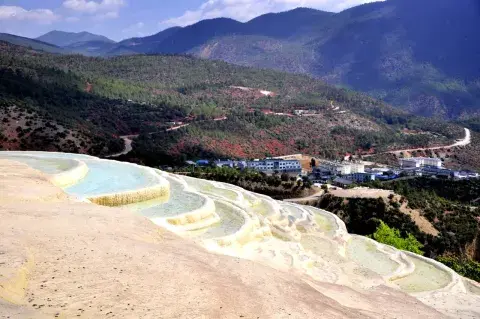
The variegated landform of the tableland is a continual deposition of calcium carbonate that is contained in the spring water. Every year, the surface of the land is covered by the deposition and finally transformed into the terraced structure you see today. Today, the White Water Terraces cover an area of three square kilometers (about 741 acres).
The spring water runs down along the slope of the mountain, leaving an impression of a large white jade carving among the green mountain. The tableland lies layer by layer giving the appearance of a terraced field, so the local people call it 'a field left by fairies'. To the left of the tableland, there is a pool and a moon-shaped platform that is said to be the dresser of the fairies. During the autumn, the mountains around the White Water Terraces will be covered by various bright-colored flowers and leaves. Amid the mountains, the White Water Terraces will form a spectacular white contrast.
stream up the karst terraces
Emerald upper reaches of the stream
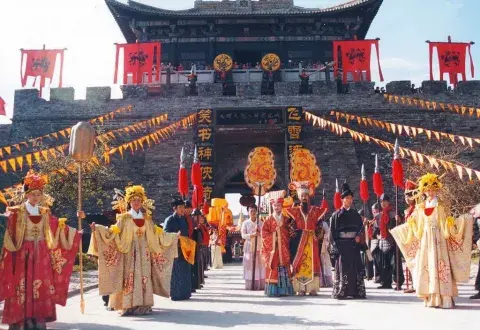
Besides being a beautifully scenic spot, the White Water Terraces is also the birthplace of Dongba culture of the Naxi Minority Group. According to legend, the first saint of the Dongba Religion was attracted by the fascinating scenery of this place on his way back from Tibet. He then stopped to missionize here. Later, the White Water Terraces became known as the Holy Land of the Dongba Religion. When the second saint of the Dongba Religion came here, he created the Dongba pictograph. Each year, on the eighth day of the second lunar month, the Naxi people will gather here to celebrate their traditional festival by singing and dancing all day and night.
Admission Fee: CNY 30
Recommended
Time for a Visit: Two hours