
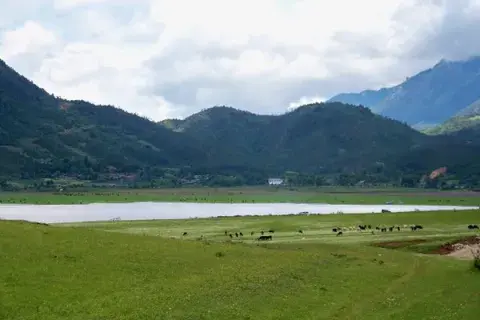
Lijiang
Lijiang (丽江市) is famous for its UNESCO Heritage Site, the Old Town of Lijiang. The town has a history going back more than 1,000 years and was once a confluence for trade along the “Old Tea Horse Caravan Trail”....
Lijiang (丽江市) is famous for its UNESCO Heritage Site, the Old Town of Lijiang. The town has a history going back more than 1,000 years and was once a confluence for trade along the “Old Tea Horse Caravan Trail”. The Dayan Old town is famous for its orderly system of waterways and bridges, a system fast becoming but a memory as the underground water table drops, probably due to over-building in the suburban areas. Lijiang’s culture combines traditional Nakhi culture and incongruous elements learned from Ming dynasty Han Chinese traders who settled in the region centuries ago. Nakhi people have kept alive a timber and mud brick housing style which they learned from Nanjing traders. Local carpenters still build elaborately constructed timber house frames from memory without blueprints or other diagrams.
If you need our guide/assistant/sourcing/interpreter, welcome to contact us.:)
We can custom your trip and guide you.
Please click my photo and add my contact. Let's talk details.
Thanks for reading.
Jessica In China (86-13570345653)

My Lijiang, My Life, My Place
Lijiang, the city of romance, a water town on the southwestern China. Lijiang with a population of 230000 in the city, with Naxi people as the majority among the 16 different ethnic groups....
Lijiang, the city of romance, a water town on the southwestern China. Lijiang with a population of 230000 in the city, with Naxi people as the majority among the 16 different ethnic groups. There is such a beautiful river flow through this mysterious region, called Jinsha River, which is the upper reach of the longest river of China, the Yangtze River, thus the name Lijiang. As a remote town in China, a commercial centre of caravans from the Tea and Horse Trail and Southern Silk Road, where you still can experience the real China. Such splendid cultures and costumes of different ethnic groups could be seen, not even to mention the fascinating beautiful natural seneries here. Lijiang has 3 UNESCO heritages, the Lijiang Old Town as the world cultural heritage, three parallel rivers (Yangtze River, Mekong River, Salween River) as the world natural heritage, Dongba Manuscripts as the world memory heritage. Lijiang has so many attractions such as Lijiang Old Town, Jade Dragon Snow Mountain, Tiger Leaping Gorge, the Lugu Lake.
Lijiang, the dreamland of travellers, either you can relax yourself or hike around, Lijiang always could be one of the best destinations in China. As a tour guide from Lijiang, with all my love, passion in here, I will show you a wonderful Lijiang, take you to experience a tour you will love for long. Come to Lijiang, Pamper yourself in Lijiang with me.
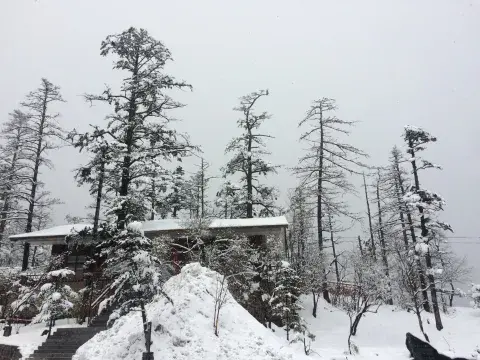
Jade Dragon Snow Mountain after snow
The best seasons of Jade Dragon Snow Mountain could be spring and autumn, winter is OK , summer is not that good( if the weather really bad).
...The best seasons of Jade Dragon Snow Mountain could be spring and autumn, winter is OK , summer is not that good( if the weather really bad).
Spring: the weather is really nice, clear sky and beautiful mountain with lot of snow. Of cause the air is not very cold as winter.
Summer: most days of summer is really wet and foggy,sometimes you can not really see the mountain.
Autumn: the colour is totally different from other seasons, everything changing to yellow.
Winter: the coldest period , but the snow is really nice in that time.
But the weather of Lijiang is very changeable, the rainning night of summer sometimes even colder then winter, sometimes snow in spring or even summer. So the photos actually took in spring.
Lijiang Murals
Lijiang Murals
...Lijiang Murals
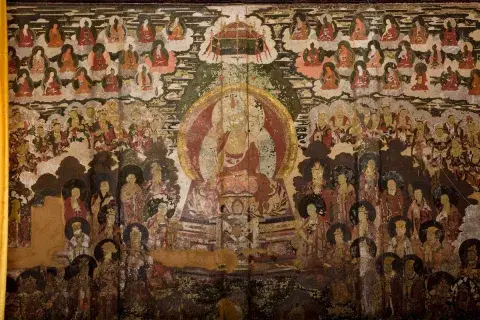
Lijiang's murals are works of the Ming Dynasty,chiefly created from the Hongwu to the Wanli eras.They were originally distributed among the Juexiansi Temple and twelve others,nine of which fell to ruins.The remaining four temples have altogether 55 murals,with a total area of 139.22 sq.m.The biggest of them is in Dabaoji Palace.the figures depicted in it amount to 100,all disposed naturally and reasonably,with life-like miens expressing a variety of postures the whole gamut of emotions.The murals contained in the glazed chamber of the Dabaoji Palace are provincial cultural relic under enhanced preservation.
The murals in Dabaoji Palace are anonymous.According to the research of Lijiang's artists for many years,they might be regarded as the collective creation of the Ming painters during several hundred years,and is a crystal of are which mergres the painting style of the Naxi,Tibetan,bai and Han people.One of the distinctive features is the mixing together,in one mural,of the classic stories of Buddhism that came from Tibet(Lamaism) and the local people's own Buddhism adopted from India as well as Taoism. The paining technique is characterized by delicate and exquisite strokes containing the elements of condensation and compactness of the inland and Tibetan paining as well as the elements of boldness and dynamism of the Dongba painting and the Tibetan Lamaist painting.They are marked by strong contract of colours,vividness and truthfulness of features,plumpness of figures and elaborateness of production.
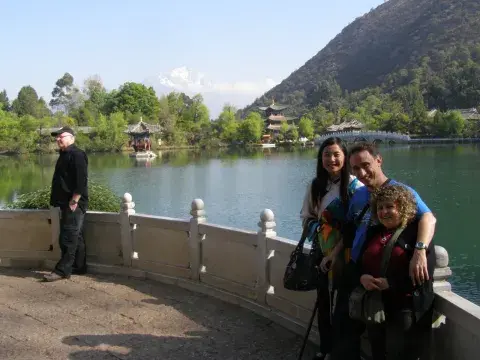
Lijiang Black Dragon Pool Introduction
Lijiang Black Dragon Pool Introduction
...Lijiang Black Dragon Pool Introduction
Lijiang Black Dragon Pool was built in Qing dynasty,around three hundred years old,the local people believe there is black dragon live this pool,protect local people,so called Black Dragon Pool,
The shape of Black Dragon Pool is eight diagram(bagua),Deyue Pavilion is yang,was biult in 1963,the bridge is taiji,Yiwen Pavilion is ying,so it is good for Chinese fengshui,.
At the north end of the park there is Five Phoenix (wufeng) Pavilion,was built in 29th year of Wanli era of the Ming Dybasty(1601).it is the main building of Fuguosi Temple,with a height of 20m,and in the style of flying cornices,the threefold overlap.Since the ground floor has octagonal flying cornices,the threefold overlap make up 24 angles;so from every viewpoint the pavilion looks like five phoenixes spreading their wings for flight,hence its name.The structure is built on a noble scale,with elaborate carvings,redolent of antiquity and a strong local flavor as well as distinctive ethnic colour.
The pavilion was originally built on a mountain far away from the town,for the convenience of visitors,it was moved to this park and constructed by the side of Deyue pavilion,to the mutual enhancement of their splendour.its reflection in the clear water of Jade dragon snow Mountain make the view all the more exquisite,In the 12th year of the Chongzhen era of the Ming Dynasty(1639),the famous traveler Xu Xiake came here on his tour and stayed for eights days i the pavilion,which he took a fortune.
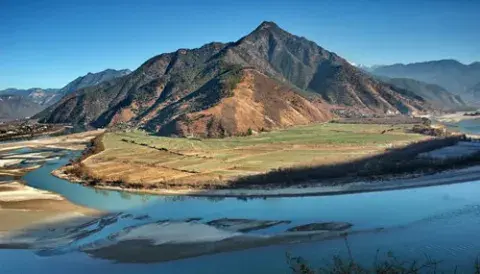
The First Bend Of Yangsze River
The First Bend Of Yangsze River
The First Bend Of yangsze River is located on the north side of the highway leading from Dali to Lijiang ,about 70KM far from Lijiang city.
...The First Bend Of Yangsze River
The First Bend Of yangsze River is located on the north side of the highway leading from Dali to Lijiang ,about 70KM far from Lijiang city.
According to historical accounts,The jinshajiang River in olden times flowed southward along the Hengduan Mountain ranges and was forced to the turn to north because of the Alpine movement which caused changes in the earth's physiognomy,When the river reaches Shigu township,it makes an abrupt tunr and flows further northward,forming the marvelous view reputed as The First Bend of Yangsze River.
On the hill as the river bend stands the small Shigu(stone drum)Township.it is so called because of existence of a drum-like stone tablet.It is1.5m in diametre,70mm.in thickness,being the memorial tablet making the victory of teritorrial expansion of Lijiang's local ruler Baichun,surnamed Mu,in the 27th to 40th year of the Jiaqing era of the Ming Dynasty(1548-1561).It is one of the earliest stone tablets hitherto found at Lijiang.
The river is broadened at the bend and flows slowly.The famous historical event,such as"Zhuge Liang"s crossing the Lushui River in the Fifth Month",Kublai Khan's "crossing the River on Leather rafts" all chose this place as a ferry>In May 1936,the Red Army Leaders Helong,Ren Bishi and Guan Xianying led the second Route red Army to march north ,crossing the river also at this plase.At present,a slendid memorial tablet marking the victorious crossing is erected here.
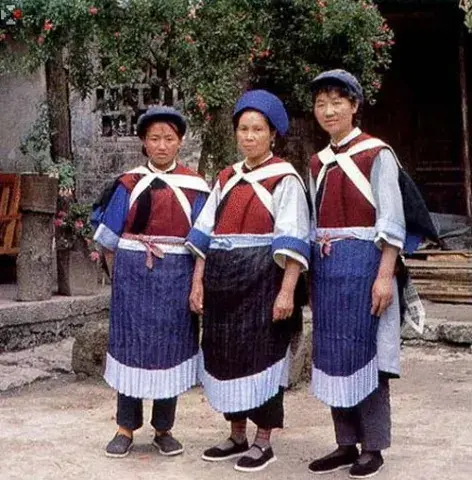
Traditional Naxi clothing
Sheepskin cape is an important symbol of the lijiang naxi women's dress. It usually made from the whole piece of pure black sheepskin....
Sheepskin cape is an important symbol of the lijiang naxi women's dress. It usually made from the whole piece of pure black sheepskin. Sheepskin cape is elegant , can not only have adornment effect, but aso keep warm and protect the body, the Naxi clothing can be concluded as"Pixingdaiyue" in chinese which means "To travel day and night" . there is 7 embroidery circles in the middle of Black and white color, symbol of 7 stars in the sky, means naxi women get up early, to travel day and night, in a show of diligence.
Circle cutting sheepskin is to imitate the shape of a frog, There is 2 round embroidery circles on the shoulder according to the old style of Naxi clothing, meaning "the eyes of the frog," this shows the aboriginal residents worship of frog and Sheep.
Clothing of Naxi people living in shangrila is much more primitive, They use the whole piece of sheep skin as shawl in their back.