Batu Caves Sri Subramaniam Swamy Temple

The Batu Caves is located on a limestone outcrop some 13km from the city of Kuala Lumpur. It is a very popular tourist destination and receives hundreds of visitors daily.

The site has a number of Hindu temples at ground level and also the famous Sri Subramaniam Swamy Temple which is acce...

The Batu Caves is located on a limestone outcrop some 13km from the city of Kuala Lumpur. It is a very popular tourist destination and receives hundreds of visitors daily.

The site has a number of Hindu temples at ground level and also the famous Sri Subramaniam Swamy Temple which is accessible by climbing a series of 272 steps up a concrete staircase, about 200 ft above the ground.

The huge Caves was made a Hindu temple site in 1891 by Thamboosamy Pillai. He was an Indian trader and a leader of the Tamil community in the early days of Kuala Lumpur. He dedicated the Caves Temple to the Lord Murugan (sometimes known as Lord Subramaniam).

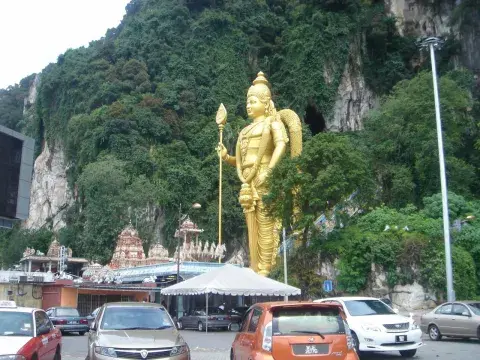
A 140ft tall statue of the Lord Murugan stands at the foot of the caves. Construction of this statue started began in 2004 and was completed in 2005 through the work of 15 sculptors from India. It was opened to the public on Jan 2006 during the Thaipusam Festival. It statue consumed 250 tons of steel bars, 1,550 cubic meters of concrete and 300 liters of gold paint.

The Caves is also famous for the Annual Thaipusam Festival of the Hindus which was held recently on the 17th Jan 2014. 

Independence Square Kuala Lumpur

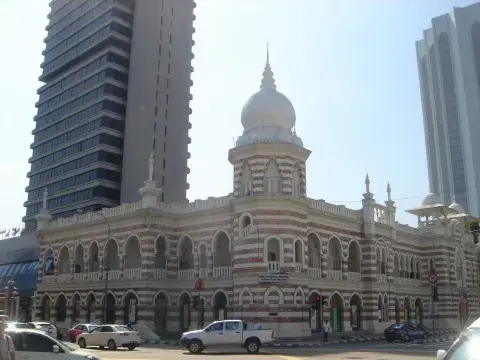
Independence Square was formerly the heart of Colonial British Malaya. In this Square can be found a big field, then used as a cricket field of the British Selangor Club. The field is surrounded by beautiful Moghul-inspired buildings built by the British in the l...

Independence Square was formerly the heart of Colonial British Malaya. In this Square can be found a big field, then used as a cricket field of the British Selangor Club. The field is surrounded by beautiful Moghul-inspired buildings built by the British in the late 19th century and was used to house:

1. the Government Secretariat Buildings of the Federated Malay States, now named the Sultan Abdul Samad Building now functioning as an office of the Ministry of Tourism and Culture, and also another building being used as the City Hall Theatre,

2. the Government Printers Building, now named as the KL City Gallery and a giant scale model of Kuala Lumpur is exhibited in the Gallery.

3. the Chartered Bank of India, China and Australia, now being converted into the Music Museum,

4. the British Club House, now known as the Royal Selangor Club,

5. the St. Mary’s Cathedral, the first Anglican Church in Malaya and is still a functioning church.

6. the first Kuala Lumpur Railway Headquarters, now used as the Textile Museum.

Independence Square got its name when the Malayan flag was raised for the very FIRST time at the field when the clock ticked 12:01am on the 31st August 1957 just after the British Union Jack flag was lowered for its last time. Today, a giant 100metre tall flag-pole marks the exact venue of the event and a huge Malaysian flag flies atop the flag-pole for all to see.

Independence Square located by the Klang River and across the bridge lies Chinatown. It is a place that must be visited by everyone who visits Kuala Lumpur.

Beneath the field are surprises for you to discover when you visit this place.

Dr Sun Yat Sen Penang Base Museum

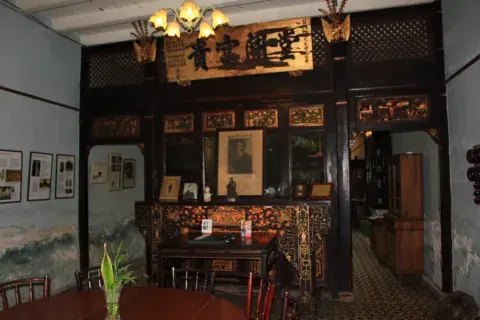
Dr Sun Yat Sen Penang Base Museum is a small house located 120 Lebuh Armenian or Armenian Street. Although the house is small, it has presented a valuable and historical events to mainland China. Without the house, the current mainland China may not have it is now.

In year 1906, Dr Sun st...

Dr Sun Yat Sen Penang Base Museum is a small house located 120 Lebuh Armenian or Armenian Street. Although the house is small, it has presented a valuable and historical events to mainland China. Without the house, the current mainland China may not have it is now.

In year 1906, Dr Sun stepped on Penang island for the first time. Before year 1906, China had gone through 9 uprising to remove China monarchy but they never succeeded. The 10th uprising had been called and formed a emergency meeting at the museum in 1910. There were a few reasons why Dr Sun chose the house as his base to hold the emergency meeting in 1910. To find out the answer, you may want to speak to the commentator at the museum.

In year 1906 to 1910, the house had occurred a few big events like an oldest Chinese daily newspaper, Kwong Wah Jit Poh, started its journey. The newspaper has followed the new market trend to publish its newspaper online. Penang Philomatic Union had moved its headquarter to this house from Dato Kramat, too.

On the second part of the house, visitors hike some guides or ask a museum commentator, they may get some answers for fengshui aspects and other factors for the house to have a sky well. For visitors have extra time to kill, they can spend some time to read history collection books and enjoy the complementary chinese tea and pandan water.

For the third part of the house, it is displaying some kitchenware used by the fourth owner of the house's mother-in-law who was a nyonya. Some kitchenware are quite unique to the museum and difficult to find them in the market.

For my experience with the museum guests, they will impress of the house historical events, fung shui, house structure and etc. They do not expect to get much knowledge from this small shop house. By the way, the house also attracted two China presidents came to visit in year 2008 and 2012. To lure the world second economy giant to visit this shop house, it must have unique history events or unique to their nation in the past. To find the answer, you may visit the museum.

If you want to understand more about the museum or George Town, you can hire me. I shall explain in more details than I explain in this short review.
Sri Mahamariamman Temple

The Sri Mahamariamman Temple can be considered the oldest functioning Hindu Temple in Kuala Lumpur.  The Temple was initially a private family shrine of a Hindu trader by the name of K. Thamboosamy Pillai in 1873. 

Being a very successful and influential Indian ...

The Sri Mahamariamman Temple can be considered the oldest functioning Hindu Temple in Kuala Lumpur.  The Temple was initially a private family shrine of a Hindu trader by the name of K. Thamboosamy Pillai in 1873. 

Being a very successful and influential Indian leader, he had many people who looked up to him and depended on him for advice and guidance. He began to allow his followers access to what was originally his family shrine and many Hindus started to meet regularly for prayers and devotions since 1885. 

Indian immigrants came to Malaya in large numbers during the mid-19th century because of the prospects available for them to work in the railways and road building sectors besides the rubber plantations. In fact, the British openly encouraged them to leave their homeland to come to work in Malaya.

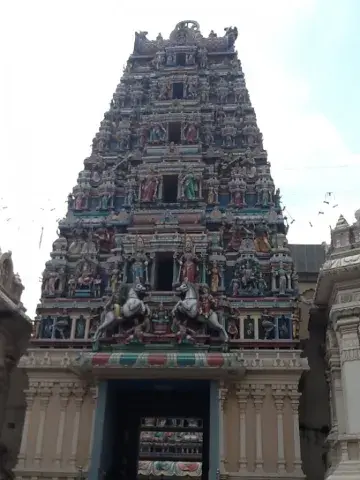
The one very colorful and attractive feature of the Temple is it’s 75-foot high tower forming the entrance to the Temple called the “Gopuram”. This tower consists of 5-tiers and on the tiers can be found 228 carvings of Hindu deities forming dioramas depicting stories from the Hindu holy book, the Ramayana.

As one crosses the entrance into the courtyard and Temple itself, you will suddenly find yourself as if in an oasis of peace and serenity. Many colorful Hindu deities abound inside the Temple. The main deity is of course that of the Lord Mahamariamman, who is actually a Goddess.

It is from this Temple that a silver chariot carrying the deity of the Lord Murugan will begin its annual 13km trek to the Batu Caves during the Thaipusam Festival. Accompanying the chariot will be many thousands of Hindu devotees.  (See Batu Caves, Lord Subramaniam Swamy write-up for pictures of the Thaipusam Festival at the Batu Caves Temple. Thaipusam Festival was a 5-day Festival and was recently held from the 15th Jan - 19th Jan. 2014

Kwan Ti Temple

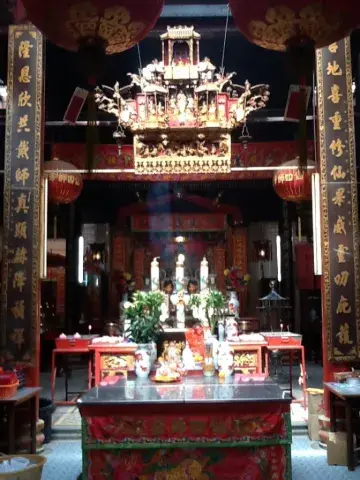
The Kwan Ti Temple is a Chinese Taoist temple located in Chinatown, Kuala Lumpur.

It is locally also known as the Kwong Siew Association Building because it was started by Chinese immigrants from the Kwong Foo and ...

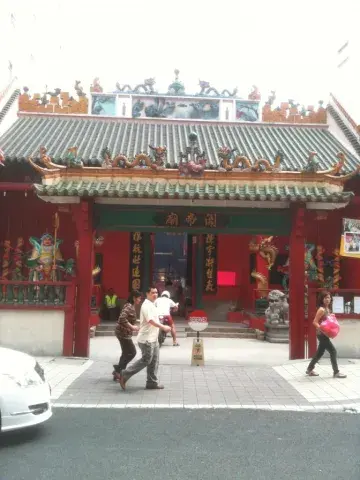
The Kwan Ti Temple is a Chinese Taoist temple located in Chinatown, Kuala Lumpur.

It is locally also known as the Kwong Siew Association Building because it was started by Chinese immigrants from the Kwong Foo and Siew Foo villages in the Provinces of Guangdong in Southern China.

This Temple/Association was built in 1888 and is now nearly 126 years old. Since it’s inception, the building has both been used as a place of worship as well as a community centre where the people could seek comfort and support from fellow countrymen as they begin their life in Kuala Lumpur.

The Kwong Siew Association places a very high emphasis on education and has been organizing Chinese language classes since 1927 and the classes are open to the public (see banner advertisement in the last picture). Only a very nominal fee is levied on the classes.

Worship is always central to man and in this Taoist Temple is the deity, Kwan Ti, the Chinese God of Justice. Kwan Ti was a very famous general during the Han Dynasty and his courage and bravery in the defense of truth and righteousness made him a deity among the Chinese community.

An interesting feature of this Temple are the replicas of General Kwan Ti’s sword and long-blade sword (see 2nd picture)which was brought over from China by the early immigrants.

Masjid Jamek, Kuala Lumpur

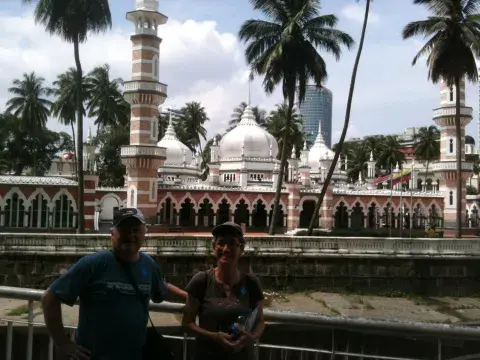
Jamek Mosque is one of the oldest mosques in Kuala Lumpur, Malaysia. It is located at the confluence of the Klang and Gombak River.

Designed by Arthur Benison Hubback (who also worked on the renowned Sultan Abdul Samad Building), the foundation stone was both laid on 23 M...

Jamek Mosque is one of the oldest mosques in Kuala Lumpur, Malaysia. It is located at the confluence of the Klang and Gombak River.

Designed by Arthur Benison Hubback (who also worked on the renowned Sultan Abdul Samad Building), the foundation stone was both laid on 23 March 1908 and opened by Sultan Sir Alauddin Sulaiman Shah in 23 Dec 1908. It served as the MAIN Mosque of KL until 1965 when a new mosque, the National Mosque was built to commemmorate the birth of our Independence from Britain. 

This remarkable red-brick and marble structure boasts highly of its Moorish architecture, in fact, is a nice specimen of North-Indian Islamic architecture. Nearby stands the Sultan Abdul Samad Building, a building that was designed by the same architect and was the seat of the Colonial Government of the Federated Malay States.

Masjid Jamek has three domes that cover the prayer hall. Its brick walls and arched colonnades are topped by numerous cupolas and minarets. While the 21.3m high central dome dominates the skyline, the two 26.8m high minarets in red and white stripes at the corners stand upright in perfect conjunction.

At that point of time, its construction cost was raised by donation from the Malaysian community and Government funds. Commonly known as the Friday Mosque, Masjid Jamek receives lots of people who come for their ritual prayers on Friday. The term 'Jamek' (Jamik) is Arabic and actually means a congregation place.

Visitors are welcomed to visit the mosque during OFF-PRAYER hours.

Nearby is the Masjid Jamek LRT station that is a major train exchange station and served by the Kelana Jaya Line, Sri Petaling Line and Ampang Line. The station is located between Chinatown and Little India.

Old Kuala Lumpur Railway Station

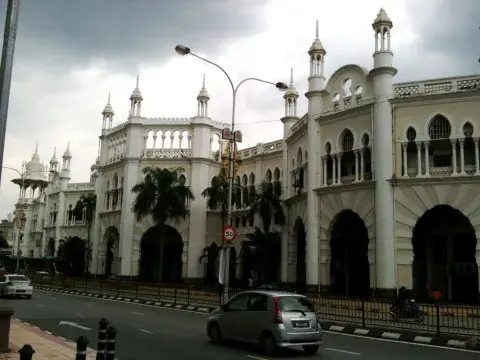
The Old KL Railway Station has been described as a Mughal fantasy and a celebration of minarets.  It was reputed to be one of the prettiest railway stations in Southeast Asia.

Designed by Mr. Arthur Benison Hubback who worked for the Public Works Department (PWD) of the Federate...

The Old KL Railway Station has been described as a Mughal fantasy and a celebration of minarets.  It was reputed to be one of the prettiest railway stations in Southeast Asia.

Designed by Mr. Arthur Benison Hubback who worked for the Public Works Department (PWD) of the Federated Malay States (FMS), work started in 1910 and completed in 1911.  It replaced the original wooden structure that served as the town’s railway terminal near Market Street where the Bank Pertanian building now stands. 

This station comprises of TWO sections:
1. The terminal section comprising offices, waiting rooms and a hotel and
2. The Adjoining train shed.

While the terminal section displayed Indian-Muslim and Byzantine influences, the railway shed was definitely English.

Facing the railway station is the Malayan Railway’s administrative Headquarters, also designed by Hubback. This was completed in 1917.

It was planned much earlier but its construction was delayed by the onset of WWI. (Began 1910 - 1912, then interrupted by WW11, resumed 28 July 1914 – 11 Nov 1918)

These TWO beautiful buildings have contributed much to the identity of KL as an oriental city and capital of an Islamic nation. It is said that Hubback put all his energy , heart and soul into these two buildings as he died soon after they were completed.

National Mosque

The National Mosque or Masjid Negara (local language) was built in 1965 to play it’s role as the primary mosque in Kuala Lumpur, the capital city of an independent nation. While Islam is Malaysia’s official religion, all other religions are a...

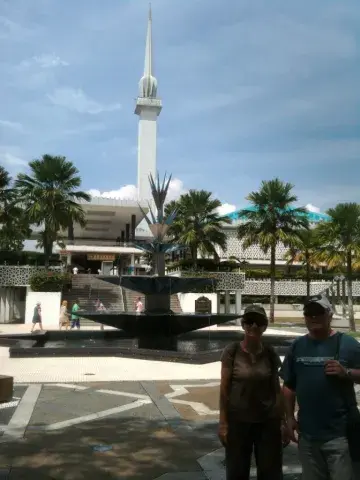
The National Mosque or Masjid Negara (local language) was built in 1965 to play it’s role as the primary mosque in Kuala Lumpur, the capital city of an independent nation. While Islam is Malaysia’s official religion, all other religions are allowed to be practiced freely. 

Unlike other mosques that have typically dome-shaped roof structures, the National Mosque is unique in that it has a blue roof that resembles that of an open-umbrella. This has been said to symbolize shelter and protection for all the people of the independent nation of Malaysia.

The main prayer hall can accommodate 8,000 worshippers and is fully air-conditioned. As Muslim women are not allowed to mix with the men, there is a balcony-like area above the ground floor for the women to gather for the Friday congregational prayer rituals.

A tall white minaret with the shaped of a closed umbrella supports loudspeakers which carries the call to prayer five times daily.

Surrounding the main prayer hall are water fountains and pillars to add a “kampung” or village-like atmosphere, with the water representing rivers and pillars, that of coconut trees. Colorful mosaic glass allows light into the prayer hall.

Behind the National Mosque can be found the Heroes Mausoleum which are placed former Prime Ministers and Deputy Prime Ministers, now deceased. However, the first Prime Minister of the nation, the honorable Tunku Abdul Rahman is not buried here but in his own royal burial grounds in Alor Star, the capital of Kedah.

Located just beside the Old Kuala Lumpur Railway Station, many visitors come to visit the mosque and are allowed into the mosque during non-prayer times and robes are provided to ladies who wish to enter the mosque for a closer look at the prayer hall.
As can be seen from the photos, this beautiful mosque is another must-see for visitors to Kuala Lumpur.