


Shahcheragh
Shah Cheragh is
the name of a holy place and a
funerary monument in Shiraz. In
fact, Shah Cheragh is the tomb of
Mir Seyyed Ahmad nicknamed
Shah Cheragh, son of Imam ...
Shah Cheragh is
the name of a holy place and a
funerary monument in Shiraz. In
fact, Shah Cheragh is the tomb of
Mir Seyyed Ahmad nicknamed
Shah Cheragh, son of Imam Mùsà al-Kàdhim, the seventh Imam of Shia.
This building has been constructed in the 6th century of Islamic calender and at the time of Atabakan-e-fars.
The dome and shrine of this building have beautiful mosaic and tiles that attracts the attention of every visitor and pilgrims; also, inside the shrine is decorated with colorful tiny mirror works, unique stucco, and beautiful and artistic comice. Near the shrine of
Hazrat-e Shah Cheragh there is the shrine of Mir Mohammad, Shah Cheragh's brother, which
dates back to 10th century of Islamic calendar, and it is reconstructed and decorated in
Zandiyye period. The mosaic work of its dome is in the style of the mosaic works of Qaj'ar period.
One of the other features of the building is the wooden structure of the ceiling of the terrace and the writing of the holy names on them.
There is a huge pond in the middle of the yard which is made of porcelain from the mines of Neyriz.
There is also museum and the
library of the Shrine of Shah Cheragh in this complex.
By Taxi
Chehel Sotoun
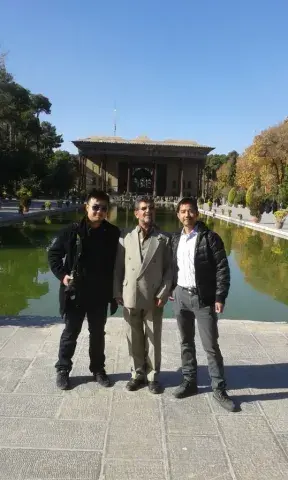
Chehel Sotoun (also Chihil Sutun or Chehel Sotoon; literally: “Forty Columns”) is a pavilion in the middle of a park at the far end of a long pool, in Isfahan, Iran, built by Shah Abbas II to be used for his entertainment and receptions. In this palace, Shah Abbas II and his successors would rece...
Chehel Sotoun (also Chihil Sutun or Chehel Sotoon; literally: “Forty Columns”) is a pavilion in the middle of a park at the far end of a long pool, in Isfahan, Iran, built by Shah Abbas II to be used for his entertainment and receptions. In this palace, Shah Abbas II and his successors would receive dignitaries and ambassadors, either on the terrace or in one of the stately reception halls.
The name, meaning "Forty Columns" in Persian, was inspired by the twenty slender wooden columns supporting the entrance pavilion, which, when reflected in the waters of the fountain, are said to appear to be forty.
As with Ali Qapu, the palace contains many frescoes and paintings on ceramic. Many of the ceramic panels have been dispersed and are now in the possession of major museums in the west. They depict specific historical scenes such as the infamous Battle of Chaldiran against the Ottoman Sultan Selim I, the reception of an Uzbek King in 1646, when the palace had just been completed; the welcome extended to the Mughal Emperor, Humayun who took refuge in Iran in 1544; the battle of Taher-Abad in 1510 where the Safavid Shah Ismail I vanquished and killed the Uzbek King. A more recent painting depicts Nader Shah's victory against the Indian Army at Karnal in 1739. There are also less historical, but even more aesthetic compositions in the traditional miniature style which celebrate the joy of life and love.
The Chehel Sotoun Palace is among the 9 Iranian Gardens which are collectively registered as one of the Iran’s 21 registered World Heritage Sites under the name of the Persian Garden.
Milad tower
Milad Tower, also known as the Tehran Tower, is a multi-purpose tower in Tehran, Iran. It is the sixth-tallest tower and the 17th-tallest freestanding structure in the world.
It is located between the Qarb Town and Gisha District, stand...
Milad Tower, also known as the Tehran Tower, is a multi-purpose tower in Tehran, Iran. It is the sixth-tallest tower and the 17th-tallest freestanding structure in the world.
It is located between the Qarb Town and Gisha District, standing at 435 metres from base to the tip of the antenna.The head consists of a large pod with 12 floors, the roof of which is at 315 m.