Jiangsu Art Gallery

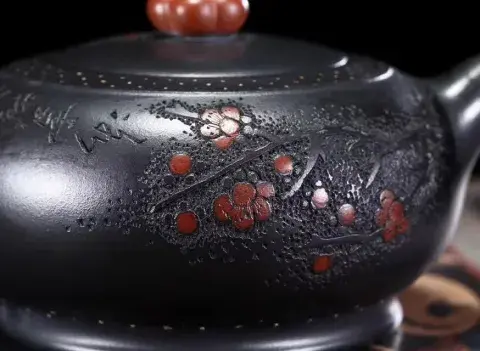
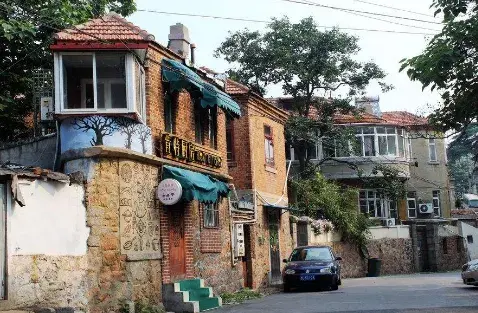
The Jiangsu Art Gallery hosts rotating art shows of paintings, drawings and photographs by mostly local artists.  Prints and sometimes original works are available for sale.

How to Get There:

From the Presidential Palace or 1912 district walk straight west along Changjiang Lu for 2-5 minutes.

The Ancient Observatory

After a while in Beijing the contrast of historic sites and ancient temples against the backdrop of a modern skyline becomes all too familiar. The Ancient Observatory, or Exhibition Hall of Ancient Astronomical Instruments as it is officially known, is typical of the Bei...
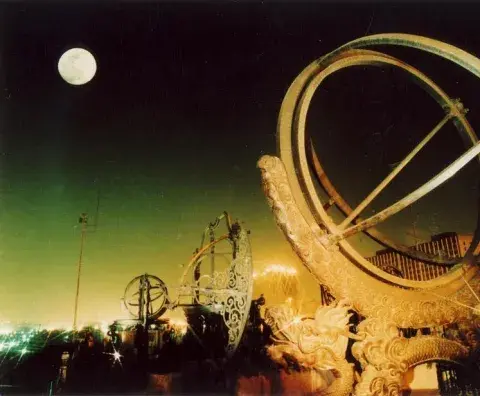
After a while in Beijing the contrast of historic sites and ancient temples against the backdrop of a modern skyline becomes all too familiar. The Ancient Observatory, or Exhibition Hall of Ancient Astronomical Instruments as it is officially known, is typical of the Beijing landscape in this regard. That is, upon reaching the top of the tower to view the ancient astronomical instruments, visitors are then afforded and impressive view of the surrounding city and its imposing high-rises.
 
By blocking out the surrounding city view for just a moment, it is easy to get the sense that the eight bronzed instruments, among which are a celestial globe and an ecliptical armilla, are indeed ancient. Located in a former watchtower, the Observatory was built in 1442(allegedly by Jesuit missionaries), making it one of the oldest observatories in the world and therefore a place of great interest for astronomers. 
 
For those with little to no interest in astronomy, one hour should be ample time to comfortably visit the Ancient Observatory.  Simply observe the ancient instruments and visit the exhibition hall in the adjacent building.
 
The Ancient Observatory is conveniently located directly behind Jianguomen subway station.
 
How to get there:
 
Take subway line 2 to Jianguomen subway stop and take Exit C. Once outside the subway station, turn immediately right, then right again. You can’t miss the tower which will be right in front of you.
 
Link:
 

Local bus routes: 1、4、9、10、20、29、37、39、52、120、122、403、420、728、729、802、938, get off at the Beijing Dong Zhan(北京东站).

Ferry

There are several different companies that provide ferry rides up and down the Huangpu River.  The views from the boat of the Pudong district (east of the river) and Puxi district (west) allows for an excellent ...
There are several different companies that provide ferry rides up and down the Huangpu River.  The views from the boat of the Pudong district (east of the river) and Puxi district (west) allows for an excellent impression of these two very different faces of Shanghai.
 
 
Most tourist ferries depart from the west side of the Huangpu River along The Bund.  Last checked (May 2007), the ferry dock on the east side at Dongchang Lu (东昌路) only serviced tour groups.
  
 
For those planning an itinerary for a trip to Shanghai, put the ferry trip down as a “maybe”  due to the city’s smog-condition.  The smog can sometimes become so thick that buildings in the distance are not even visible.
 
Tips
 
Stop by one of the nearby convenience stores to pickup some beverages or snacks before the ride.
 
Bring some extra change if you want to use the toilet before your trip.  Public toilets are nearby.
  
Directions to the Ferry:
 
Many ferries depart around the area of the bund at Jinling Dong Lu (金陵东路).
- Any taxi driver will know how to get there.
- It is a pleasant 15 minute walk from the Henan Zhong Lu (河南中路) subway station located on Nanjing Dong Lu (南京东路).
- It’s possible to take a ferry across the river from Dongchang Lu (东昌路).
 

Wuhou Shrine

The Wuhou Temple actually features three main sections. The Temple of the Han Dynasty Emperor Zhao Lie, the Wuhou Shrine dedicated to the 50 heroes of the Shu Kingdom, and the Temple of the Three Righteous Men. From the main gate you cross through a courtyard, and then reach another courtyar...

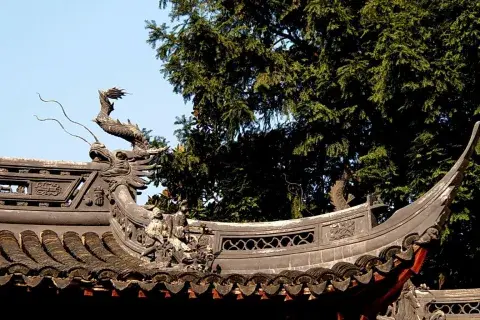
The Wuhou Temple actually features three main sections. The Temple of the Han Dynasty Emperor Zhao Lie, the Wuhou Shrine dedicated to the 50 heroes of the Shu Kingdom, and the Temple of the Three Righteous Men. From the main gate you cross through a courtyard, and then reach another courtyard featuring the 50 heroes of the Shu Kingdom. The 50 heroes are displayed behind glass around the four sides of the courtyard. The seated figures have long hair and traditionally long beards or goatees, and are adorned with colorful robes. Two main figures regarded as the Shu Kingdom's most prominent heroes are featured across the courtyard with larger statues. Liu Bei (161-223 AD), formerly known as Xuande from Hebei province, was the general credited with establishing the kingdom. His strategist and later the kingdom's Prime Minister, Zhu Ge Liang (181-234 AD), is next to him. Mention either of these names to a Chengdu local and they will be very pleased and even impressed that a foreigner possesses such knowledge.

The Wuhou Temple park is actually quite large. Take an entire afternoon or morning to wander around the park and get the most out of the Y60 admission price. The park's vegetation is extremely well-kept and simply gorgeous to look at. The park maintains Bonsai, Peach, Pine, and Bamboo trees just to name a few. There is a turtle pond, a goldfish pond, and of course a few teahouses. Bring a book, some snacks, or some playing cards and bask in the fresh scents of the seemingly endless gardens. 

Directions: The Wuhou Temple is located on Wuhouci Dajie. It is a main street and the temple's large red walls are hard to miss. Take the southbound no. 1 bus from the city center. After you cross the river, just hop off when you see the unmistakable red walls.

Fuzhou Lu

The streets running perpendicular to the Bund are named after cities such as Hankou, Suzhou, Beijing, Jinling and Nanjing. Those running parallel to the Bund are named after Provinces such as Sichuan, Henan and Shandong. These streets are thriving areas of activity each of which offers a sample...
The streets running perpendicular to the Bund are named after cities such as Hankou, Suzhou, Beijing, Jinling and Nanjing. Those running parallel to the Bund are named after Provinces such as Sichuan, Henan and Shandong. These streets are thriving areas of activity each of which offers a sample of a slightly different aspect of Shanghai life. Often dwarfed by the fame of its neighboring sister street Nanjing Lu, Fuzhou Lu is an understated, underrated and often overlooked gem.
 
Starting from the Bund, the street runs down to Peoples Square, home of the Shanghai Museum, the Urban Exhibition Center as well as plethora of restaurants, shops and historical buildings.
 
At the end of the Bund, number 19 houses Ristorante Truffre, an exquisite Italian restaurant with a genuinely romantic atmosphere. With main meals at 180 RMB per plate, the restaurant is certainly at the pricier end of the pasta scale. However, Ristorante serves up authentic cuisine, and that’s the bottom line.
 
Further down at number 37 is the Captain Youth Hostel, a firm favorite and legend amongst budget travelers  in Shanghai. The hostel’s bar, offering cut price beers and the opportunity to meet people from all walks of life, is wildly popular amongst both guests at the hostel and a loyal resident clientele. Book rooms or beds early to avoid disappointment.
 
At number 209 is the famous American Club. The club was host to American politicians and traders 200 years ago when Fuzhou Lu was renowned for its entertainment and hospitality.
 
Of course, Fuzhou Lu is now known as a cultural centre by most Shanghai residents, the reason being the street’s innumerable book stores. Travelers passing through who are itching for some new reading material should head for two large bookstores boasting a bountiful selection of English language books. At number 390 is the Foreign Language Bookstore, and at number 465 is City of Books, a gargantuan 7 floor building. Despite its size, City of Books only reserves the corner of one floor, the 7th, for English books. Therefore I much prefer the former with its three floors of foreign language titles. Go to the third floor to find modern novels and magazines such as Cosmopolitan and Hello. The first floor contains mostly souvenirs, books about China, and old classics. The City of Books, however, offers a vast collection of western music CDs that are not pirated, yet still rather affordable. Expect to pay around 25 RMB for an album.
 
Past the bookstores, on the left, is the Beijing Opera theater, which is well worth checking out for professional performances. Further down on the right at the end of Fuzhou Lu is the ever popular Raffles City shopping mall, and its impressive collection of retail outlets for all your shopping needs. The basement includes a Hotdog stand and a Watson’s pharmacy, the Chinese version of Boots, which stocks name brands of shampoo, toothpaste and the like.  Across the road is the magnificent Peoples Square, the cultural and traffic hub of Shanghai. The square also marks the intersection of metro lines 1 and 2.  
 
I am confident that as every person who wanders down Fuzhou Lu will find their own hidden treasures.