Yuejiang Tower (Yuejiang Lou)
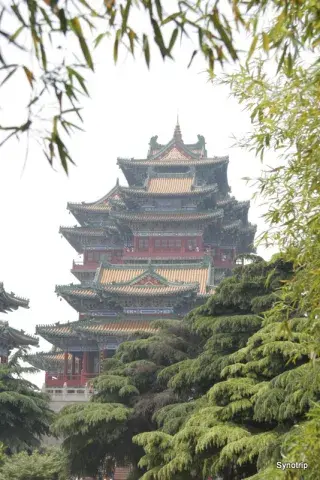
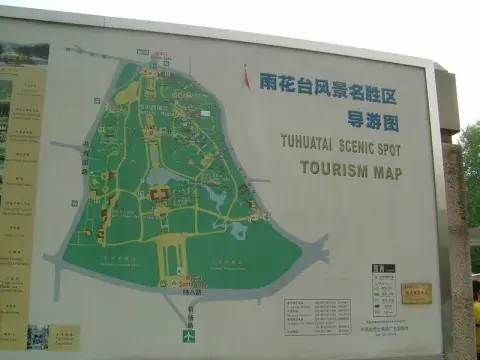
Yuejiang Tower (Yuejiang Lou, 阅江楼) sits on Lion Hill (Shizi Shan, 狮子山) in the northwest part of Nanjing near the banks of the Chang Jiang (Yangzi, Yangtze, 长江) River. It is one of the best places in Nanjing to enjoy a view of the river. Inside the 52 meter tower are displays re...
Yuejiang Tower (Yuejiang Lou, 阅江楼) sits on Lion Hill (Shizi Shan, 狮子山) in the northwest part of Nanjing near the banks of the Chang Jiang (Yangzi, Yangtze, 长江) River. It is one of the best places in Nanjing to enjoy a view of the river. Inside the 52 meter tower are displays related to the Ming Dynasty and Zheng He’s sea voyages as well as a multi-storey tile mural. Part of the restored Nanjing City Wall stretches around Lion Hill, but most of it was still under construction at the time of writing.
 History of Yuejiang Tower
In 1360, Lion Hill (Shizi Shan, 狮子山) was the site of a battle that helped pave the way for the ascension of the Ming Dynasty. A force of 80,000 soldiers under the command of emperor-to-be Zhu Yuanzhang defeated the 400,000 strong force of Chen Youliang (陈友谅). A few years later in 1374, Zhu Yuanzhang (Emperor Hongwu) decided to build the Yuejiang Tower. He composed a poem about the tower and also ordered many scholars to write about the project. Unfortunately, the construction was soon suspended indefinitely and Yuejiang Tower existed only on paper for over 600 years. Construction finally began in 1999 and it was opened to the public in 2001.
How to Get There
Buses 10, 12, 16, 18, 21, 39, 54 and 95 stop near Yuejiang Tower. It should cost about 10-15 yuan to take a cab from Hunan Road (湖南路) or 20-25 yuan to take a cab from Xinjiekou (新街口).
There are two south-facing entrances on Jianning Road (建宁路). The entrance to the west is next to cement stairs and an elevator that goes up to the top of the hill. The entrance on the east allows for a scenic walk to the top of the hill. The tower itself also has an elevator.

View from Yuejiang Tower. Look closely to see the impressive bridge in the distance.

Links
Places to Get a Closer View of Chang Jiang River
Swallow Rock (Yanzi Ji, 燕子矶)
Nanjing Chang Jiang Bridge (Nanjing Chang Jiang Daqiao, 南京长江大桥)
Nanjing 2nd Bridge (南京二桥)
www.yuejiangtower.com - No English, but the site does have a few more pictures of the tower.

 ...
... How to Get There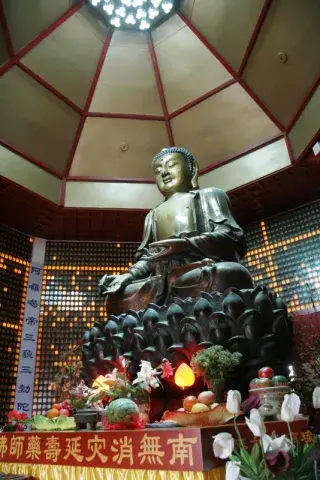
Jiming Temple
Jiming Temple was founded in 300 AD during the Eastern Jin Dynasty. Since then it has been destroyed and reconstructed several times. It was last destroyed by fire in 1973 and restored again in 1981. It is now one of Nanjing’s most active temples.
...
Jiming Temple was founded in 300 AD during the Eastern Jin Dynasty. Since then it has been destroyed and reconstructed several times. It was last destroyed by fire in 1973 and restored again in 1981. It is now one of Nanjing’s most active temples.
The seven story high Bhaisajyaguru Pagoda (Yaoshi Ta, 药师塔) was renovated in 2006 and is again open for visitors.
Those interested in temples could combine a trip to Jiming Temple with a trip to Xuanzang Temple at Jiuhuashan, just a 15 minute walk to the east.

How to get there
It would be ideal to walk or bike to Jiming temple since it is located near Jiuhuashan, just off Beijing Dong Lu and next to Xuanwu Lake.
The back entrance connects to the Nanjing Ming Dynasty City Wall. The top of this section of the wall can be reached from the entrances at Jiefang Men and Jiuhuashan.
Unfortunately for travellers that choose to take the bus, there are at least 3 bus stops that take the Jiming Temple name. Jiming Temple is right next to the Paleontology Museum and a couple hundred meters west of the city government buildings.
The Tale of Qiantong - A Visit Into History
Sometimes when travelling in China, the massive crowds, teeming traffic, and simply that which is unfamiliar makes us hungry for an extra rest. So here we were, having escaped the Shanghai masses to the more peaceful surrounds of Ningbo, some four ho...
Sometimes when travelling in China, the massive crowds, teeming traffic, and simply that which is unfamiliar makes us hungry for an extra rest. So here we were, having escaped the Shanghai masses to the more peaceful surrounds of Ningbo, some four hours journey to the south. While we still desired to unwind a bit more, we still felt the need to catch up on some Chinese history.
What to do? We first stopped by the Ningbo Tourism Office in Tianyi Square to pick up some local travel brochures. We then discussed our plans over a few cold beers at “Grandma’s”, our personal name for a little restaurant with reliable service and cold beers for just 3 RMB (just under $0.40 US!) per large bottle. The comfortable environment produced a decision.... Qiantong!
Qiantong you ask? Just exactly what and where is Qiantong? Well, according to the brochure, it's about an hour and a half south east of Ningbo, around 10 km from the town of Ninghai near the Ningbo-Taizhou- Wenzhou Expressway. Qiantong is an old Song/Qing Dynasty town whose history dates back 800 years. Fortunately I knew a local Chinese girl who lived in Ninghai, so a quick phone call, and naturally she would be happy to be our guide.
A trip to Ningbo South Bus Station secured us tickets for an early morning bus the next day. There were seven of us, two Americans, two Australians (one 6 years old) and three lovely Chinese companions. Our bus was comfortable and air conditioned and the one hour trip to Ninghai would have been a pleasant and restful journey were it not for the bus driver, aka the horn blower from hell. The blare of the horn was very frustrating for those who might have wanted a rest on the journey, but this is China, so we did not allow it to spoil our day.
We were met at Ninghai by our lovely guide, Dream. After getting acquainted, we hopped on suburban bus No 106, right outside the bus station. The fare was 1 RMB and buses departed every few minutes, so there was no seating issue. After being deposited a few kilometers down the road, we took one look at the next bus, a fourteen seater that 30 people were trying to fit into, and quickly elected for two taxis for the rest of the journey, as the 35 RMB fare ($4 US) was a small price to pay for comfort.
The trip to Qiantong took us down some bumpy dusty country lanes, but the rice paddies and brilliant colours of the autumn rural scenery made the 20 minute journey a pleasant one.

And at last, we arrived. Qiantong was a quaint old village, reminiscent of a Jiangsu water town, but without a lot of water. A local boy named Tong adopted us as a guide, a common practice for kids in a tourist area. We later learned that 80% of Qiantong's 2,000 residents have the family name Tong.
The village was picturesque with old world narrow lanes, some water lined, others merely pedestrian paths. There were no vehicles except for the occasional ubiquitous bicycle. A middle aged woman was squatting to wash clothes in the rivulet, while 30 yards upstream another woman was rinsing her vegetables.

Despite the numerous street stalls and gift shops, wood carvings and statues, local fruit and drink vendors, the atmosphere was quiet and relaxed. My daughter Michelle, the 6 year old, was fascinated by an old woman churning traditional tofu, and was even happier when the old woman let her help turn the churn.

We stopped at a little indoor-outdoor restaurant; it was a lovely day, so we opted to sit outside. Lunch was cold local beer with country style stir fried foods, which appeared totally at home with the bench tables and wooden stools. Our international group naturally produced many spectators and some light hearted discussion from nearby local men, spinning yarns to each other.

One of our party, had a small dose of gastritis and was not looking forward to a battle with a squat toilet. To his complete surprise he was very happy to find a brand new western toilet within this centuries old building. While eating our delicious country fare, Rex, one of the Americans, noticed an old barber shop and told us it reminded him of his youth, so he decided to have a haircut.
We looked the barbershop, an old, well lived room with cardboard packing lining the ceiling. We tried to decide what was the oldest, the room, the chair or the barber himself. Rex, being the daring type, deposited himself in the chair and gave himself up to the care of the proprietor. Of course the shop and window was soon crowded with curious locals and Chinese banter filling the air. We could only sit back, drink our beer, and watch. There was no need to worry we found, as this barber was a veteran and in little time at all, the job was done and Rex and barber were equally content.


Our day in Qiantong was still not yet complete. For an entry fee of a mere 5 RMB ($0.60 US) we were treated to a display of a traditional Song Dynasty wedding, complete with drums, Sudan chair, musicians and even red carpet. Rex was so pleased by his new haircut that he rounded up a group of local “girls” and had them pose with him.

And so, after a very peaceful day of escape, we returned to Ninghai by local bus. An express bus to Ningbo thankfully did not include a horn-loving driver. The trip home was a pleasant journey, and we all were quite content with our day trip to Qiantong.
Qiantong is located 10 km from Ninghai city near Ningbo-Taizhou- Wenzhou Expressway. An alternative bus route is to take the 108 or 102 bus from Ningbo south station, then transfer to the number 3 bus at Ninghai station. The ticket price 40 RMB. Opening Hours: 0800 – 1730 all year long. Telephone: 0574 – 6537 2777


Chaotian Palace and Nanjing City Museum
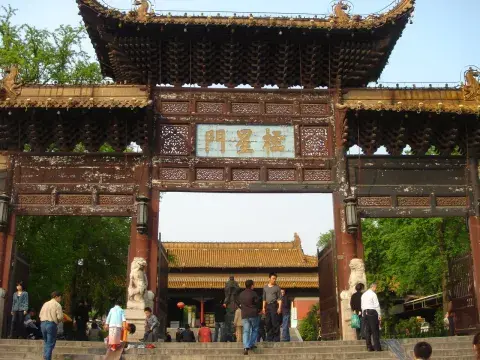
The Nanjing City Museum focuses on Nanjing’s history. A range of exhibits are featured within the halls of Chaotian Palace. Since there is a lot of walking to be done outside, it is best to visit when the weather is nice.
Most of the general...
The Nanjing City Museum focuses on Nanjing’s history. A range of exhibits are featured within the halls of Chaotian Palace. Since there is a lot of walking to be done outside, it is best to visit when the weather is nice.
Most of the general signs are in English, but many of the artifact labels are not translated into English. English speaking tour guides are occasionally available for 60 yuan.
Artifacts from the Shipyard
From 1405 to 1433 Zheng He (郑和) made seven voyages west of China. These adventurs carried Zheng He and his crew to Southeast Asia, India, and even as far as Africa. At the time Nanjing was the capital of China’s Ming Dynasty, and Zheng He’s ships were built in Nanjing. The shipyard has since been excavated, and remains from the ships and the tools used to build them are on display at the museum. It was said to be the only ancient ship building excavation site in China.
Six Dynasties Period
Located in Dacheng Hall is an exhibit focused on Nanjing during the Six Dynasties period.
Exhibition of Nanjing History and Culture
This exhibition is worth a look, but it is easy to miss as it is hidden in a building with a relatively insignificant appearance just to the west of Dacheng Hall. The exhibitions contain information on Nanjing’s history from as early as the time of “Nanjing homo erectus” all the way up to the present.
How to Get There
Chaotian Palace is located between Mochou Lu (莫愁路), Jianye Lu (建业路), and Wangfu Street (王府大街). It is a 10 minute walk west of Zhangfuyuan Subway Station.
Remember not to confuse Nanjing City Museum with Nanjing Museum which is a totally different museum.

Nanjing Brocade Museum of China
What is Nanjing Brocade?
Nanjing brocade is regarded as one of the best forms of silk. It boasts a history of more than 1500 years and was originally formed by a merging of Northern and Southern Chinese technologies. It is&nbs...
What is Nanjing Brocade?
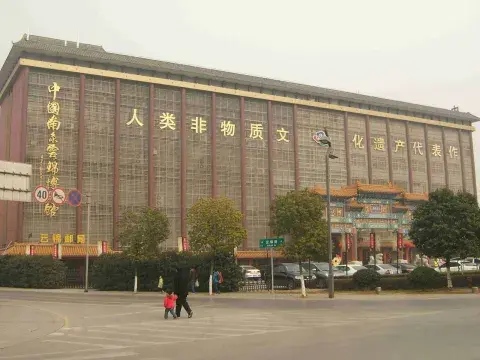
Nanjing brocade is regarded as one of the best forms of silk. It boasts a history of more than 1500 years and was originally formed by a merging of Northern and Southern Chinese technologies. It is famous for it’s cloud-like colours and intricate patterns.
Inside the Museum
The museum displays many samples of Nanjing brocade. There is also an exhibition room where visitors can observe professional brocade artists working wooden looms which produce brocade products that are sold both on location and abroad.
There is a store on the first floor that sells authentic Nanjing brocade. There are many other locations in Nanjing that sell brocade. However, while many of these shops will claim their products are authentic, they may be imitations.

How to Get There
The museum is located right next to
 the Nanjing Massacre Memorial Museum. Take bus 7, 37 or 61 to Chanan Road Station (茶南路站). From the bus stop walk east to the corner and then head northwest down the alley. Look for the insignificant building with the red sign on top.
Tips
The Nanjing Brocade Museum and Brocade Research Institute are both in the same building. In many tour guides and maps, these two names are used interchangeably to refer to the same location.
A trip to both the Brocade Musem and the Massacre Memorial Hall easily fits into an afternoon.