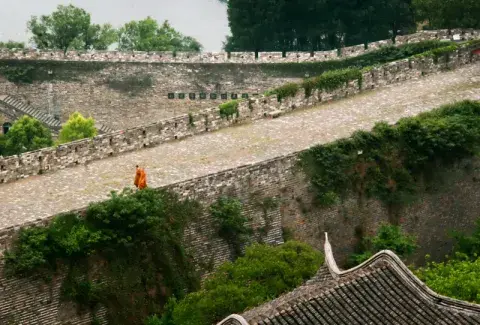
Nanjing City Wall, constructed during the Yuan and Ming Dynasties between 1365 and 1386, originally stretched over 30km which made it the longest city wall in the world. Now, with about two thirds of the wall still intact it still remains the longest city wall in China. It reaches all the way from the North end of Xuanwu Lake to the south-west corner of Purple Mountain. It snakes along the edge of Qinhuai River and heads back north all the way up to Yuejiang Tower (阅江楼).
Touring the Wall
Zhonghua Men Fortress (Zhonghua Men Chengbao, 中华门城堡)
 Zhonghua Men
 is the most famous and most fortified gate of the wall. It was constructed with 1000kg vertically sliding doors and contained 27 vaults that could hold thousands of soldiers. The idea was that if an enemy entered, the doors could be slammed shut. The enemy, trapped inside, would then be ambushed by soldiers inside. Enemy armies avoided this super-fortified gate in favour of attacking Nanjing via weaker points along the wall.
Zhonghua Men fortress is located across the bridge from Yuhua Lu (雨花路) and about 500 meters east of Zhongshan Nan Lu (中山南路). There are several buses that stop within view of this gate.
For 20 yuan you can climb up to the top of this fortress to get a good view of the city near Qinhuai river.
Qinhuai River - A 10 minute walk east of Zhonghuamen
West of Zhonghua Men Fortress
About 2 blocks to the west of Zhonghua Men Fortress, there is an entrance to the top of the wall that goes almost unnoticed. There is no entrance fee here and the gate seems to always be open. Perhaps the scattering of construction materials on top are an indication of more development to come. However, this location is not considered to be very safe since there have been robberies here.
This part of the wall runs along Xigan Chang Xiang (西干长巷). One the south side of the wall to see the Qinhuai River and the road below. On the other side is old-style housing and factories and Xinjiekou in the distance.
To get to this portion of the wall, you must enter from the east corner. To get there from Zhonghua Men, first walk (bike, skip, whatever) towards the river, follow the road to the west and cross under the bridge. There are signs prohibiting bicycles from entering this road but they are the type of signs that nobody really pays attention to, including the guards. Once you get to the east corner, follow the stairs on the North side of the road up to the entrance.
There is also an entrance to Xigan Chang Xiang on the west end just off of Fengtai Lu (风台路). If you come from this direction, it would be about a ten minute walk to the east corner.
 Jiefang Men
Admission fee: 15 yuan.
Jiefang Gate is located on the south side of
Xuanwu Lake and just north of
Jiming Temple (Jiming Si, 鸡鸣寺). This small gate is another point where it is possible to walk on top of the wall.
Walking upwards from the entrance point leads to a small display about the city wall in which there is a model of how the wall and the rest of Nanjing looked in the past. Walking west leads towards
Jiming Temple. Walking north-west leads towards Xuanwu Men. Walking east leads towards a store located inside the wall that sells crystal and then
Jiuhuashan (九华山), both of which are also entrances to the top of the wall.
Xuanwu Men
Xuanwu Gate is the most popular entrance to
Xuanwu Lake. You cannot get on top of the wall at this point. For many people this gate will be the most convenient to reach since it is just one block east of the aptly named Xuanwu Men
subway station.
The 13 Original Gates
Originally there were 13 gates (门, men):
Taiping Men (太平门)
Chaoyang Men (朝阳门) - Now called Zhongshan Men (中山门)
Zhengyang Men (正阳门) - Now called Guanghua Men (光华门)
Tongji Men (通济门)
Jubao Men (聚宝门) - Now called Zhonghua Men (中华门)
Sanshan Men (三山门) - Now called Shuixi Men (水西门)
Shicheng Men (石城门) - Now called Hanzhong Men (汉中门)
Qingliang Men (清凉门)
Dinghuai Men (定淮门)
Yifeng Men (仪风门) - Now called Jinxing Zhong Men (今兴中门)
Zhongfu Men (钟阜门)
Jinchuan Men (金川门)
Shence Men (神策门) - Now called Heping Men (和平门)
Link: Xi’an City Wall