Taiyuan Attractions




China Coal Museum
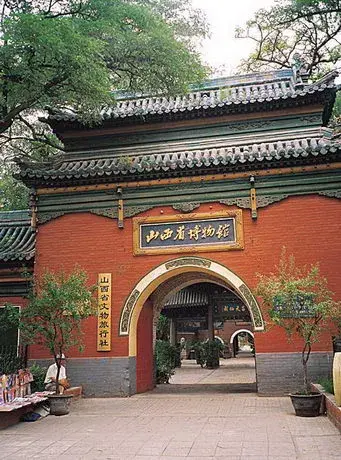
China Coal Museum, located in the "Coal Town" -Taiyuan City, Shanxi Province.
It's the only state-level coal industry museum in China.
Total construction area of 35,000 square meters.

China Coal Museum, located in the "Coal Town" -Taiyuan City, Shanxi Province.
It's the only state-level coal industry museum in China.
Total construction area of 35,000 square meters.


Taiyuan Articles
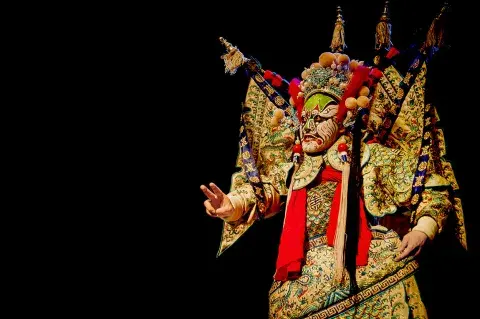
Shanxi Drama (Jin Drama)
The Shanxi drama has a long history and is considered one of the original Chinese dramas, with its own unique cultural charateristics, for which it is accorded a certain honor....
The Shanxi drama has a long history and is considered one of the original Chinese dramas, with its own unique cultural charateristics, for which it is accorded a certain honor. The earliest Shanxi drama dates back to the Han Dynasty (206BC-220) and was referred to as “baixi” (hundred dramas) for its dances and acrobatics. By the Song Dynasty (AD420-479), it had reached quite a high level.
Shanxi has more than 390 drama types, 54 of them its own particular type, and these days, thanks to the gradually developing culture and innovation, has the new vigor, with many famous artists In May of this year, 44 Shanxi performers won the Plum Blossom Prize, China’s top dramatic performance award, putting the province in the No.1 slot nationwide.
Shanxi has a form of Bangzi operas, a kind of local opera accompanied by wooden clappers, including Puzhou, Zhonglu, Beilu, and Shangdang , which are outstanding representatives of Bangzi opera and of the historical and cultural values of the Chinese dramatic arts mixed with folk customs.
Zhonglu Bangzi, also known as Jin opera or Shanxi Bangzi, is popular in the middle part of the province, especially in the cities of Taiyuan and Jinzhong, and is known for its rhythm and clear spoken parts.
Beilu, which developed in the mid-16th century, is popular in northern Shanxi and the Inner Mongolia autonomous region, where it is known for its loud, strong rhythm, power, and excitement.
Shangdang, also called Great Opera or Shangdang classical, dates back to the end of the Ming Dynasty (1368-1644) and, in May 2006, was ranked among the top group of national cultural heritage. Shangdang Bangzi has a high, clear sound and a powerful, rich rhythm, with 400 traditional dramas, mainly relating to heroes, loyal officials, resisting foreign invaders, and punishing treacherous people, portraying a positive, patriotic theme for audiences.
Puzhou, also called Pu opera, is oldest of the four bangzi and came into being during the Jiajing reign period of the Ming. In 2006, it was ranked among the top group of national cultural heritage. It developed different genres over a long time period, with the Nanlu being quite elegant, while the Xilu is quite strong. Pu opera is good at expressing solemn heroic themes and characters’ feelings. Shanxi also has many local operas as well, such as Daoqing, Yangko, and Wanwan, all of which help to fill out Shanxi drama.
There are two train stations in Pingyao & Taiyuan since from 1st of July of 2014
Notice for the tourists are going to Taiyuan and Pingyao.
There are two train stations in Taiyuan.One is old train station named (Taiyuan Station) and one is the Taiyuan South Station named (Taiyuan Nan Station)
...
Notice for the tourists are going to Taiyuan and Pingyao.
There are two train stations in Taiyuan.One is old train station named (Taiyuan Station) and one is the Taiyuan South Station named (Taiyuan Nan Station)
There are two train stations in Pingyao .One is the old train station named (Pingyao Station) and one is the Pingyaogucheng Station named(Ping yao gu cheng)
You have to look at the ticket you get very carefully,otherwise you may go to wrong station and miss your train.
Have a tour.
Jinci Temple
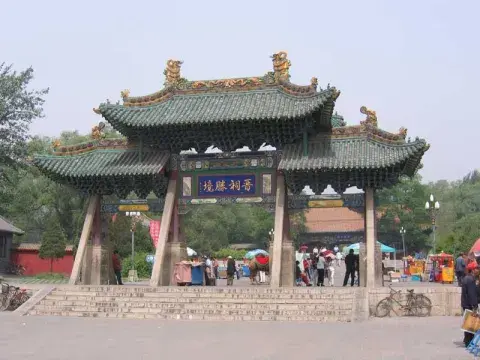
Jinci is a must-see in Taiyuan City. People also say that “Not going Jinci temple when you are in Taiyuan is like not going to the Forbidden City when you are in Beijing.” It situates in 25km away from downtown Taiyuan, Xuanweng Mountain....
Jinci is a must-see in Taiyuan City. People also say that “Not going Jinci temple when you are in Taiyuan is like not going to the Forbidden City when you are in Beijing.” It situates in 25km away from downtown Taiyuan, Xuanweng Mountain. The Temple is under special protection of the state attracting visitors all over the world. The ancient trees soar to unbelievable heights. It is in compound with hall, pavilions, and towers. The Saintly Mother’s Hall, built from 1023 to 1032 during the Song Dynasty, is the most magnificent and oldest building remains of ancient in Jinci Temple. Jinci Temple is fine combination of natural landscape and architecture. The main buildings are distributed along the central axis from east to west. All the buildings are in compact and designed strictly according to traditional style. The cypresses grown in the Zhou Dynasty and pagoda trees of the Sui Dynasty are still vigorous, lush and exuberant.
Jinci Temple Attractions
The Buddhist Relics Tower
Everlasting Spring
Water Mirror Stage
Jinci Temple Stories
1. Fengsheng Temple Pagoda Tree
Around the Fengsheng Temple there stands a giant centuries-old pagoda tree. The trunk is crooked but the branches are young and tender. Story has it the tree was old and dead until 1756, the Qing Dynasty. A Taoist priest was selling plaster under this tree claiming that it is panacea. However, no matter how hard he tried to sell his medicine no one cast a look at it. Disappointed and upset, he pasted the plaster on the dry bark of the dead pagoda tree. Miracle happened several months later: the tree began to branch out again! Nonetheless, it is probably just happened to come to itself after hundreds of years of sleep.
2.The Iron man in the Jinci Temple
It is said that in a hot summer, an iron man wanted to cross the Fen River. When he was stranded in the heat by the river bank, he noticed that a boat coming from downstream. He waved and asked the boatman to carry him across the river. “All right. But I’ll wait and see if there’re other people want to cross the river. It’ll be such a waste to carry just you.” “Really? I’m wondering is you’re skillful enough to carry just me!” “How much do you weigh? I can ferry dozens of people except that you’re made of iron.” To the boatman’s surprise, the man began to freeze right in front him and the man looked rather familiar! The man was the iron man in the Jinci Temple. The boatman gathered some fellow villagers to carry the iron man back to the Temple. The Buddha commanded him to be whipped on his feet. Today the scars still can be seen on the statue’s feet.
Top Taiyuan Tours
$1150 Per Day
6-day Shanxi Highlights Tour
Day 01 Arrival in Datong (no meal)
Arrival in Datong by train or bus in the evening, be picked up and transferred to the hotel.
Day 02 Datong (B, L)
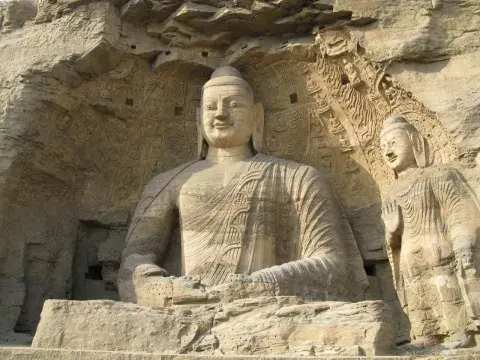
Visit the UNESCO World Cultural Heritage site – Yungang Grottoes. Then proceed to ancient Huayan Temple of Liao and Jin Dynasty and Nine Dragon Screen.
Day 03 Datong – Mount Wutai (B, L)
Drive to visit Hanging Temple, Wooden Pagoda at Ying County, which is the oldest existent fully wooden pagoda still standing in China, first built in 1056. Overnight at Wutaishan city....Read more
Day 01 Arrival in Datong (no meal)
Arrival in Datong by train or bus in the evening, be picked up and transferred to the hotel.
Day 02 Datong (B, L)
Visit the UNESCO World Cultural Heritage site – Yungang Grottoes. Then proceed to ancient Huayan Temple of Liao and Jin Dynasty and Nine Dragon Screen.
Day 03 Datong – Mount Wutai (B, L)
Drive to visit Hanging Temple, Wooden Pagoda at Ying County, which is the oldest existent fully wooden pagoda still standing in China, first built in 1056. Overnight at Wutaishan city.
Day 04 Mount Wutai – Taiyuan (B, L)
Half day tour to Mount Wutai, one of the four holy mountains for Buddhists in China, you will tour the Xiantong Temple, Pusading Temple and Tayuan Temple. After lunch, drive 4 hours to Taiyuan, the capital city of Shanxi Province.
Day 05 Taiyuan - Pingyao (B, L)
After breakfast, transfer to visit Jinci Temple, which was founded about 1,400 years ago, boasting a diverse collection of more than 100 sculptures, buildings, terraces, and bridges. Then proceed to Pingyao, you will visit Qiao Family Compound and Double Forest Temple before checking into the hotel.
Day 06 Pingyao (B, L)
Explore the old town of Pingyao escorted by your guide, including the visits to the city wall, Rishengchang Draft Bank and Ming and Qing Street. Free time at the rest of the day.
$1 Per Day
Hougou Ancient Village Tour
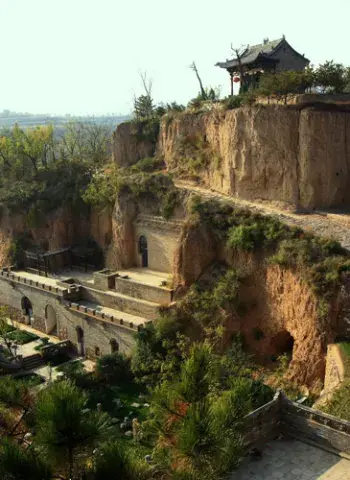
Pick up from your Taiyuan hotel 9.00am in the morning then transfer to Hougou Ancient Village (about 1 hour drive) then visit the the only ancient hamlet in China designated as a farming heritage site,Cave House there are mud cave house and brick cave houses,Enjoy free walk inside the village ,After lunch, take a 2 hrs driver to Pingyao in the afternoon.