Shiyan Attractions
Shiyan Articles
Wudang Mountains in China
The Wudang Mountains (武当山) consist of a small mountain range in the northwestern part of Hubei, China, just south of Shiyan. They are home to a famous complex of Taoist temples and monasteries associated with the god Xuan Wu....
The Wudang Mountains (武当山) consist of a small mountain range in the northwestern part of Hubei, China, just south of Shiyan. They are home to a famous complex of Taoist temples and monasteries associated with the god Xuan Wu. The Wudang Mountains are renowned for the practice of Taichi and Taoism as the Taoist counterpart to the Shaolin Monastery, which is affiliated with Chinese Chán Buddhism. For centuries, the mountains of Wudang have been known as an important center of Taoism, especially famous for its Taoist versions of martial arts or Taichi. The first site of worship—the Five Dragons Temple—was constructed at the behest of Emperor Taizong of Tang.Further structures were added during the Song and Yuan dynasties, while the largest complex on the mountain was built during the Ming dynasty (14th–17th centuries) as the Yongle Emperor claimed to enjoy the protection of the god Beidi or Xuan Wu. Temples regularly had to be rebuilt, and not all survived; the oldest extant structures are the Golden Hall and the Ancient Bronze Shrine, made in 1307.[4] Other noted structures include Nanyang Palace (built in 1285–1310 and extended in 1312), the stonewalled Forbidden City at the peak (built in 1419), and the Purple Cloud Temple (built in 1119–26, rebuilt in 1413 and extended in 1803–20). The monasteries such as the Wudang Garden were made a UNESCO World Heritage Site in 1994.
If you need our guide/assistant/sourcing/interpreter, welcome to contact us.:)
We can custom your trip and guide you.
Please click my photo and add my contact. Let's talk details.
Thanks for reading.
Jessica In China (86-13570345653)
Top Shiyan Tours
$300 Per Day
Wuhan-Mt. Wudang 2-day tour
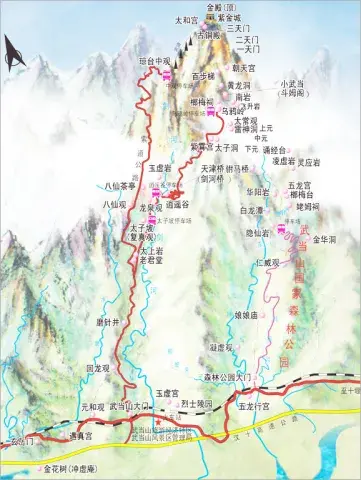
D1 Wuhan – Mt. Wudang
Depart from Wuhan in the morning and head for Mt. Wudang(5.5hrs)
Highlights: pricess slop complex, Nanyan-south cliff palace
or Depart from Wuhan at night and arrive at Mt. Wudang next early morning!
D2 Mt. Wudang
Highlights: Qiongtai. Golden peak
Back to Wuhan in the late afternoon and arrive at Wuhan at 22:04
$300 Per Day
Wudang Mount 2 days Tour
2 days tour to Wudang Mount
Day 01: arrive by bus in Wudang mountain tourist center, take the park bus to Taizi po temple, visit the Taizi po temple one hour, and continue to take park bus to Qiongtai, and change cable car to golden top, alot of steep stair cases to the top, and then descend 4.5km on foot to south cliff -Nanyan, stay overnight here
Day 02: visit Nanyan temple complex, Zixia temple, Xiaoyao valley-care-free valley, finish tour in the afternoon
...Read more2 days tour to Wudang Mount
Day 01: arrive by bus in Wudang mountain tourist center, take the park bus to Taizi po temple, visit the Taizi po temple one hour, and continue to take park bus to Qiongtai, and change cable car to golden top, alot of steep stair cases to the top, and then descend 4.5km on foot to south cliff -Nanyan, stay overnight here
Day 02: visit Nanyan temple complex, Zixia temple, Xiaoyao valley-care-free valley, finish tour in the afternoon
Wudang Mountains
As a Chinese well known Taoist shrine, Wudang Mountain located in Shiyan City, Hubei Province. it is famous for its magnificent ancient building complex and appealing natural landscape. the Ancient Building Complex in the Wudang Mountains was listed on the World Heritage List by UNESCO in 1994. Besides, the mountain is the home of the famous Chinese Wudang Martial Arts.
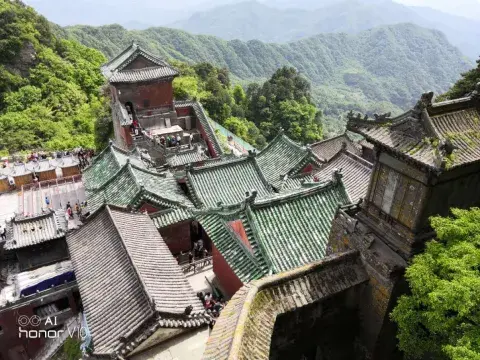
Construction of the Ancient Building Complex originated in the Tang Dynasty (618-907). During the reign of Emperor Taizong , the Five Dragon Ancestral Temple was built on Wudang Mountains. In the Ming Dynasty (1368-1644), about 33 palaces and structures including the Yuxu Palace, the Grand Purple Cloud Palace, the Yuzhen Palace and the Palace of Harmony were built. Then the grand and magnificent building complex was formed. At present, the extant building complex includes the Palace of Harmony, the Grand Purple Cloud Palace, the South Cliff Palace, the Yuzhen Palace, relics of the Yuxu Palace and the Five Dragon Ancestral Temple, Xuanyue Gate (a huge archway) and the Fuzhen Temple.
Palace of Harmony
Wudang Mountain, Shiyan, Hubei
Situated on the south section of Tianzhu Peak, the Palace of Harmony is composed of the Golden Palace (Golden Peak), the Forbidden City and the Gutong Hall. The Golden Palace is the most celebrated. Constructed of bronze, the palace is about four meters (13 feet) long, three meters (10 feet) wide and six meters (20 feet) high. In the hall stands the statue of Emperor Zhenwu in the shrine with Golden Boy and Jade Girl, and two generals of Fire and Water attending him on the left and right. It was told that the statue of Emperor Zhenwu is about ten tons (22,046 pounds). Above the shrine is hung a golden plaque with four Chinese characters 'Jin', 'Guang', 'Miao' and 'Xiang' written by Kangxi, an emperor in the Qing Dynasty (1644-1911). Through the ages, the palace still lives its glamour and grandiosity.
Grand Purple Cloud Palace
Located below Zhanqi Peak, the Grand Purple Cloud Palace is the most magnificent and best-preserved Taoist building on Wudang Mountains. with an area of 6,850 square meters (two acres), the palace consists of the Dragon and Tiger Hall, the Stele Pavilion, the Shifang Hall, the Parents' Hall, the Grand Hall of Purple Cloud Palace and other buildings. Covered with blue glazed tiles and yellow and blue carvings on the roof, the Grand Hall is the most representative wooden structure on the mountain. In the hall is worshipped the sculpture of Emperor Jade which was made by a Ming Dynasty artisan.
South Cliff Palace (Nanyan Palace)
The South Cliff Palace is situated below the Duyang Cliff. It has the Tianyi Zhenqing Hall, the Two Bearings Hall, the Eight Diagrams Pavilion, the South Heaven Gate and the Flying Cliff. Built in the Yuan Dynasty (1271-1368), the Tianyi Zhenqing Hall is the most renowned. All the beams, pillars, doors and windows were carved from stone. This stone palace is a masterpiece of Chinese stone carving.
Ancient Building Complex in the Wudang Mountain An ancient temple, Wudang Mountain
Yuzhen Palace
The Yuzhen Palace, the relics of the Yuxu Palace and the Five Dragon Ancestral Temple, Xuanyue Gate (a huge archway) and the Fuzhen Temple are also must-sees on the mountain. In addition, many sculptures, offerings and sutras in the palaces, tablets and inscriptions on the cliffs are precious relics.
The mountain is also famous for its appealing natural landscape including 72 peaks, 36 rocks, 24 streams, 11 caves, nine springs and three ponds. At any time of the year, tourists can enjoy its wonderful natural scenery.
Gilt Bronze Hall, Wudang Mountain Wudang Mountain, Shiyan, Hubei
How to Get to Wudang Mountains
By train: train from Wuhan, Chongqing, Beijing, Shanghai, Guangzhou, Nanjing, Qingdao, Yichang or some other cities and get off at Wudangshan Station. Transfer to intercity bus no. 202 or 203 to the tourist center of scenic area directly.
See Wudangshan Train Schedule & Stations.
By bus:
1. From Shiyan: Intercity bus no. 202 can transfer visitors from Shiyan Railway Station to the tourist center of mountain within 1 hour and 10 minutes
2. From Xian: Two direct tourist buses to the scenic area are scheduled at the Provincial Bus Station opposite Xian Railway Station, leaving at 09:00 and 15:00. It takes around 4 hours.
3. From Wuhan: One direct bus is available from Jinjiadun Bus Station, departing at 13:40 daily. It takes around 6 hours and costs CNY179/person.
By air: Tourists fly to Wudangshan Airport from Wuhan, Xian, Tianjin, Kunming, and Hangzhou. Then take a taxi to get to the tourist center of mountain at a cost of CNY60-80.
$300 Per Day
Shennongjia Nature Reserve 2 Days Tour
Shennongjia Natural Reserve 2 Days Tour
Day 01: arrive in Muyu town by bus, check in a hotel, in the afternoon start tour to Guanmenshan mountain, to visit museum of species, plants and wild animals
and see pandas, then visit naturally born bridge, shennong -god of Agriculture monument park,
...Read moreShennongjia Natural Reserve 2 Days Tour
Day 01: arrive in Muyu town by bus, check in a hotel, in the afternoon start tour to Guanmenshan mountain, to visit museum of species, plants and wild animals
and see pandas, then visit naturally born bridge, shennong -god of Agriculture monument park,
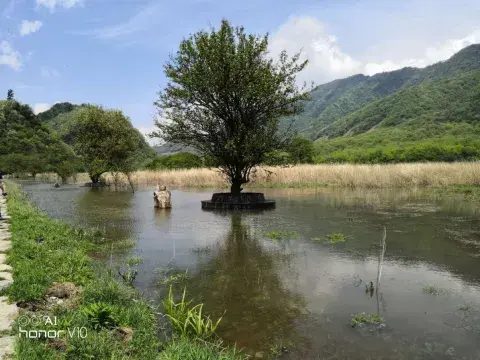
Day 02: drive 2 hours to Dajiuhu lakes, famous wetland, pictureque land of distance mountains, beautiful lake and grass land and horses, very photogenic place, and visit Shennong mountain top, to see unique rockformation in Bangbi rock, and Shennong valley 4.5 km long along the cliff road, we have chance to visit animal rescue station to see snub nosed monkeys, and other animals. tour finish at around 5 oclock in the afternoon.
Shennongjia Nature Reserve
with an area of 803,833 acres (about 3,253 square kilometers), Shennongjia Nature Reserve in western Hubei Province bordering with Chongqing Municipality in the west and Baokang County of Hubei Province in the east. In 2013, it was approved as Shennongjia Global Geopark.then, it was listed as a world natural heritage by the UNESCO in 2016. its marvelous natural scenery, rare foliages, endangered animals and famous legends such as the mysterious "Wild Man" (Chinese Yeti) said to be found in the mountains makes it famous destination, the forest zone has attracted many tourists every year, also researchers and scientists.
Origin of Name
Shennongjia (god of agriculture) was named after a very famous Chinese chief in prehistoric time, Shennong, also known as Yandi emperor. He was believed to be one of the two ancestors of Chinese people (the other was Huangdi emperor). He invented crockery, discovered herbal medicine by personally tasting herbs and taught his people how to cultivate. It is said that while Shennong tasted herbs here, he suffered from poisoning more than 70 times! However in the end, he managed to discover many useful herbal medicines. To commemorate his great work, he became the namesake for the land we speak of today, Shennongjia.
Landscape
Shennongding Peak, the highest mountain of the scenic area, with the altitude of 10,188 feet (about 3105.4 meters) high above sea level. The lowest point, Shizhu River in southeastern Shennongjia Forestry District, is only 1,306 feet (about 398 meters) high above sea level. Varity of beauties of the four seasons at different altitudes. Flowers blossom out at every corner; firs, spruces, dove trees, and many rare trees can be seen everywhere. Virgin forests, clear streams and grand waterfalls in the thousands of canyons beckon visitors to indulge in the wild nature. Peculiar caves also often amaze visitors. There is the Swallow Cave that inhabited thousands of swallows, the Tide Cave that floods three times a day, the Icy Cave that is always icy in summers, the Fish Cave that inhabited lots of fish at times of thunder and much more. Wild animals, some of which are really rare species, are also frequently seen (i.e. the golden haired monkey, giant salamander, spotted deer and etc.).
Rare Species
The most peculiar species founded in the forest zone are certainly the "white animals". The first albino animal spotted in the scenic area was a white bear, which looks like a giant panda in white skin. White monkeys, white roes, white deer, white squirrels, white snakes, white crows and even white toads have also been gradually discovered by scientists. Aside from the endangered animals, it is a natural garden for herbal medicines as well. More than two thousand kinds of precious herbs, such as Jiaogulan (gynostemma pentaphyllum, which is as efficient as ginseng), actinidia, muskiness, fritillaria, Chinese angelica and etc., can be easily found in the forest zone.
Story of Wild Man
The Wild Man of Shennongjia is a mysterious figure come out as a shock as Nessie and UFOs. The records of the Wild Man appear many times in ancient Chinese books, and since the 1970s, people said that they had spotted The Wild Man. They are said to be ape-like, about two meters (6 ft.) high, covered by red or brown hair and can run very fast while standing erect. There have been many research studies held, which have yielded some evidence of the creature, such as the footprints and hair of The Wild Man. It is believed by many people that The Wild Man is an ancient species just like the giant panda and the golden haired monkey. Recently, some explorers also announced their witness of The Wild Man. But to nowadays, no Wild Man has been caught yet.
with no doubt, the forest zone is mysterious land full of virginal scenery and folk lore, it is potential great destination for all the people.