Wudang Mountain
Tours That Go to Wudang Mountain
China-Wudang Mountains
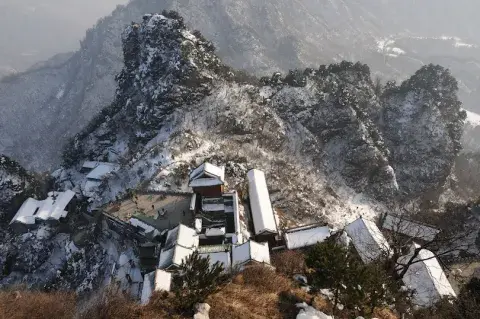
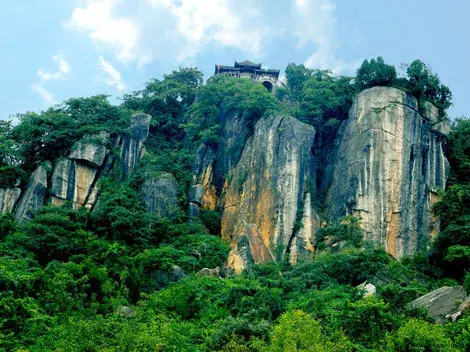
Travelers who’ve seen Crouching Tiger, Hidden Dragon already know how scenic the Wudang Mountains, located in northwestern Hubei Province, are. Besides being scenic, the Wudang Mountains is the most sacred Taoist mountain range in China. There travelers will find temple complexes, including the palatial Nanyan Temple, considered the most spectacular of the 36 temples on Wudangshan because it’s built of rock from the cliff behind it.
If you need our guide/assistant/sourcing/interpreter, welcome to contact us.:)
We can custom your trip and guide you.
...Read moreTravelers who’ve seen Crouching Tiger, Hidden Dragon already know how scenic the Wudang Mountains, located in northwestern Hubei Province, are. Besides being scenic, the Wudang Mountains is the most sacred Taoist mountain range in China. There travelers will find temple complexes, including the palatial Nanyan Temple, considered the most spectacular of the 36 temples on Wudangshan because it’s built of rock from the cliff behind it.
If you need our guide/assistant/sourcing/interpreter, welcome to contact us.:)
We can custom your trip and guide you.
Please click my photo and add my contact. Let's talk details.
Thanks for reading.
Jessica In China
图文来源于自网络,如有侵权,请联系删除
Wudang Mount 2 days Tour
2 days tour to Wudang Mount
Day 01: arrive by bus in Wudang mountain tourist center, take the park bus to Taizi po temple, visit the Taizi po temple one hour, and continue to take park bus to Qiongtai, and change cable car to golden top, alot of steep stair cases to the top, and then descend 4.5km on foot to south cliff -Nanyan, stay overnight here
Day 02: visit Nanyan temple complex, Zixia temple, Xiaoyao valley-care-free valley, finish tour in the afternoon
...Read more2 days tour to Wudang Mount
Day 01: arrive by bus in Wudang mountain tourist center, take the park bus to Taizi po temple, visit the Taizi po temple one hour, and continue to take park bus to Qiongtai, and change cable car to golden top, alot of steep stair cases to the top, and then descend 4.5km on foot to south cliff -Nanyan, stay overnight here
Day 02: visit Nanyan temple complex, Zixia temple, Xiaoyao valley-care-free valley, finish tour in the afternoon
Wudang Mountains
As a Chinese well known Taoist shrine, Wudang Mountain located in Shiyan City, Hubei Province. it is famous for its magnificent ancient building complex and appealing natural landscape. the Ancient Building Complex in the Wudang Mountains was listed on the World Heritage List by UNESCO in 1994. Besides, the mountain is the home of the famous Chinese Wudang Martial Arts.
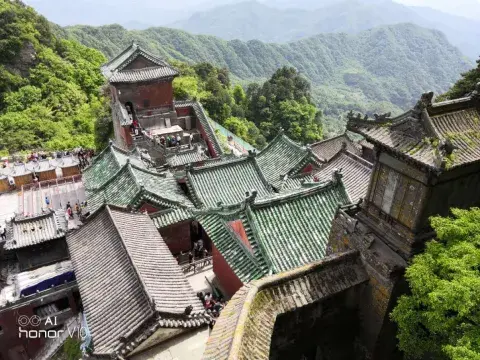
Construction of the Ancient Building Complex originated in the Tang Dynasty (618-907). During the reign of Emperor Taizong , the Five Dragon Ancestral Temple was built on Wudang Mountains. In the Ming Dynasty (1368-1644), about 33 palaces and structures including the Yuxu Palace, the Grand Purple Cloud Palace, the Yuzhen Palace and the Palace of Harmony were built. Then the grand and magnificent building complex was formed. At present, the extant building complex includes the Palace of Harmony, the Grand Purple Cloud Palace, the South Cliff Palace, the Yuzhen Palace, relics of the Yuxu Palace and the Five Dragon Ancestral Temple, Xuanyue Gate (a huge archway) and the Fuzhen Temple.
Palace of Harmony
Wudang Mountain, Shiyan, Hubei
Situated on the south section of Tianzhu Peak, the Palace of Harmony is composed of the Golden Palace (Golden Peak), the Forbidden City and the Gutong Hall. The Golden Palace is the most celebrated. Constructed of bronze, the palace is about four meters (13 feet) long, three meters (10 feet) wide and six meters (20 feet) high. In the hall stands the statue of Emperor Zhenwu in the shrine with Golden Boy and Jade Girl, and two generals of Fire and Water attending him on the left and right. It was told that the statue of Emperor Zhenwu is about ten tons (22,046 pounds). Above the shrine is hung a golden plaque with four Chinese characters 'Jin', 'Guang', 'Miao' and 'Xiang' written by Kangxi, an emperor in the Qing Dynasty (1644-1911). Through the ages, the palace still lives its glamour and grandiosity.
Grand Purple Cloud Palace
Located below Zhanqi Peak, the Grand Purple Cloud Palace is the most magnificent and best-preserved Taoist building on Wudang Mountains. with an area of 6,850 square meters (two acres), the palace consists of the Dragon and Tiger Hall, the Stele Pavilion, the Shifang Hall, the Parents' Hall, the Grand Hall of Purple Cloud Palace and other buildings. Covered with blue glazed tiles and yellow and blue carvings on the roof, the Grand Hall is the most representative wooden structure on the mountain. In the hall is worshipped the sculpture of Emperor Jade which was made by a Ming Dynasty artisan.
South Cliff Palace (Nanyan Palace)
The South Cliff Palace is situated below the Duyang Cliff. It has the Tianyi Zhenqing Hall, the Two Bearings Hall, the Eight Diagrams Pavilion, the South Heaven Gate and the Flying Cliff. Built in the Yuan Dynasty (1271-1368), the Tianyi Zhenqing Hall is the most renowned. All the beams, pillars, doors and windows were carved from stone. This stone palace is a masterpiece of Chinese stone carving.
Ancient Building Complex in the Wudang Mountain An ancient temple, Wudang Mountain
Yuzhen Palace
The Yuzhen Palace, the relics of the Yuxu Palace and the Five Dragon Ancestral Temple, Xuanyue Gate (a huge archway) and the Fuzhen Temple are also must-sees on the mountain. In addition, many sculptures, offerings and sutras in the palaces, tablets and inscriptions on the cliffs are precious relics.
The mountain is also famous for its appealing natural landscape including 72 peaks, 36 rocks, 24 streams, 11 caves, nine springs and three ponds. At any time of the year, tourists can enjoy its wonderful natural scenery.
Gilt Bronze Hall, Wudang Mountain Wudang Mountain, Shiyan, Hubei
How to Get to Wudang Mountains
By train: train from Wuhan, Chongqing, Beijing, Shanghai, Guangzhou, Nanjing, Qingdao, Yichang or some other cities and get off at Wudangshan Station. Transfer to intercity bus no. 202 or 203 to the tourist center of scenic area directly.
See Wudangshan Train Schedule & Stations.
By bus:
1. From Shiyan: Intercity bus no. 202 can transfer visitors from Shiyan Railway Station to the tourist center of mountain within 1 hour and 10 minutes
2. From Xian: Two direct tourist buses to the scenic area are scheduled at the Provincial Bus Station opposite Xian Railway Station, leaving at 09:00 and 15:00. It takes around 4 hours.
3. From Wuhan: One direct bus is available from Jinjiadun Bus Station, departing at 13:40 daily. It takes around 6 hours and costs CNY179/person.
By air: Tourists fly to Wudangshan Airport from Wuhan, Xian, Tianjin, Kunming, and Hangzhou. Then take a taxi to get to the tourist center of mountain at a cost of CNY60-80.
Super China Buddhist Tour
D1 Arrive in Shanghai
Arrive in Shanghai and transfer to the hotel.
D2 Shanghai
This morning visit the Jade Buddha Temple where we can look with reverence for two jade Buddha which came from Myanmar in the year of 1882. Then we will sightsee the Bund in modern Shanghai and highest tower in Asia - the Oriental Pearl TV Tower.
Temple in Mount Putuo
D3 Shanghai - Putuo
D1 Arrive in Shanghai
Arrive in Shanghai and transfer to the hotel.
D2 Shanghai
This morning visit the Jade Buddha Temple where we can look with reverence for two jade Buddha which came from Myanmar in the year of 1882. Then we will sightsee the Bund in modern Shanghai and highest tower in Asia - the Oriental Pearl TV Tower.
Temple in Mount Putuo
D3 Shanghai - Putuo
In the morning take the speed boat to Putuo Mountain. Located on one of the Zhoushan Islands about 100 sea miles off the eastern coast of Hangzhou Bay in Zhejiang Province, it is one of the four famous Buddhist shrines in China, covering an area of 12.5 square kilometers. Built in the Song Dynasty, Puji Temple is regarded as the Bodhimandala of Bodhisattva Guanyin. Also included for today are the Fayu Temple and Thousand-step Beach. Stay at the hotel in Putuo Mountain.
D4 Putuo - Hangzhou
Purple Bamboo Temple was built on the original site of Refuse-To-Leave Temple, the oldest temple in Putuoshan. A visit to it and Kwanyin Statue inside is our schedule for the morning. After lunch, a bus ride to Hangzhou, a city widely reputed as "the Paradise on Earth". According to Marco Polo, Hangzhou was "without doubt the finest and most splendid city the world... there are said to be 13,000 bridges, mostly of stone... vast are the numbers of those accustomed to dainty living, to the point of eating fish and meat at one meal." Stay in the hotel in Hangzhou.
D5 Hangzhou - Tunxi
After an excursion on the pictureque West Lake, symbol of Hnagzhou City, we will be inside the Lingyin Temple (Soul's Retreat Temple) which was built in 326 by the Indian monk Hui Li; and Jingci Temple, another famous temple with a history of more than 1,000 years. Lingyin temple attracts numerous pilgrims each year, both at home and abroad. Later we will drive for about 3 hours to reach Huangshan City. Stay in a downtown hotel. Since you'll have to carry everything yourself up Huangshan unless you hire a porter, it is advisable that you leave your big luggage in the hotel in downtown and bring only a small handbage or knapsack with you up mountain.
Clouds Sea in Mount Huang
D6 Mount Huang
A bus ride to Mt. Huangshan Scenic Area before taking the Yuping Cable-car up mountain from the western step. A three-and-half-hour hike will take you to sightsee the fantastic and unforgettable views, including the Jade Screen Peak, Welcoming-guest Pine Tree, Lotus Peak, Turtle Peak, Heavenly Sea Pavilion, Bright Top Peak, the Flying-over Rock, the Cloud-dispelling Pavilion and Grand Canyon of the West Sea. Stay at the hotel on Huangshan Mountain.
D7 Huangshan - Mount Jiuhua
Descend the Mountain by Taiping Cable Car and drive for two hours to get to Jiuhua Mountain - one of the four most sacred Buddhist mountains in China. The mountain attracts a large number of pilgrims throughout China and overseas daily, a sign that China is more open and tolerant towards religious belief. We'll be visiting Huacheng Temple, the oldest and the leading monastery of Jiuhua Mountain which was built in the Tang Dynasty (756-758). In the hall are preserved horizontal boards inscribed by emperors of the Qing Dynasty. Stay overnight up Jiuhua Mountain.
Mount Jiuhua
D8 Mount Jiuhua
A full day visiting and sightseeing up Jiuhua Mountain today. We'll take cable car to visit the Longevity Palace, which preserves a saint Buddhist Mummy, monk Wu Xia of the Ming Dynasty. The temple, built in the Ming Dynasty, is 871 meters above sea level. Besides, we'll also be visiting the Hall of Sacred Remains, Qiyuan Temple, one of the four biggest temples in the mountain and the Temple of the Heavenly Terrace which towers on a precipitous cliff of the Tiantai Peak and resembles a magnificent castle from a distance. After dinner, we'll go t o Qiyuan Temple to attend a Buddhist ceremony. Stay in the same hotel.
D9 Jiuhua
Drive for two and half hours to visit Hongcun Village-the main village in Yi County which was listed into the world cultural heritage by UNESCO in 2001. The Oscar-awarded movie "Crouching Tiger, Hidden Dragon" was filmed there. Then we'll drive to visit Nanping Village (the place where the movie "Judou" was filmed). Drive back to visit the fantastic Old Street, center of the old town section. Leave Huangshan City by evening flight after dinner.
12-Day Famous Daoism Mountain Adventure Tour in China
In this adventure tour, you will visit the China’s four Daoism Mountain!
In this tour, you will visit Mt.Luofou in Guangdong, Mt.Longhu in Jiangxi, Mt.Qincheng in Sichuan, and Mt.Wudang in Hubei, the four mountains are regarded as the Four Famous Daoism Mountains of China.
Including: Guangzhou, Chengdu, Wuhan, Nanchang & Shanghai
Day 1 Guangzhou
Arrive in Guangzhou, the metropolis in south China and transfer to the hotel.
Day 2 Guangzhou...Read more
In this adventure tour, you will visit the China’s four Daoism Mountain!
In this tour, you will visit Mt.Luofou in Guangdong, Mt.Longhu in Jiangxi, Mt.Qincheng in Sichuan, and Mt.Wudang in Hubei, the four mountains are regarded as the Four Famous Daoism Mountains of China.
Including: Guangzhou, Chengdu, Wuhan, Nanchang & Shanghai
Day 1 Guangzhou
Arrive in Guangzhou, the metropolis in south China and transfer to the hotel.
Day 2 Guangzhou
Drive half day to Mount.Luofu, afternoon visit the mountain, including the Chong Xu Guan and the Zhu Ming Cave.
- Mount Luofu: Luofu Mountain, one of the 10 most famous mountains of China, is situated to the northwest of Boluo County, Guangdong Province. The mountain is actually part of a range of 432 peaks, and with over 900 waterfalls, 18 caves, and 72 cliffs. To Daoists, the mountain is known as the Grotto Heaven of Vermillion Brightness and Shining Perfection. Luofu Shan (shan means mountain) is best known as the place where the renowned Daoist Ge Hong (281-341 A.D.) once refined elixirs.
Day 3 Guangzhou
Morning continue visit the mountain, including the Huang Long Guan, Jiu Tian Guan, Shu Miu Guan. In the afternoon, drive back to Guangzhou.
Day 4 Chengdu
Take a morning flight from Guangzhou to Chengdu, meet at Chengdu airport, and transfer to visit the Qing Yang Gong Daoism Palace, and the Giant Panda Breeding Center.
- Qingyang Daoism Palace:Qingyang Temple is one of the most famous Taoist temples in China. It is conveniently located in the northwest part of Chengdu, in the Sichuan Province.The temple was originally built in the Tang Dynasty (618-907), a period when Taoism was flourishing. Most of the parts of the temple that remain in existence are restorations from the Qing Dynasty (1644-1911), including Sanqing Hall, Doulao Hall, Hunyuan Palace, the Eight Trigrams Pavilion, and Wuji Palace.
Day 5 Chengdu
Drive to visit Mt.Qincheng, including the Jian Fu Gong, Chang Dao Guan, Tian Si Cave, Shang Qin Gong, etc. In the late afternoon, drive back to Chengdu.
- Mt.Qincheng: Located east to Chengdu and Dujiangyan with a distance of 68 kilometers and 10-odd kilometers respectively, Mount Qingcheng dominates the Chengdu plain. It is one of the most famous Taoist holy lands in China and listed together with the neighboring Dujiangyan as the World Heritage site. Mount Qingcheng abounds with historic sites and cultural relics as well as natural beauties.
Day 6 Wuhan
Take a morning flight from Chengdu to Wuhan, meet at airport, and transfer to visit the Chang Chun Guan, after dinner, board a night train on soft sleeper from Wuhan to Shi Yian.
- Changchun Taoist Temple:Located south of Shuangfeng Mountain, at Da Dong Men, Wuchang District, Wuhan City, Changchun Taoist Temple is the largest and most well-preserved Taoist Temple in Wuhan. Renowned as a blessed place in the south of Yangtze River for generations, it was listed as a key national Taoist temple by the State Council in 1983.
Day 7 Shiyan
Your train will arrive in Shi Yian in early morning, meet at train station, and drive to visit Mt.Wudang, including Zi Xiao Gong, Tai He Gong, and the Golden Temple.
- Mt.Wudang:The Wudang Mountains are a small mountain range in the Hubei province of China, just to the south of the manufacturing city of Shiyan.In years past, the mountains of Wudang were known for the many Taoist monasteries to be found there, monasteries which became known as an academic centre for the research, teaching and practise of meditation, Chinese martial arts, traditional Chinese medicine, Taoist agriculture practises and related arts.
Day 8 Wuhan
Take a train on soft sleeper from Shi Yian back to Wuhan, meet at Wuhan train station.
Day 9 Yingtang
Take a morning flight from Wuhan to Nanchang, meet at Nanchang airport, and transfer to Ying Tang. Stay at the foot of Mt.Longhu.
- Mt.Longhu:Originally called "Yunjin Mountain", Longhushan Mountain is located in Yingtan City of Jiangxi Province. It is the birthplace of Chinese Taoism. The well-established Taoist culture, green rivers and red mountains of unique beauty and cliff tombs with unraveled mysteries are the "three marvelous features" of Longhushan Mountain.
Day 10 Mt.Longhu
Visit Mt.Longhu, including the Tian Si Fu, Shang Qin Gong, afternoon take a bamboo raft down the Luxi river, enjoy the pretty scenery of the Xian Shui Yian.
Day 11 Nanchang
Drive back to Nanchang, then take an afternoon flight from Nanchang to Beijing, meet at Beijing airport.
Day 12 Beijing
Morning visit Bai Yun Guan in Beijing, after lunch, transfer to airport for your departure flight.
- Baiyun Guan:Beijing Baiyun Guan, meaning the White Cloud Taoist Temple, this is one of the largest and oldest Taoist temples in China, and is home to the Taoist Association of China. Baiyun Guan holds an important position for numerous Taoists.